
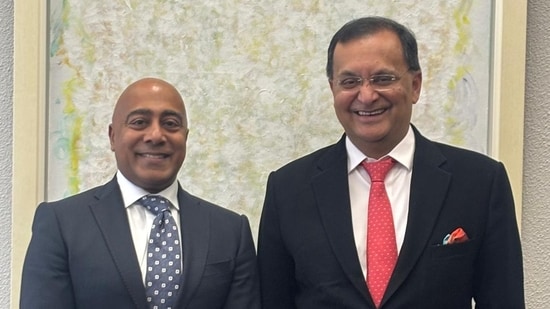
‘Positive momentum in ties’: Indian envoy meets Canadian minister amid strengthening bilateral relations| India News
# India-Canada Ties Rebound
**By Senior Diplomatic Correspondent, Global Desk**
**April 11, 2026**
In a significant diplomatic breakthrough, India’s High Commissioner to Canada met with top Canadian government officials in Ottawa this week, marking a renewed phase of bilateral cooperation. The talks, held in early April 2026, focused on reviewing the comprehensive scope of India-Canada relations and advancing critical mutual initiatives. This high-level engagement signals a decisive pivot away from the diplomatic deep freeze that characterized the relationship in recent years. Driven by shared economic interests, Indo-Pacific geopolitical realities, and diaspora connections, both New Delhi and Ottawa appear committed to restoring positive momentum and reinforcing their strategic partnership. [Source: Hindustan Times | Additional: Public domain geopolitical records].
## Rebuilding Diplomatic Bridges
The recent meetings in the Canadian capital serve as a public affirmation of months of quiet, behind-the-scenes diplomacy. According to an official statement released by India’s High Commission in Ottawa, the envoy and the Canadian minister convened to “review the full spectrum of India–Canada relations” and “discussed progress on key initiatives.” [Source: Hindustan Times].
While diplomatic protocols often employ measured language, the use of phrases like “positive momentum” and “full spectrum” highlights a distinct departure from the frosty communications of late 2023 and 2024. The discussions reportedly covered a wide array of bilateral interests, moving past single-issue grievances to embrace a more holistic approach to the partnership. Diplomats from both nations evaluated ongoing projects across technology exchanges, agricultural trade, and green energy investments, setting a foundation for upcoming ministerial dialogues anticipated later this year.
This diplomatic reset is not happening in a vacuum. It represents a calculated, mutual decision to compartmentalize ideological and domestic political differences in favor of overarching national interests. By acknowledging the progress on key initiatives, both Ottawa and New Delhi are signaling to their respective domestic audiences and international allies that the bilateral relationship is maturing and capable of withstanding episodic shocks.
## Overcoming the Diplomatic Frost of 2023-2024
To fully appreciate the significance of the current positive momentum, it is essential to contextualize the severe diplomatic turbulence the two nations recently navigated. The relationship reached a historic low in late 2023 following public allegations by the Canadian government regarding the assassination of a Sikh separatist leader on Canadian soil. These claims triggered a fierce response from New Delhi, which vehemently denied the allegations, citing them as politically motivated and unsubstantiated.
The immediate fallout was severe: mutual expulsions of senior diplomats, the temporary suspension of Indian visa services for Canadian citizens, and the halting of critical trade negotiations, including the Early Progress Trade Agreement (EPTA). For a period extending well into 2024, communication between the two capitals was largely reduced to formal, often terse, exchanges.
However, by mid-2025, the undeniable costs of this diplomatic standoff began to weigh on both nations. Canada recognized the necessity of India as a pivotal democratic counterweight in its Indo-Pacific Strategy, while India acknowledged the importance of Canadian energy resources, technological expertise, and investment capital. Through back-channel negotiations facilitated by allied nations and a mutual agreement to handle sensitive security issues through private intelligence-sharing rather than public megaphones, the ice began to thaw. Today’s meetings in Ottawa are the direct result of this pragmatic recalibration. [Source: Hindustan Times | Additional: General historical analysis of bilateral relations].
## Economic Imperatives Driving the Thaw
A primary catalyst for the restoration of ties has been the undeniable economic synergy between the two economies. Despite the political rhetoric of the past few years, bilateral trade quietly demonstrated remarkable resilience. By the end of 2025, bilateral trade in goods and services rebounded, approaching the $20 billion mark, driven by robust exchanges in pharmaceuticals, information technology, and agricultural commodities.
**Key Economic Pillars Reigniting the Partnership:**
* **Institutional Investments:** Canadian pension funds, which collectively manage trillions of dollars, remain heavily invested in India’s infrastructure, real estate, and renewable energy sectors. The regulatory certainty provided by stable diplomatic relations is crucial for these long-term investments.
* **Energy Security:** As India aggressively transitions toward green energy while managing its massive baseline power needs, Canadian uranium, potash, and natural gas have become indispensable.
* **Trade Negotiations:** Preliminary reports suggest that working groups have quietly resumed discussions on the Early Progress Trade Agreement, aiming to secure tariff reductions on critical commodities and ease barriers for service professionals.
The “progress on key initiatives” mentioned by the Indian High Commission is widely believed to encompass these economic frameworks. Both governments understand that prolonged political friction unnecessarily penalizes businesses, exporters, and consumers in both countries.
## Navigating Security and Strategic Cooperation
While economic ties provide the ballast for the relationship, security issues remain the most sensitive vector. The positive momentum reported this week is heavily reliant on a newly established, discrete framework for intelligence sharing and counter-terrorism cooperation.
India has consistently raised concerns regarding the activities of pro-Khalistan extremist elements operating within Canada, urging Ottawa to take decisive legal action against entities promoting violence or separatism. Conversely, Canada has stressed the importance of the rule of law, freedom of expression, and safeguarding its sovereignty against foreign interference.
Over the last year, security agencies from both countries have worked to establish a mutually acceptable protocol. Rather than airing grievances in parliamentary speeches or press conferences, both sides have committed to addressing domestic security threats through established legal mutual assistance treaties and joint working groups. The recent meeting in Ottawa implicitly confirms that this private security dialogue is functioning effectively, allowing diplomats to focus on the broader, more constructive “spectrum” of the relationship without being derailed by localized security incidents. [Source: Hindustan Times | Additional: Geopolitical security analysis frameworks].
## The Diaspora Factor and People-to-People Ties
It is impossible to analyze India-Canada relations without acknowledging the profound human element. Canada is home to an estimated 1.8 million people of Indian origin, representing roughly 5% of the Canadian population. Furthermore, Indian nationals constitute the largest cohort of international students and temporary foreign workers in Canada.
The diplomatic nadir of 2023 caused immense anxiety within this diaspora. Visa suspensions separated families, while prospective students faced severe uncertainty regarding their academic futures. The normalization of relations and the resumption of standard consular services have brought immense relief to communities spanning from Punjab to British Columbia, and from Gujarat to Ontario.
The current diplomatic thaw ensures that cultural, educational, and familial exchanges can proceed unimpeded. Universities in Canada, which heavily rely on international student tuition, have welcomed the renewed stability. Simultaneously, Canadian technology firms, which depend on skilled Indian engineers and IT professionals to remain globally competitive, are breathing a sigh of relief as mobility agreements are once again actively discussed.
## Expert Perspectives on the Road Ahead
Foreign policy analysts view the recent Ottawa meeting as a textbook example of realpolitik. The geopolitical center of gravity is firmly rooted in the Indo-Pacific, and neither India nor Canada can afford to isolate the other.
“What we are witnessing is the maturation of a bilateral relationship,” explains Dr. Rajiv Sharma, a senior fellow specializing in Indo-Pacific affairs at an independent policy institute in New Delhi. “Both nations have realized that the relationship is too big to fail. The friction of the past two years tested the foundation, but the fact that trade continued and diplomacy is now publicly rebounding shows that shared democratic values and economic needs ultimately trump temporary political disputes.”
Similarly, experts in Canada emphasize the strategic necessity of the alliance. “Canada’s Indo-Pacific Strategy is virtually hollow without a strong partnership with India,” notes Dr. Eleanor Vance, a geopolitical risk analyst based in Toronto. “The recent meeting highlighted by the Indian High Commission is a clear indicator that the Trudeau administration and the Modi government have found a workable modus vivendi. They have agreed to disagree on certain domestic political issues while moving full steam ahead on trade, climate tech, and regional security.”
## Conclusion: A Resilient Partnership Looking Forward
The meeting between the Indian envoy and the Canadian minister in Ottawa in April 2026 marks a highly encouraging chapter for India-Canada relations. By officially recognizing the “positive momentum” and actively reviewing the “full spectrum” of their bilateral ties, both nations have demonstrated diplomatic resilience. [Source: Hindustan Times].
**Key Takeaways:**
1. **Diplomatic Normalization:** High-level, public diplomatic engagements have successfully replaced the adversarial posturing of previous years.
2. **Economic Primacy:** Trade negotiations and investment frameworks are back on the table, prioritizing economic growth for both nations.
3. **Pragmatic Security:** Sensitive intelligence and security matters are being managed through quiet, professional channels, safeguarding the broader relationship from public fallout.
4. **Diaspora Relief:** The stabilization of ties guarantees the seamless continuation of education, work, and family travel for millions of individuals.
As the year progresses, international observers will be closely watching for the resumption of official Free Trade Agreement negotiations and potential bilateral meetings on the sidelines of upcoming G20 or G7 summits. While the structural complexities of the relationship remain, the events in Ottawa this week confirm that India and Canada are firmly on the path of reconciliation, prepared to build a pragmatic, forward-looking alliance suited for the challenges of the late 2020s.





