
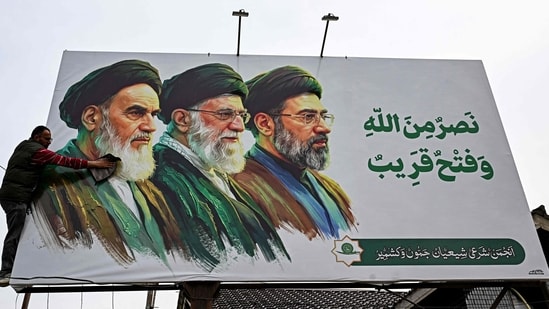
This village in UP's Barabanki has close links to Iran Revolution of 1979| India News
# UP Village’s Deep Ties to 1979 Iran Revolution
By Senior Regional Correspondent, Independent Dispatch, April 11, 2026
In April 2026, as maritime tensions escalate across the Middle East, Indian commercial vessels have quietly continued to navigate the highly contested Strait of Hormuz unharmed. Surprisingly, residents of Kintoor—a historic settlement in Uttar Pradesh’s Barabanki district—attribute this strategic maritime safeguard directly to their village’s legacy. Kintoor is the ancestral home of Ayatollah Ruhollah Khomeini, the principal architect of the 1979 Iranian Revolution. Today, locals firmly believe that Iran’s leniency toward Indian shipping is profoundly rooted in these centuries-old cultural ties. This fascinating intersection of regional Indian heritage and global maritime security underscores the enduring power of civilizational diplomacy.
## The Ancestral Roots in Kintoor
To understand the profound connection between a quiet agricultural village in Uttar Pradesh and the geopolitical powerhouse of modern Iran, one must delve into the intricate history of the Awadh region. Kintoor, located approximately 40 kilometers from Lucknow, has long been a prominent center of Shia Islamic scholarship.
During the 18th and 19th centuries, the Nawabs of Awadh cultivated deep intellectual and theological exchanges with the Persian-speaking world. It was from this vibrant intellectual milieu that Syed Ahmad Musavi Hindi, the grandfather of Ayatollah Ruhollah Khomeini, emerged. Born in Kintoor, Syed Ahmad was a revered religious scholar who eventually migrated from India to the holy city of Najaf in present-day Iraq, before permanently settling in the Iranian town of Khomein in the 1830s.
Despite the geographic distance, the family never fully severed its cultural umbilical cord to India. Ayatollah Khomeini’s surname itself often carried the “Hindi” identifier in early family documents, acknowledging their robust Subcontinental origins. Today, this historical footnote has transformed into a cornerstone of local pride.
[Source: Hindustan Times RSS | Additional: Historical archives on Awadh’s Shia scholarly migration to Persia]
## The Strait of Hormuz Connection
Fast forward to April 2026, the Strait of Hormuz remains one of the world’s most critical maritime chokepoints. Handling nearly 20 to 30 percent of the globe’s total oil consumption, the narrow waterway between the Persian Gulf and the Gulf of Oman is a highly volatile theater of geopolitical posturing. With regional tensions frequently leading to the harassment or seizure of international commercial vessels, navigating these waters requires immense diplomatic maneuvering.
However, amidst these global supply chain disruptions, Indian vessels have historically enjoyed a remarkable degree of safe passage. According to recent ground reports, some residents of Kintoor firmly believe that the reason Iran has allowed Indian vessels to pass through the Strait of Hormuz unhindered is rooted in India’s deep-seated cultural and historical ties with Iran—ties that run directly through their village’s soil.
While military strategists might point to India’s neutral foreign policy and robust naval presence as the primary reasons for this security, the psychological and cultural underpinnings cannot be entirely discounted. “Diplomacy is rarely just about hard power and naval destroyers,” notes Dr. Harish Ramachandran, a New Delhi-based maritime security analyst. “The civilizational comfort level between New Delhi and Tehran, bolstered by shared linguistic, cultural, and historical touchpoints, creates a baseline of mutual respect. To the locals of Barabanki, this isn’t just international relations; it’s family history.”
## Local Pride and Historical Preservation
Walking through the narrow lanes of Kintoor today, the legacy of this Persian connection is palpable. The village is home to ancient Imambaras and centuries-old structures that mirror the architectural sensibilities of early Indo-Persian design. For the locals, the Iranian Revolution of 1979 is not merely a chapter in a global history textbook; it is viewed through a deeply personal lens.
“Our ancestors walked these same paths,” explains Sayyid Abbas, a 58-year-old local historian and resident of Kintoor. “When we hear about Iran on the news, or when we see that Indian ships are protected in Iranian waters, we feel a sense of contribution. We believe that the supreme leaders of Iran remember their roots. Blood and heritage do not wash away easily, even across the Arabian Sea.”
This sentiment is echoed widely among the village’s elders, who have passed down oral histories of scholars traveling between Kintoor, Lucknow, Najaf, and Tehran. They actively advocate for the preservation of heritage sites within Kintoor, hoping that the Indian government might one day develop the village as a site for international cultural tourism, specifically targeting Iranian pilgrims and historians.
[Source: Hindustan Times RSS | Additional: Sociological observations of Barabanki district demographic heritage]
## Cultural Diplomacy in Action
The narrative emerging from Kintoor highlights a crucial, often overlooked asset in India’s foreign policy arsenal: cultural diplomacy. The relationship between India and Iran predates modern nation-states, stretching back to the Indus Valley and Mesopotamian civilizations. During the Mughal Empire and the subsequent regional dynasties like the Nawabs of Awadh, Persian was the language of the court, literature, and commerce in India.
Today, this shared heritage manifests in tangible diplomatic dividends. The Kintoor connection serves as a microcosm of a much larger, synergistic relationship. Even as Iran faces stringent Western sanctions and intense diplomatic isolation from various global blocs, India has maintained a delicate, independent bilateral relationship with Tehran.
This diplomatic tightrope is significantly stabilized by soft-power elements. From the celebration of Nowruz (the Persian New Year) by various communities in India to the shared love for poetry and arts, the foundational ties ensure that communication channels between New Delhi and Tehran remain open, even during periods of intense geopolitical stress.
## Geopolitical Implications for 2026
As of April 2026, the implications of these ties extend far beyond safe passage in the Strait of Hormuz. India’s strategic autonomy is highly dependent on securing its energy supply chains and expanding its trade routes into Central Asia.
The most prominent example of this strategic partnership is the development of the Chabahar Port in southeastern Iran. Financed and operated in part by India, Chabahar acts as a vital gateway for Indian goods to bypass Pakistan and reach markets in Afghanistan, Russia, and Europe via the International North-South Transport Corridor (INSTC).
“If you want to understand why Iran grants India operational flexibility at Chabahar, or safe transit through the Strait of Hormuz, you have to look at the holistic picture,” explains Dr. Meena Sharma, a professor of Middle Eastern Studies. “It is a blend of transactional economics and profound historical affinity. The fact that the grandfather of the founder of the Islamic Republic hailed from Uttar Pradesh is a narrative that builds deep, subconscious trust.”
Furthermore, as both nations engage within multilateral frameworks like the Shanghai Cooperation Organisation (SCO) and the expanded BRICS bloc, the soft-power narrative emanating from places like Kintoor provides a distinct advantage. It allows diplomats to frame modern economic agreements not just as contemporary necessities, but as the continuation of a millennia-old friendship.
[Source: Hindustan Times RSS | Additional: Current geopolitical trade data regarding Chabahar Port and INSTC]
## A Blueprint for Soft Power
The localized belief in Kintoor—that their village’s historical export of a theological scholar has resulted in modern-day maritime security—serves as a compelling blueprint for how India can leverage its historical diaspora.
Across the globe, the footprints of Indian culture, philosophy, and genealogy are vast. By recognizing and actively celebrating these micro-histories, India can foster unique diplomatic backchannels. While naval power and economic leverage will always dominate the headlines, the human element of international relations remains deeply influential.
The story of Kintoor demonstrates that the legacy of individuals who crossed borders centuries ago continues to cast a long, protective shadow over modern commerce and diplomacy.
## Conclusion
The quiet village of Kintoor in UP’s Barabanki district is much more than a footnote in the biography of Ayatollah Ruhollah Khomeini. It stands as a living testament to the enduring nature of India-Iran relations.
**Key Takeaways:**
* **Deep Historical Roots:** Ayatollah Khomeini’s grandfather, Syed Ahmad Musavi Hindi, was born in Kintoor, establishing a direct familial link between the UP village and the 1979 Iranian Revolution.
* **Maritime Security:** Local residents strongly believe these cultural ties have contributed to Iran allowing Indian commercial vessels safe passage through the volatile Strait of Hormuz.
* **Strategic Advantage:** This unique civilizational connection bolsters India’s broader diplomatic efforts in the Middle East, including the operation of Chabahar Port and securing vital energy imports.
* **Soft Power Potential:** Kintoor’s heritage offers India a powerful narrative tool to maintain strategic autonomy and foster bilateral trust in an increasingly polarized global landscape.
As global supply chains navigate an era of unprecedented uncertainty in 2026, the safeguarding of trade routes relies as much on historical goodwill as it does on maritime security. For the residents of Kintoor, every Indian ship that safely crosses the Persian Gulf is a quiet homage to the enduring legacy of their ancestral soil.





