
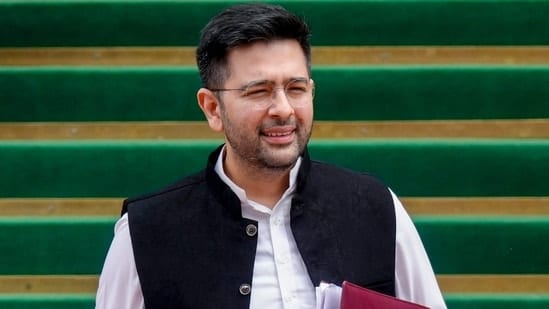
Raghav Chadha on why he left AAP along with 6 other MPs: ‘Mai unke gunaah me…’| India News
# AAP Crisis: Chadha & 6 MPs Quit
By Vikram Ahuja, Senior Political Correspondent | April 24, 2026
Raghav Chadha, alongside six other Members of Parliament, officially resigned from the Aam Aadmi Party (AAP) on Friday, April 24, 2026, delivering a seismic blow to the Arvind Kejriwal-led organization. Addressing a packed press conference in New Delhi, the 35-year-old leader and prominent face of the party announced the departure, stating an inability to remain complicit in the party’s recent ideological deviations, declaring, “*Mai unke gunaah me shamil nahi ho sakta*” (I cannot be a partner in their sins). The sudden exodus of seven parliamentarians not only triggers a massive political crisis for AAP in both Punjab and the national capital but also forces imminent by-elections, fundamentally altering the calculus of India’s opposition landscape ahead of the next electoral cycle.
## The Breaking Point: “Mai Unke Gunaah Me…”
The rift within the Aam Aadmi Party, which had been the subject of hushed whispers in the corridors of power over the past year, finally exploded into the public domain on Friday afternoon. Raghav Chadha, visibly emotional but resolute, took to the podium to articulate the collective grievances of the dissenting parliamentarians.
While stopping short of naming specific individuals, Chadha’s use of the word *gunaah* (sins/crimes) has sent shockwaves through the political establishment. [Source: Hindustan Times]. This phrase heavily implies that the departing members believe the party’s leadership has crossed red lines—whether administrative, financial, or ethical—that fundamentally contradict the party’s foundational ethos.
“There comes a time in the life of every public servant when loyalty to the nation and the truth must supersede loyalty to a political banner,” Chadha noted during the 40-minute address. The rebellion highlights a deepening schism between AAP’s old-guard idealists and the pragmatic, often controversial, survival strategies adopted by the party’s top brass amidst ongoing federal investigations and governance challenges.
## Idealism vs. Realpolitik: A Dream Betrayed
The core narrative of Chadha’s resignation centered on the abandonment of the “alternative politics” that AAP once championed. Emerging from the historic 2012 India Against Corruption movement, AAP was built on the promise of clean governance, transparency, and the dismantling of V.I.P. culture.
Reflecting on this journey, Chadha poignantly reminded the press of the personal sacrifices made by the party’s early adherents. “We didn’t enter politics to make our career, but we left our career to enter politics for the nation,” Chadha said. [Source: Hindustan Times].
Before entering the political fray, Chadha was a practicing Chartered Accountant with a lucrative trajectory in corporate finance. His transition from a backroom financial advisor for the party to one of its youngest and most articulate Rajya Sabha MPs mirrored the rise of a new generation of Indian professionals engaging directly with electoral politics. His resignation, therefore, is not just a political defection; it is symbolic of the disillusionment of the urban, educated middle class that once formed the bedrock of AAP’s support base. [Additional Source: Public Political Archives 2012-2026].
## The Exodus: Impact on Parliamentary Dynamics
The departure of seven MPs is a catastrophic loss of legislative muscle for AAP. While the exact division between the Lok Sabha and Rajya Sabha among the seven resigning members has profound constitutional implications, the sheer volume of the exodus paralyzes the party’s ability to effectively negotiate within the national opposition bloc.
**Constitutional and Electoral Ramifications:**
Under the Tenth Schedule of the Indian Constitution (Anti-Defection Law), elected members voluntarily giving up their party membership are subject to disqualification. Anticipating this, Chadha and the six MPs have simultaneously tendered their resignations to the presiding officers of their respective Houses.
This move guarantees:
1. **Immediate Vacancies:** Seven parliamentary seats will now sit vacant, drastically reducing AAP’s footprint in New Delhi.
2. **Imminent By-Elections:** The Election Commission of India will be mandated to hold by-elections for these seats within six months, forcing AAP into an unseasonable and highly defensive electoral battle.
3. **Optics of Instability:** The mass resignation paints a picture of a sinking ship, which rival national parties—namely the Bharatiya Janata Party (BJP) and the Indian National Congress (INC)—are already weaponizing in their public messaging.
## Decoding the Internal Turmoil
What drove one of AAP’s most loyal lieutenants to stage such a dramatic exit? Political historians and analysts point to a compounding series of crises that have beset the party since 2023.
The shadow of the Delhi excise policy case, which saw several top-tier AAP leaders subjected to prolonged incarceration and intense scrutiny by the Enforcement Directorate (ED) and the Central Bureau of Investigation (CBI), permanently scarred the party’s “anti-corruption” shield. Furthermore, the administrative burden of governing Punjab—a border state fraught with agricultural distress, financial debt, and internal security challenges—has repeatedly exposed the limitations of AAP’s governance model.
Chadha, who was heavily involved in the party’s Punjab strategy and served as the chairman of the state’s advisory committee, reportedly found himself increasingly at odds with decisions dictated by the Delhi-based high command. Insiders suggest that the centralization of power, combined with a refusal to enforce internal accountability regarding the alleged “sins” Chadha referenced, created an untamable toxic environment for dissenting voices.
## Expert Analysis: The End of an Era?
Political analysts view Friday’s developments as a potential point of no return for AAP’s national ambitions.
“Raghav Chadha was not just an MP; he was the urbane, articulate, and youthful face of the Aam Aadmi Party. He was their bridge to the corporate world, the youth, and the intelligentsia,” explains Dr. Neerja Singh, Senior Fellow at the New Delhi Centre for Democratic Studies. “When a leader of his stature claims he is leaving to avoid complicity in ‘sins’, it validates the opposition’s long-standing allegations of institutional rot within AAP.”
Prof. Alok Verma, a specialist in Punjab politics at Panjab University, notes the regional fallout. “Six of the seven resigning MPs have deep ties to Punjab’s electoral matrix. The state is already facing anti-incumbency sentiments. This rebellion could fracture the AAP cadre in Punjab, providing an open playing field for the Congress and the resurgent Akali Dal.”
## The Road Ahead: Where Do the Rebels Go?
The immediate question dominating national media is the future political trajectory of Chadha and his cohort of six ex-AAP MPs. During the press conference, Chadha remained tight-lipped about joining a rival political outfit, emphasizing instead that their immediate focus is on “returning to the people” to explain their decision.
However, in the unforgiving realm of Indian politics, independent survival is historically improbable. Several scenarios are currently being debated by political corridors:
* **Integration into a National Party:** The BJP has historically welcomed disgruntled leaders from opposition ranks, framing their induction as proof of Prime Minister Narendra Modi’s governance appeal. Alternatively, the Congress, which shares a direct overlapping voter base with AAP in Delhi and Punjab, might see the induction of these rebels as a way to reclaim its lost bastions.
* **Formation of a Regional Splinter Group:** Given the specific demographic and geographic influence of the resigning MPs, there is speculation about the formation of a Punjab-centric political front. Such a front could leverage the original “clean politics” ideology of the 2012 AAP, attempting to capture the disillusioned voter base.
* **A Temporary Sabbatical:** Staying true to his statement about leaving his career for the nation, Chadha may opt for a temporary withdrawal from electoral politics to build a non-political civil society movement, reminiscent of the very movement that birthed AAP.
## AAP’s Response and the Leadership Vacuum
The Aam Aadmi Party’s official response has been characteristically combative, though tinged with undeniable panic. Preliminary statements from AAP spokespersons have attempted to downplay the ideological nature of the resignations, instead framing the exodus as the result of “unbearable pressure” from central investigative agencies—a defense the party has frequently deployed over the past three years.
However, this narrative faces a severe credibility test. Chadha has historically been one of the most vocal defenders of the party against central agencies. For him to pivot and point the finger back at the party leadership suggests that the rot is internal rather than an external imposition.
The resignations leave a gaping leadership vacuum. With several founding members either politically sidelined, battling legal challenges, or having previously abandoned the party (such as Yogendra Yadav, Prashant Bhushan, and Kumar Vishwas in the early years), Arvind Kejriwal now presides over an increasingly isolated high command.
## Conclusion: A Watershed Moment in Indian Politics
The events of April 24, 2026, will likely be recorded as a watershed moment in the contemporary history of Indian politics. The Aam Aadmi Party, born out of a utopian vision to cleanse the Indian political system, now finds itself battling the very accusations of moral compromise it once levied against established behemoths.
Raghav Chadha’s assertion that he and his colleagues “left their careers for the nation, not to make a career in politics” serves as a haunting epitaph for AAP’s original mandate. As the country braces for the inevitable by-elections in the wake of these seven resignations, the Indian electorate is left to ponder a cynical reality: whether the system inevitably corrupts the crusader, or if alternative politics was merely a fleeting illusion in the world’s largest democracy.
The coming weeks will determine whether AAP can salvage its foundational credibility or if this exodus marks the beginning of its ultimate unravelling. What remains certain is that the political tremors generated by this resignation will be felt from the neighborhood mohalla clinics of Delhi to the agricultural heartlands of Punjab.





