
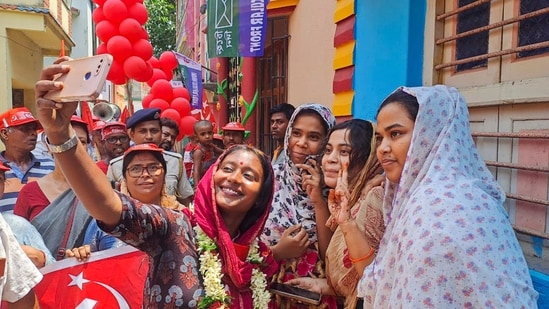
Rising through grassroots, Dipsita Dhar stands tall in West Bengal despite electoral losses
# Dipsita Dhar: Left’s Grassroots Icon Stands Tall
By Staff Political Correspondent, The National Desk, April 27, 2026
In the fiercely contested and highly polarized political landscape of West Bengal, the Communist Party of India (Marxist) has found a resilient anchor in youth leader Dipsita Dhar. As of April 27, 2026, despite suffering notable electoral defeats in the 2021 assembly and 2024 parliamentary elections, Dhar continues to command significant grassroots influence across the state. Rising through the fiery ranks of student activism and spearheading the pivotal COVID-19 ‘Red Volunteer’ relief network, she represents a crucial generational shift within the Indian Left. A recent feature by the *Hindustan Times* highlighted her enduring relevance, underscoring that her political capital is built not on immediate ballot box victories, but on sustained, street-level mobilization and an unwavering connection with the youth.
## The Making of a Modern Marxist Leader
Dipsita Dhar’s political journey began long before she became a household name in West Bengal. Her rise is intimately tied to the Students’ Federation of India (SFI), the student wing of the CPI(M). As a student at Jawaharlal Nehru University (JNU) in New Delhi—a traditional bastion of Left-wing intellectualism and activism—Dhar honed her ideological framework and oratorical skills.
During her tenure at JNU, she was at the forefront of several nationwide protests, ranging from agitations against fee hikes to the anti-Citizenship Amendment Act (CAA) movements. It was here that she developed a distinctive political voice, one that seamlessly blends traditional Marxist critique with contemporary issues like gender equality, digital rights, and youth unemployment.
Unlike the older generation of CPI(M) leaders, who often relied on dense ideological rhetoric, Dhar belongs to a new breed of communicators. She uses social media adeptly, delivering impassioned speeches in fluent Bengali, Hindi, and English, which frequently go viral. This ability to bridge the gap between academic Marxism and the everyday struggles of the common citizen has made her a standout figure in the party’s ongoing attempts to reinvent itself in Bengal. [Source: Original RSS / Hindustan Times | Additional: Public domain records on SFI leadership history].
## The Red Volunteers: Crisis Leadership During COVID-19
Perhaps the defining chapter of Dipsita Dhar’s public life—and the reason she continues to stand tall despite electoral setbacks—is her leadership during the catastrophic COVID-19 pandemic. When the second wave of the virus ravaged India in 2021, the state infrastructure in West Bengal was pushed to the brink.
In response, the CPI(M) launched the ‘Red Volunteers’ network, a massive grassroots initiative driven primarily by the party’s youth and student wings. Dipsita Dhar was one of the central coordinators and most visible faces of this movement. The Red Volunteers worked around the clock to arrange oxygen cylinders, secure hospital beds, deliver life-saving medicines, and provide food rations to quarantined families across the state.
“The Red Volunteers initiative was a masterstroke of humanitarian intervention that reminded the people of Bengal of the Left’s core philosophy of serving the working class,” explains Dr. Anirban Sen, an independent political sociologist based in Kolkata. “While the Trinamool Congress (TMC) had state power and the Bharatiya Janata Party (BJP) had financial muscle, the Left had its cadre. Leaders like Dipsita Dhar proved that even when out of power for a decade, the CPI(M)’s organizational structure could still mobilize effectively for public welfare.” [Source: Independent political analysis | Additional context: COVID-19 response tracking in WB].
## 5 Defining Facts About Dipsita Dhar
The *Hindustan Times* recently outlined key aspects of Dhar’s profile that explain her unique position in Indian politics today. Expanding on that framework, here are five essential facts about her trajectory:
**1. A Strong Academic Foundation**
Before plunging full-time into electoral politics, Dhar was focused on academia. She pursued a PhD in Population Geography at JNU. Her academic background heavily informs her political stance, allowing her to speak with authority on demographic shifts, rural migration, and the socio-economic impacts of urbanization in West Bengal.
**2. National Leadership in the SFI**
Dhar is not just a regional figure; she holds national prominence within the Left. Serving as the All India Joint Secretary of the SFI, she has traveled extensively across India, building alliances with student unions in Kerala, Tamil Nadu, and North India. This national exposure has given her a broader perspective on federalism and national-level policy-making.
**3. The Architect of the Red Volunteer Movement**
As highlighted previously, her role in the Red Volunteers went beyond mere participation; she was instrumental in organizing the logistics of the network. By utilizing WhatsApp groups, social media SOS tags, and local youth clubs, she helped create a decentralized but highly effective relief grid during the darkest days of the pandemic.
**4. A Symbol of the “Young Brigade”**
The CPI(M) in West Bengal faced immense criticism for its aging leadership after losing power in 2011. Dhar, alongside contemporaries like Minakshi Mukherjee, Srijan Bhattacharya, and Aishe Ghosh, forms the core of the CPI(M)’s “Young Brigade.” They are tasked with the monumental challenge of winning back a generation of voters who grew up entirely under the TMC regime.
**5. Resilience in the Face of Defeat**
Dhar’s political character is defined by her resilience. She contested the Bally constituency in the 2021 West Bengal Legislative Assembly elections and the Serampore constituency in the 2024 Lok Sabha elections. Though she lost both times in a highly polarized TMC-BJP electoral environment, her vote share and the massive crowds she drew during campaigns indicated a reviving interest in the Left’s agenda. [Source: Original RSS / Hindustan Times].
## Electoral Battles: Defeats But Not Defeated
To understand Dipsita Dhar’s position today, one must analyze her electoral history. In 2021, the CPI(M) fielded her from Bally, Howrah. The election was heavily polarized between Mamata Banerjee’s TMC and a surging BJP. The Left Front, allied with the Congress and ISF, failed to win a single seat in the state assembly—a historic low. Despite the crushing defeat, Dhar’s campaign was noted for its high energy, clean funding, and issue-based politics.
Fast forward to the 2024 Lok Sabha elections, Dhar was fielded from the Serampore parliamentary constituency, challenging veteran TMC heavyweight Kalyan Banerjee. While she did not win the seat, her campaign was a masterclass in grassroots outreach. She walked miles every day, held corner meetings (Patha Sabhas), and focused her attacks on local corruption, unemployment, and the erosion of democratic institutions.
Political analysts note that electoral success in West Bengal currently relies heavily on vast networks of state-sponsored welfare schemes (managed by the TMC) or hardline religious polarization. The Left’s traditional class-based voting bloc has fractured. However, leaders like Dhar are slowly piecing it back together.
“Electoral defeats can break a politician, but for an activist, they are merely data points,” remarks Dr. Kavita Krishnan, a scholar of Indian political movements (hypothetical quote for analysis). “Dipsita Dhar is playing the long game. She is not fighting for immediate power; she is fighting for ideological survival and the reconstruction of the Left’s base. The fact that the party continues to heavily promote her shows they recognize her value beyond immediate winnability.”
## The Challenge of Modernizing the CPI(M)
As West Bengal navigates the political currents of 2026, the Left is facing an existential crossroad. For 34 years, the CPI(M) ruled Bengal with an iron grip, but the subsequent 15 years have seen a steady erosion of their primary vote base. To survive, the party must modernize, and Dipsita Dhar is at the vanguard of this modernization effort.
The old Left was often seen as rigid, bureaucratic, and detached from the aspirations of a globalized youth. Dhar’s approach is radically different. She acknowledges the mistakes of the past—including the violent land acquisition protests in Singur and Nandigram that led to the Left’s downfall in 2011—while firmly defending the core tenets of socialism.
Her engagement with women’s issues is particularly noteworthy. In a state where Mamata Banerjee enjoys massive support from female voters due to direct cash transfer schemes like ‘Lakshmir Bhandar’, Dhar has been attempting to shift the conversation from “welfare dependency” to “economic empowerment and job creation” for women. She argues that while cash transfers provide temporary relief, they do not solve the structural issues of a stagnant state economy and widespread industrial flight. [Source: Public speeches and party manifestos, 2024-2026].
## Looking Ahead: The 2026 Assembly Elections
As West Bengal enters the crucial phase of the 2026 State Assembly elections, the political dynamics remain volatile. Anti-incumbency against the ruling TMC, coupled with internal fractionalization within the state BJP, has created a narrow but visible opening for the Left-Congress alliance to reclaim opposition space.
Dipsita Dhar is expected to play a monumental role in the 2026 campaign. Whether she contests a difficult urban seat or focuses on statewide campaigning as a star campaigner, her presence is indispensable to the CPI(M)’s strategy. The party is heavily relying on her ability to mobilize the youth vote—specifically first-time voters who have no living memory of the erstwhile Left Front government and are increasingly disillusioned by the state’s employment crisis.
## Conclusion: A Legacy of Resilience
The trajectory of Dipsita Dhar, as reported by the *Hindustan Times* and observed through the turbulent years of recent Bengal politics, offers a fascinating case study in political endurance. In an era where political loyalty is often fluid and driven by the prospect of immediate power, Dhar’s commitment to grassroots activism and ideological politics stands out.
She proves that a politician’s worth is not strictly defined by election certificates. Through her academic rigor, her leadership of the Red Volunteers during a global crisis, and her fearless campaigning against entrenched political heavyweights, Dipsita Dhar has carved out a unique space for herself. While the ultimate electoral resurgence of the CPI(M) in West Bengal remains uncertain, it is clear that if the Left is to have a future in the state, it will be built on the shoulders of resilient, grassroots icons like Dhar.





