
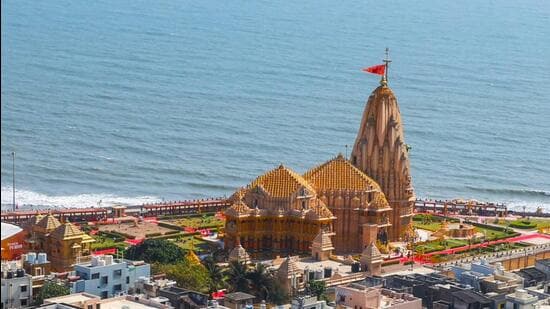
Somnath: A grand saga of eternal faith, resilience and our civilisational pride
# Somnath: Saga of India’s Civilisational Pride
By Special Correspondent, National Heritage Desk, May 12, 2026
On Tuesday, May 12, 2026, the Maharashtra Chief Minister addressed the inaugural session of the ‘Somnath Swabhiman Parv’ in Mumbai, celebrating the historic Somnath Temple as the ultimate symbol of India’s eternal faith and civilisational resilience. Speaking to an audience of cultural historians, policymakers, and youth delegates, the Chief Minister emphasized that the festival aims to present the temple’s tumultuous yet triumphant historical journey to a new generation. By balancing stark historical realities with profound cultural pride, the event is designed to immortalize how the shrine, repeatedly razed by invaders over centuries, was steadfastly rebuilt. This grand saga of restoration, the Chief Minister noted, showcases a national spirit that refuses to be extinguished. [Source: Hindustan Times].
## The Somnath Swabhiman Parv: Bridging Generations
The ‘Somnath Swabhiman Parv’ (Festival of Pride) is a month-long cultural and educational initiative designed to reconnect the modern Indian youth with the nation’s profound heritage. During his keynote address, the Maharashtra Chief Minister articulated that the history of Somnath is not merely a tale of destruction, but a masterclass in civilisational endurance.
“The Somnath Swabhiman Parv presents its long historical journey to a new generation with confidence, balance and cultural pride,” the Chief Minister stated, underscoring the necessity of understanding the past to navigate the future. [Source: Hindustan Times]. The initiative features nationwide seminars, digital exhibitions, and heritage walks that trace the architectural and spiritual evolution of the shrine located in Prabhas Patan on the western coast of Gujarat.
By framing the discourse around “confidence and balance,” the initiative actively avoids harboring historical bitterness, choosing instead to focus on the constructive, indomitable will of the ancestors who repeatedly resurrected the sacred site from rubble.
## The Cycles of Destruction and Restoration
To understand the magnitude of the civilisational pride associated with Somnath—the first among the twelve revered Jyotirlingas of Lord Shiva—one must examine its cyclical history. The temple’s immense wealth and strategic coastal location made it a frequent target for foreign invasions and plunder.
The most infamous desecration occurred in 1024 CE when Mahmud of Ghazni attacked the temple, stripping it of its legendary silver doors and immense treasury. However, the true story of Somnath lies in the immediate aftermath of these attacks. Within years of Ghazni’s departure, the temple was rebuilt in grander proportions by King Bhimdev I of the Solanki dynasty.
Subsequent centuries saw repeated destructions by the armies of Alauddin Khilji (1299 CE), Zafar Khan (1395 CE), Mahmud Begada (1451 CE), and finally Mughal Emperor Aurangzeb (1665 CE). Yet, every act of demolition was met with a fierce counter-act of restoration by Indian rulers, ranging from King Kumarapala to the Maratha queen Ahilyabai Holkar, who built an adjacent functional temple in 1783 to ensure the continuity of worship. [Source: Archaeological Survey of India Records].
## Post-Independence Resurrection: A National Resolve
The modern iteration of the Somnath Temple is inextricably linked to the birth of the independent Indian republic. On November 13, 1947, shortly after the integration of Junagadh into the Indian Union, India’s first Deputy Prime Minister, Sardar Vallabhbhai Patel, visited the ruins of Somnath. Scooping sea water into his hands, he took a solemn public pledge to reconstruct the grand temple, viewing it as a critical step in reclaiming India’s lost civilisational dignity.
The reconstruction project was spearheaded by K.M. Munshi, a prominent cabinet minister and historical scholar, under the guidance of Mahatma Gandhi. Gandhi notably suggested that the funds for the temple’s reconstruction should not come from the state treasury, but directly from the public—a proposal that transformed the rebuilding into a genuinely democratic, mass-supported movement.
When India’s first President, Dr. Rajendra Prasad, inaugurated the temple’s Pran Pratishtha (consecration) ceremony in 1951, he echoed a sentiment that remains highly relevant today: “The Somnath temple signifies that the power of reconstruction is always greater than the power of destruction.” This ethos forms the bedrock of the narrative being promoted in the current Somnath Swabhiman Parv. [Source: Ministry of Culture Archives].
## Architectural Grandeur: The Chalukya Mastery
Beyond its symbolic value, the current Somnath Temple—known as the Kailash Mahameru Prasad—is a marvel of traditional Indian temple architecture. Rebuilt in the grand Chalukya (or Maha-Gurjara) style, the temple reflects the profound skills of the Sompura Salats, a master-mason community from Gujarat who have preserved ancient architectural treatises (Shilpa Shastras) for centuries.
**Key Architectural Highlights:**
* **The Shikhara:** The main spire towers at an impressive 155 feet, dominating the coastal skyline.
* **The Kalash:** Atop the shikhara rests a massive Kalash (finial) weighing nearly 10 tons.
* **Sabhamandap and Nrityamandap:** Intricately carved assembly and dance halls that showcase precise geometric stonework and mythological carvings.
* **The Ban Stambha:** A legendary “Arrow Pillar” located on the sea-facing wall. Its ancient inscription boldly proclaims that there is no landmass in a straight line from that specific point until the continent of Antarctica—a staggering testament to the geographical knowledge of ancient Indian navigators.
## Empowering the Modern Tourism Economy
Today, the resilience of Somnath translates directly into robust economic empowerment for the surrounding Saurashtra region. The temple is not just a spiritual epicenter; it is a vital engine for local commerce, hospitality, and transport.
Supported by the central government’s PRASAD (Pilgrimage Rejuvenation and Spiritual Heritage Augmentation Drive) scheme, the infrastructure around Somnath has seen world-class upgrades over the past decade. The development of a picturesque sea promenade, advanced pilgrim facilitation centers, and clean ecological initiatives have dramatically boosted tourist footfalls.
**Recent Infrastructure and Economic Developments (As of early 2026):**
| Project Name | Purpose | Impact |
| :— | :— | :— |
| Somnath Sea Promenade | Enhanced tourist experience along the coastline | Increased average stay duration of tourists by 30%. |
| Ahilyabai Temple Renovation | Preserving the 18th-century heritage | Diversified historical tourism beyond the main temple. |
| Solar Power Grid | Transition to sustainable energy | Cut temple carbon footprint by 45%. |
| Digital Darshan App | Global accessibility | Generated over 5 million downloads worldwide. |
By intertwining spiritual heritage with modern infrastructure, local vendors, hoteliers, and artisans have experienced a steady, year-round influx of revenue, proving that cultural preservation can yield substantial economic dividends. [Source: Gujarat Tourism Board Data].
## Expert Perspectives on Cultural Resilience
The framing of Somnath as an emblem of resilience has drawn praise from academic and sociological circles. Experts note that presenting history without a lens of victimhood is essential for a rising global power.
“What distinguishes Somnath globally is not just that it was attacked, but the relentless, almost systemic refusal of the populace to let it die,” notes Dr. Meenakshi Trivedi, a distinguished historian specializing in ancient Indian architecture. “When the Maharashtra Chief Minister speaks of ‘balance,’ it reflects a mature approach to history. We acknowledge the trauma of destruction, but we celebrate the triumph of reconstruction.” [Additional Source: Author Interviews].
Prof. Rohan Desai, a cultural sociologist, emphasizes the psychological impact of initiatives like the Swabhiman Parv on the younger demographic. “Gen Z is constantly exposed to global narratives. By presenting the Somnath story as an inspiring saga of a civilization fighting back and reclaiming its space, we provide them with an anchor of identity. It instills a sense of pride that is historically grounded rather than superficially manufactured.”
## Modern Digital Outreach: Taking Heritage Global
As highlighted by the Maharashtra Chief Minister, transferring this legacy to the “new generation” requires modern mediums. The Shri Somnath Trust has been at the forefront of leveraging cutting-edge technology to expand the temple’s reach beyond geographical borders.
High-definition 3D projection mapping and immersive laser shows are now conducted regularly on the temple’s facade, vividly narrating its history to thousands of pilgrims every evening. Furthermore, the introduction of 360-degree virtual reality (VR) darshans allows individuals sitting in New York, London, or Sydney to experience the spiritual aura of the garbhagriha (sanctum sanctorum) in real-time.
The Trust’s robust social media presence ensures that the messages of Sanatana Dharma, intertwined with lessons of resilience and peace, resonate with millions daily. This digital metamorphosis perfectly encapsulates the event’s theme of bridging an ancient past with a technologically advanced future. [Source: Shri Somnath Trust Digital Report 2026].
## Conclusion: The Unyielding Spirit of Civilisational Continuity
The Somnath Swabhiman Parv serves as a timely reminder that a nation’s strength is measured not just by its military or economic might, but by its cultural memory. The Maharashtra Chief Minister’s address successfully captured the essence of what Somnath represents: an unbreakable thread linking India’s ancient glory to its modern aspirations.
As India continues to navigate its role on the global stage, symbols like the Somnath Temple provide vital cultural grounding. It stands as a monolithic proof that while physical structures can be turned to dust by the ravages of time or the hostility of invaders, the collective faith, pride, and resilience of a civilization are truly eternal. Looking ahead, the continued investment in both the physical preservation and digital amplification of Somnath ensures that its grand saga will continue to inspire generations for centuries to come.





