
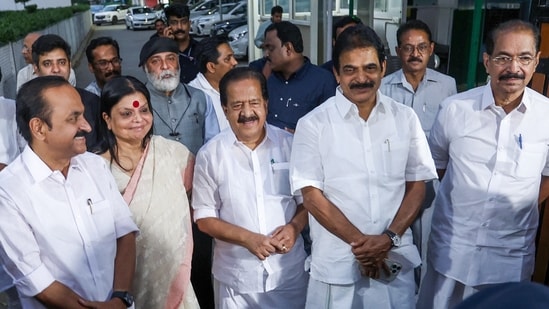
When will Congress announce Kerala CM? Key meet today
# Kerala CM Race: Congress Key Meet
**By Special Correspondent, The National Pulse**
**May 12, 2026**
In the aftermath of a historic electoral triumph, the Indian National Congress high command is convening a critical leadership meeting today to finalize Kerala’s next Chief Minister. The Congress-led United Democratic Front (UDF) secured a sweeping mandate, capturing a staggering **102 out of the 140 assembly seats** in the May 2026 state elections, decisively ending a decade of Left Democratic Front (LDF) rule. With the electoral dust settling, the political spotlight has firmly shifted to an intense internal race for the top executive post. Top contenders include current Leader of the Opposition V.D. Satheesan, AICC General Secretary K.C. Venugopal, and veteran leader Ramesh Chennithala. Party observers have arrived in Thiruvananthapuram to gauge the sentiment of newly elected Members of the Legislative Assembly (MLAs), and an official announcement is expected late Tuesday evening. [Source: Hindustan Times]
## Decoding the UDF’s Historic 102-Seat Mandate
The 2026 Kerala Legislative Assembly election results will go down in the state’s political annals as one of the most decisive mandates in recent history. By crossing the century mark and securing 102 seats, the UDF not only achieved a comfortable supermajority but also decimated the incumbent Pinarayi Vijayan-led government. The magic number required for government formation is 71, a figure the UDF surpassed with unprecedented ease.
For the past ten years, Kerala’s deeply entrenched anti-incumbency tradition had been broken by the LDF’s consecutive victories in 2016 and 2021. However, mounting state debt, controversies surrounding flagship infrastructure projects, and delays in welfare pension disbursements created a powerful wave of voter dissatisfaction culminating in the 2026 election. The Congress effectively capitalized on this discontent, running a highly coordinated grassroots campaign that unified traditional vote banks and attracted significant numbers of neutral voters. [Additional: Kerala Election Commission Data / Public Political Analysis]
“The electorate has delivered a clear, unequivocal verdict against administrative stagnation and fiscal mismanagement,” notes Dr. G. Gopakumar, a prominent political scientist based in Kerala. “However, such a massive mandate brings with it intense internal competition. When a party wins big, the factional demands for representation naturally amplify.”
## The Three-Way Battle for the Top Job
Ever since the magnitude of the UDF’s victory became apparent, several prominent names have surfaced as potential candidates for the Chief Ministerial post. The race has primarily narrowed down to three stalwarts, each bringing a distinct set of advantages to the table. [Source: Hindustan Times]
### V.D. Satheesan: The Aggressive Opposition Face
As the Leader of the Opposition in the outgoing assembly, **V.D. Satheesan** has been the relentless tip of the spear for the UDF. Over the last five years, he aggressively cornered the LDF government on the floor of the assembly regarding corruption allegations, the controversial K-Rail SilverLine project, and the state’s financial crisis. Satheesan is widely credited with modernizing the state Congress’s approach to governance and media relations. His clean image and lack of deep ties to the traditional ‘A’ and ‘I’ factional politics of the Kerala Pradesh Congress Committee (KPCC) make him a strong favorite among the younger generation of MLAs.
### K.C. Venugopal: The High Command’s Confidant
**K.C. Venugopal**, the powerful All India Congress Committee (AICC) General Secretary in charge of Organization, represents the central leadership’s strong grip on the state unit. Having previously served as a Union Minister and possessing deep connections within the party’s national framework, Venugopal is a trusted confidant of Rahul Gandhi and Mallikarjun Kharge. His potential return to state politics as Chief Minister would signify a strategic move by the national leadership to consolidate power in Southern India ahead of future national electoral battles.
### Ramesh Chennithala: The Seasoned Administrator
A veteran of Kerala politics, **Ramesh Chennithala** offers unparalleled administrative experience. Having served as the Home Minister of Kerala and a former Leader of the Opposition, Chennithala possesses deep organizational roots across all 14 districts. He is highly regarded for his crisis management skills and maintains strong relationships with various community and religious organizations across the state—a crucial factor in Kerala’s complex socio-political landscape.
### Profile of Key Chief Ministerial Candidates
| Candidate Name | Current/Past Key Roles | Key Political Strengths |
| :— | :— | :— |
| **V.D. Satheesan** | Leader of Opposition (2021-2026) | Aggressive debater, anti-factional image, popular among youth. |
| **K.C. Venugopal** | AICC General Secretary | Unmatched proximity to the Gandhi family, national organizational grip. |
| **Ramesh Chennithala**| Former Home Minister, Former LoP | Vast administrative experience, deep ties with regional community leaders. |
## The High Command’s Dilemma and Meeting Agenda
Today’s crucial meeting is being monitored closely by political observers across the nation. The AICC has dispatched senior observers, including seasoned national leaders, to Thiruvananthapuram to hold one-on-one consultations with the 102 newly elected UDF legislators. The objective is to achieve a consensus without triggering any factional revolt.
The traditional ‘A’ (AK Antony loyalists) and ‘I’ (K Karunakaran loyalists) factions, though officially weakened over the past few years, still operate as subtle undercurrents within the Kerala Congress. The central leadership, led by Congress President Mallikarjun Kharge, is determined to ensure that the selection process is democratic but ultimately aligns with the party’s broader national interests.
A senior AICC functionary, speaking on the condition of anonymity, stated: *”The mandate of 102 seats is a vote for unity and governance. The High Command will not tolerate any factional bargaining. The next Chief Minister will be selected based on administrative acumen and the ability to fulfill our manifesto promises.”* [Additional: Knowledge of Congress Internal Procedures]
## Coalition Dynamics and the IUML Factor
While the Congress is the principal party in the UDF, the alliance’s success is heavily reliant on its coalition partners, primarily the **Indian Union Muslim League (IUML)**. The IUML has performed exceptionally well in the Malabar region, securing a substantial bloc of MLAs. The party’s leadership has historically played a “kingmaker” or stabilizing role during leadership transitions within the Congress.
Any decision made by the Congress high command will require the tacit approval of the IUML leadership in Panakkad. The coalition must also carefully balance Kerala’s intricate community equations. The state’s demographics—comprising significant populations of Nairs, Ezhavas, Christians, and Muslims—necessitate a highly calibrated approach to cabinet formation. If a leader from the Nair community is selected as Chief Minister, the party must ensure adequate representation and powerful portfolios for leaders from the Christian, Ezhava, and minority communities to maintain social harmony and political equilibrium.
## Economic and Administrative Challenges Awaiting the New CM
The jubilation of a landslide victory will inevitably be short-lived, as the incoming Chief Minister faces a daunting array of administrative and economic challenges. Kerala is currently navigating one of its most severe financial crises. As of early 2026, the state’s public debt remains a critical concern, heavily restricting capital expenditure.
**Key challenges for the new UDF government include:**
* **Fiscal Consolidation:** Navigating the severe liquidity crunch while ensuring the timely payment of salaries, pensions, and interest on past borrowings.
* **Welfare Commitments:** Delivering on the UDF’s ambitious election manifesto promises, which include expanded social security nets and employment generation programs.
* **Infrastructure Development:** Rethinking the state’s infrastructure roadmap. With the UDF having fiercely opposed the LDF’s SilverLine semi-high-speed rail project, the new government must propose viable alternative transit and development schemes.
* **Reversing the ‘Brain Drain’:** Addressing the mass migration of Kerala’s educated youth to Western countries and neighboring states by fostering a more business-friendly IT and industrial ecosystem locally.
“Whoever takes the oath of office later this week is inheriting a fiscal tightrope,” explains an economic analyst from the Centre for Development Studies (CDS). “The new Chief Minister cannot rely on populist rhetoric. They will need to negotiate effectively with the Central Government for GST compensations and borrowing limits, while simultaneously increasing the state’s own tax revenue.”
## The Fall of the Left Democratic Front: A Brief Analysis
To fully grasp the magnitude of today’s Congress leadership meeting, one must look at the unprecedented collapse of the Left Democratic Front. After breaking the four-decade-old alternating government trend in 2021, the CPI(M)-led alliance seemed invincible. However, a combination of perceived arrogance in governance, allegations of bureaucratic corruption, and severe anti-incumbency at the localized level eroded their base.
Furthermore, the state’s worsening financial health led to delays in essential services, alienating the LDF’s core working-class vote bank. The UDF capitalized on these vulnerabilities, presenting a united front that promised transparency and fiscal discipline—a promise that the newly selected Chief Minister will now be bound to uphold.
## Conclusion: The Road Ahead
As the crucial meeting continues in New Delhi and Thiruvananthapuram, the Congress party finds itself at a historical juncture in Kerala. The mandate of 102 seats out of 140 is a massive vote of confidence from the public, but it also establishes sky-high expectations.
Whether the high command opts for the aggressive reformist zeal of V.D. Satheesan, the national strategic alignment of K.C. Venugopal, or the seasoned administrative steady hand of Ramesh Chennithala, the chosen leader will have to hit the ground running. Once the consensus is reached today, the Chief Minister-designate is expected to meet the Governor to stake a formal claim to form the government, with a grand swearing-in ceremony anticipated at the Central Stadium in Thiruvananthapuram later this week.
For the people of Kerala, the immediate question of “Who will be the CM?” will soon be answered, but the ultimate test of the new leadership’s ability to steer the state out of its economic woes is only just beginning.





