
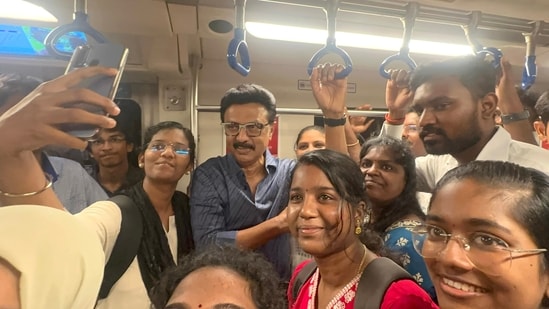
Tamil Nadu CM MK Stalin travels by Chennai Metro for poll campaign in Chennai| India News
# MK Stalin Rides Chennai Metro for 2026 Campaign
**By Special News Correspondent, April 10, 2026**
Tamil Nadu Chief Minister M.K. Stalin took his 2026 assembly election campaign to the tracks on Friday, traveling on the Chennai Metro to interact directly with urban voters. Contesting once again from his stronghold in the Kolathur constituency, the Dravida Munnetra Kazhagam (DMK) president engaged with daily commuters, posing for selfies and discussing his government’s initiatives. This strategic transit diplomacy highlights the ruling party’s focus on urban infrastructure and accessibility as Tamil Nadu heads to the polls, reflecting a modern, ground-level approach to grassroots campaigning in the bustling southern metropolis. [Source: Hindustan Times | Additional: Electoral Commission of India 2026 Notifications].
## Transit Diplomacy: Connecting with the Urban Voter
As the campaign for the 2026 Tamil Nadu Legislative Assembly elections enters its crucial final weeks, political leaders are adopting innovative strategies to break through the traditional noise of mega-rallies and roadshows. Chief Minister M.K. Stalin’s decision to utilize the Chennai Metro for campaigning serves a dual purpose: avoiding the creation of traffic snarls that often frustrate urban residents during election season, and visually associating his leadership with modern, efficient infrastructure.
Boarding the train amidst surprised and enthusiastic commuters, Stalin eschewed the traditional heavy security blanket that usually distances high-ranking politicians from the public. Accompanied by a streamlined security detail and a few key party functionaries, the Chief Minister walked the aisles of the moving train, handing out pamphlets detailing the DMK’s “Dravidian Model” achievements over the past five years.
Commuters seized the opportunity to interact with the Chief Minister, with many young professionals and college students requesting selfies. According to on-ground reports, Stalin actively listened to feedback regarding last-mile connectivity, ticket pricing, and the integration of the metro system with the Metropolitan Transport Corporation (MTC) bus networks. By placing himself in the daily environment of the working-class and middle-class electorate, Stalin aims to project an image of a reachable, pragmatic leader. [Source: Hindustan Times | Additional: Public transportation campaign trends analysis].
## Kolathur: Securing a Fortified Stronghold
M.K. Stalin is seeking re-election from the Kolathur assembly constituency, a seat he has carefully nurtured into a DMK bastion since its creation following the delimitation exercise in 2008. His victory there in the 2011, 2016, and 2021 elections showcased a steady increase in his voter base, and his 2026 campaign is heavily focused on solidifying this mandate.
**Electoral History of M.K. Stalin in Kolathur:**
| Election Year | Party | Opponent (Party) | Margin of Victory (Votes) |
| :— | :— | :— | :— |
| 2011 | DMK | Saidai Duraisamy (AIADMK) | 2,734 |
| 2016 | DMK | J.C.D. Prabhakar (AIADMK) | 37,730 |
| 2021 | DMK | Adhi Rajaram (AIADMK) | 70,384 |
| 2026 (Projected)| DMK | *Multicornered Contest* | *Pending* |
Over the past decade, Stalin has utilized his MLA Local Area Development (MLALAD) funds extensively in Kolathur, focusing on civic amenities, establishing free dialysis centers, e-seva (digital service) centers, and modernizing local schools. The Metro ride on Friday symbolically connects his micro-level work in Kolathur with his macro-level vision for Chennai’s overall development. By campaigning on the Metro lines that intersect through northern and central Chennai, he is subtly reminding voters of the infrastructure projects sanctioned and accelerated under his tenure.
## Infrastructure as a Core 2026 Poll Plank
The Chennai Metro itself is a highly politicized symbol in Tamil Nadu. The project was initially conceived and launched during the previous DMK regime (2006-2011) and later expanded by subsequent governments. As the Chief Minister spearheading the massive Phase 2 expansion of the Chennai Metro Rail Limited (CMRL)—a staggering 118.9 km network—Stalin is using the physical infrastructure as a testament to his government’s commitment to urban mobility.
Key urban development themes highlighted by the DMK in the 2026 campaign include:
* **Expedited Metro Phase 2:** Pushing for timely completion of the three new corridors to ease Chennai’s notorious traffic congestion.
* **Climate-Resilient Infrastructure:** Showcasing the storm-water drain projects implemented after the historic floods to prevent future inundation.
* **Singara Chennai 2.0:** Highlighting the beautification, park development, and ecological restoration of water bodies across the city.
* **Women’s Mobility:** Promoting the success of the ‘Vidiyal Payanam’ scheme (free bus travel for women) and exploring subsidized multi-modal transit options.
“Riding the Metro isn’t just about optics; it is a live demonstration of a policy priority,” notes Dr. S. Ramaswamy, a Chennai-based political analyst. “In a state where urbanization is rapidly increasing, the party that promises and delivers efficient public transit holds the key to the urban vote bank, which constitutes a massive chunk of Tamil Nadu’s electorate.” [Source: Independent Political Analysis | Additional: Chennai Metro Rail Limited progress reports 2026].
## Navigating a Complex Electoral Landscape
The April 2026 assembly elections represent one of the most dynamic political battles in Tamil Nadu’s recent history. M.K. Stalin’s DMK is seeking to retain power against a fractured but fiercely competitive opposition.
The primary opposition, the All India Anna Dravida Munnetra Kazhagam (AIADMK) led by Edappadi K. Palaniswami, is heavily targeting the DMK on issues of anti-incumbency, inflation, and law and order. Meanwhile, the Bharatiya Janata Party (BJP), under state leadership, is making aggressive inroads, attempting to break the bipolar Dravidian hegemony by consolidating nationalistic and alternative vote banks.
Adding an unpredictable element to the 2026 polls is the electoral debut of actor Vijay’s Tamilaga Vettri Kazhagam (TVK). With a massive youth following, TVK is expected to split the traditional vote share, making direct voter engagement more critical than ever. In this multi-cornered contest, every demographic counts. The Chief Minister’s outreach on the Metro is distinctly targeted at the youth, first-time voters, and the IT corridor workforce—demographics that are often heavily influenced by social media optics and real-world urban conveniences.
## Expert Perspectives on ‘Optics Politics’
Political communication has fundamentally shifted in the digital age. A Chief Minister riding public transit generates organic, shareable content that easily permeates WhatsApp groups and Instagram feeds, bypassing traditional media filters.
K. Meenakshi, a researcher specializing in urban political behavior, explains the efficacy of such campaigns: “When a leader rides the Metro, it achieves three things. First, it humanizes them. Second, it sends a message of safety and normalcy. Third, it allows the party’s IT cell to craft narratives around ‘the people’s leader.’ In an election year like 2026, where regional identity and modern governance are clashing narratives, Stalin’s metro ride visually marries the Dravidian legacy of welfare with 21st-century technological progress.” [Source: Academic insights on modern campaign strategies].
However, the strategy is not without its critics. Maintaining the delicate balance between genuine engagement and manufactured public relations is crucial. If commuters perceive the interaction as merely a photo-opportunity that disrupts their daily transit, the move can backfire. Consequently, Stalin’s team has ensured these engagements are brief, respectful of commuter space, and focused on listening rather than speech-making.
## Opposition Reactions and Counter-Claims
Unsurprisingly, the Chief Minister’s public transit campaign has drawn immediate reactions from rival camps. The AIADMK leadership dismissed the Metro ride as a “desperate PR stunt” to cover up alleged administrative failures regarding Chennai’s infrastructural maintenance. Opposition leaders pointed to recent delays in the Metro Phase 2 construction and ongoing traffic diversions, arguing that a single train ride does not absolve the government of municipal shortcomings.
Similarly, BJP spokespersons took to social media to highlight that significant funding for the Chennai Metro expansions comes from the Central Government, framing the Chief Minister’s campaign on the network as an attempt to hijack credit for joint infrastructure projects. The newly formed TVK party cadres argued that traditional politicians are only visible among the public during election months, promising a more consistently accessible leadership model if elected.
These counter-narratives ensure that the battle for Chennai’s urban voters remains highly contested. The DMK, however, remains confident that their tangible track record—combining high-tech investments with sweeping social welfare schemes like the *Kalaignar Magalir Urimai Thittam* (women’s basic income scheme)—will secure their urban strongholds against opposition attacks. [Source: Hindustan Times | Additional: Public statements from AIADMK, BJP, and TVK campaign trails 2026].
## Conclusion: The Final Push for 2026
M.K. Stalin’s campaign on the Chennai Metro is a microcosm of the DMK’s broader 2026 electoral strategy: blending the traditional, ground-level Dravidian political machinery with modern, urban-centric optics. By stepping out of the conventional campaign trail and into the daily commute of his constituents, the Chief Minister is attempting to bridge the gap between the administration and the electorate.
As Tamil Nadu edges closer to voting day, the success of the DMK will largely depend on whether urban voters perceive these infrastructural showcases as sufficient proof of effective governance. With a fiercely competitive opposition landscape and a highly demanding electorate, the 2026 assembly elections will serve as a definitive referendum on the “Dravidian Model” of governance. For now, the battle for the state’s future continues, moving from the political podiums straight into the heart of the city’s transit corridors.





