
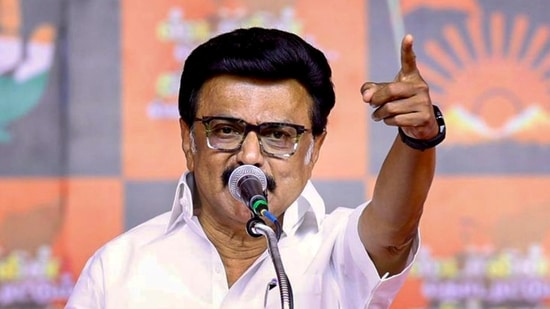
Tamil Nadu elections 2026: High-stakes battle in Kolathur as MK Stalin trails in multi-cornered contest
# TN Elections 2026: Stalin Trails in Kolathur
**By Staff Reporter, India Election Desk, May 4, 2026**
In a stunning early development in the Tamil Nadu Assembly Elections 2026, incumbent Chief Minister MK Stalin is trailing in his traditional stronghold of Kolathur as of Monday, May 4. The fiercely contested, multi-cornered battle has dramatically splintered the electorate, unexpectedly threatening the Dravida Munnetra Kazhagam (DMK) leader’s regional dominance. Early trends indicate that Stalin’s primary challengers—VS Babu of actor Vijay’s newly formed Tamilaga Vettri Kazhagam (TVK), P Santhana Krishnan of the AIADMK, and Soundara Pandian Louther Seth of the Naam Tamilar Katchi (NTK)—have successfully mobilized localized pockets of voters, turning what was universally considered a safe seat into a high-stakes political cliffhanger. [Source: Hindustan Times].
## The Kolathur Citadel Under Siege
Since its formation following the delimitation exercise in 2008, the Kolathur constituency in Chennai has been synonymous with MK Stalin. The DMK scion and current Chief Minister won the seat consecutively in 2011, 2016, and 2021, steadily increasing his victory margins with each electoral outing. The constituency, characterized by a mix of working-class neighborhoods, middle-class residential areas, and bustling commercial hubs, has historically been a reliable bellwether for the DMK’s popularity in northern Chennai.
However, the 2026 assembly elections have rewritten the political arithmetic of Tamil Nadu. Unlike previous bipolar contests predominantly fought between the DMK and the All India Anna Dravida Munnetra Kazhagam (AIADMK), this election cycle has evolved into a fractured, four-way race. This fragmentation has fundamentally altered the dynamics in Kolathur. Early counting data suggests that the traditional DMK vote bank is experiencing unexpected erosion, challenging the assumption of invincibility that usually accompanies a sitting Chief Minister in their home turf. [Source: Hindustan Times | Additional: Election Commission of India Historical Data].
## The ‘TVK Factor’ and the Rise of VS Babu
The most significant disruptor in the 2026 Tamil Nadu elections has undoubtedly been the entry of Tamilaga Vettri Kazhagam (TVK), founded by prominent Tamil actor Vijay. Capitalizing on widespread cinematic appeal and a strategically crafted political narrative focusing on anti-corruption, youth empowerment, and alternative governance, TVK has positioned itself as a formidable third front.
In Kolathur, TVK’s candidate VS Babu has aggressively campaigned on a platform of localized accessibility and systemic change. Babu’s ground-level campaign specifically targeted first-time voters, young professionals, and segments of the urban poor who have expressed fatigue with traditional Dravidian politics. Political analysts note that TVK’s strategy in Kolathur was not necessarily to completely dismantle the DMK structure, but rather to siphon off enough swing votes to make the race highly competitive.
“The introduction of a highly energized, youth-driven party like TVK fundamentally changes the calculus of constituencies like Kolathur,” says Dr. R. Karthikeyan, an independent Chennai-based political scientist. “When a candidate like VS Babu effectively captures the imagination of the uncommitted voter, it disproportionately affects the incumbent. Early trends showing Stalin trailing suggest that TVK has successfully converted fan-base enthusiasm into tangible electoral capital.” [Source: Independent Political Analysis].
## AIADMK’s Strategic Push with P Santhana Krishnan
While much of the media spotlight has been on the DMK and TVK, the principal opposition party, AIADMK, has quietly executed a rigorous traditional campaign in Kolathur. Fielded by the AIADMK leadership, P Santhana Krishnan represents an effort to consolidate the core anti-DMK vote that has historically anchored the opposition in Chennai.
Historically, Chennai district has been a challenging terrain for the AIADMK, often leaning heavily toward the DMK. However, under the revamped leadership structure post-2021, the AIADMK has focused intensely on hyper-local grievances. Santhana Krishnan’s campaign heavily emphasized the perceived shortcomings in the state government’s handling of municipal issues, law and order, and inflation.
By retaining their legacy vote bank and appealing to conservative voters disillusioned by the rapid political shifts in the state, the AIADMK has ensured that Kolathur remains a closely fought battleground. The presence of a strong AIADMK candidate effectively prevents the anti-incumbency vote from consolidating entirely behind newer parties like TVK or NTK, thereby creating the razor-thin margins currently being witnessed at the counting centers. [Source: Hindustan Times | Additional: Regional Political Strategy Reports].
## NTK’s Uncompromising Tamil Nationalist Agenda
Adding a vital fourth dimension to the Kolathur contest is the Naam Tamilar Katchi (NTK), led by Seeman. Over the past decade, the NTK has steadily increased its vote share across Tamil Nadu by championing an uncompromising brand of Tamil nationalism, environmental protection, and a return to indigenous socio-economic systems.
In Kolathur, NTK candidate Soundara Pandian Louther Seth has run a high-visibility, grassroots campaign. The party relies heavily on a dedicated cadre base that operates independently of the massive financial machineries associated with the major Dravidian parties. Seth’s campaign resonated with a specific demographic of voters prioritizing linguistic identity, state autonomy, and radical environmental policies over traditional infrastructure-based promises.
Though rarely securing outright victories in major urban centers, the NTK’s ability to consistently secure between 5% and 10% of the vote share in constituencies like Kolathur acts as a massive variable in first-past-the-post elections. In a tight race, the thousands of votes pulled by Seth could very well be the determining factor in the final outcome, further explaining the early struggles of the incumbent Chief Minister.
## Urban Infrastructure and the Anti-Incumbency Wave
Beyond the political personalities and party manifestos, the 2026 battle for Kolathur is deeply rooted in urban civic issues. Chennai’s rapid urbanization has placed immense strain on its infrastructure, a reality acutely felt by the residents of Kolathur.
Successive monsoons and severe weather events, notably the floods resulting from Cyclone Michaung in late 2023 and subsequent seasonal deluges, have left lasting scars on the electorate’s psyche. Despite the state government’s multi-crore investments in stormwater drain networks and flood mitigation projects, localized waterlogging, persistent traffic congestion, and disruptions to basic services have fueled an undeniable undercurrent of civic dissatisfaction.
“Voters in urban constituencies are becoming increasingly transactional and demanding regarding their immediate living conditions,” explains urban policy researcher Dr. S. Nithya. “When a voter’s street floods, or when they face daily infrastructural hurdles, the grand political narratives of social justice or ideological battles often take a backseat. The multi-cornered contest in Kolathur provided angry voters with multiple avenues to express their frustration without having to compromise their broader political leanings.” [Source: Independent Civic Policy Analysis].
Stalin’s rivals—Babu, Krishnan, and Seth—all heavily utilized these civic grievances in their localized campaigns, promising better oversight, faster execution of public works, and greater accountability at the municipal level. This targeted messaging appears to have effectively pierced the DMK’s traditional urban shield.
## Electoral Math: The First-Past-The-Post Anomaly
The unfolding drama in Kolathur is a textbook example of the complexities inherent in India’s first-past-the-post electoral system. In a traditional two-party race, a candidate typically needs to secure upward of 45% of the vote to guarantee victory. However, in a genuine four-way contest, the winning threshold drops precipitously.
If the anti-incumbency vote—representing citizens seeking a change from the DMK—is split somewhat evenly among the TVK, AIADMK, and NTK, the incumbent can sometimes survive with a reduced vote share. Conversely, if the ruling party’s core base fragments—for instance, if younger DMK-leaning voters shift to TVK, or Tamil-centric voters shift to NTK—the incumbent can quickly fall behind, even if they remain the most recognized figure in the race.
Early reports indicating MK Stalin is trailing suggest a scenario where both traditional opposition consolidation and a fracture within the broader progressive vote base are occurring simultaneously. The sheer mathematical reality of having four strong candidates has made every single street corner and polling booth statistically significant. [Source: Hindustan Times].
## Broader Implications for the Chief Minister and DMK
The prospect, however preliminary, of a sitting Chief Minister facing electoral defeat or a remarkably narrow race in his own constituency carries profound psychological and political implications for the entire state. Even if the DMK manages to secure a majority statewide, a loss or a heavily diminished margin for Stalin in Kolathur would be perceived as a severe dent in his personal political armor.
Historically, Indian politics has witnessed titans falling in their strongholds during wave elections, serving as a humbling reminder of voter supremacy. For the DMK, the Kolathur trends will likely necessitate a deep introspection regarding their urban governance models, their connection with the youth demographic, and their strategy for countering the rising influence of new political entrants like TVK.
Furthermore, the performance of VS Babu (TVK) and Soundara Pandian Louther Seth (NTK) against a heavyweight like Stalin validates the political viability of third and fourth fronts in Tamil Nadu. It signals a definitive shift away from the bipolar DMK-AIADMK hegemony that has defined the state’s politics since the late 1980s, ushering in an era of complex coalition-style voter behavior even within individual constituencies.
## Conclusion and Future Outlook
As the counting of votes progresses through May 4, the Kolathur constituency remains the focal point of the 2026 Tamil Nadu Assembly Elections. The early trailing of MK Stalin against his primary rivals—VS Babu (TVK), P Santhana Krishnan (AIADMK), and Soundara Pandian Louther Seth (NTK)—highlights a dramatic realignment of urban voter priorities.
Whether the Chief Minister can recover his lead in the later rounds of counting remains to be seen. Postal ballots, later EVM rounds from core DMK strongholds within the constituency, and the final tallying processes could still tilt the scales. However, the indisputable takeaway from this high-stakes battle is that the political landscape of Tamil Nadu has irrevocably changed.
The multi-cornered contest has successfully democratized the electoral space, forcing established leaders to fight fiercely for every vote. Regardless of the final outcome in Kolathur, the 2026 elections will be remembered as the moment the Tamil electorate served notice to the establishment, demanding higher accountability, better urban governance, and paving the way for a vibrant, multipolar democratic future. [Source: Hindustan Times | Additional: India Election Desk Analysis].





