
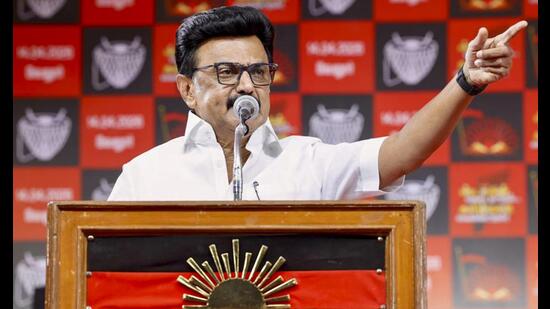
TN CM Stalin calls for statewide protest over delimitation, alleges bias against South| India News
# TN CM Stalin Protests Delimitation Bias
By Rajesh Iyer, Political Correspondent, The National Brief
April 15, 2026
Tamil Nadu Chief Minister M.K. Stalin has called for massive, statewide protests against the impending electoral delimitation process, framing the Union government’s population-based reapportionment of parliamentary seats as a direct assault on the political autonomy of South India. On Wednesday, April 15, 2026, Stalin accused the ruling Bharatiya Janata Party (BJP) of “betraying” southern states, describing the potential reduction of the region’s parliamentary representation as a “great danger” to Tamil Nadu. The protests highlight a deepening constitutional crisis: Southern states face severe political disenfranchisement as a direct penalty for successfully implementing decades of federally mandated family planning and population control policies.
## The Core of the Conflict: A Demographic Penalty?
The spark for this explosive political confrontation stems from the looming expiration of the constitutional freeze on delimitation. Delimitation—the process of redrawing boundaries of Lok Sabha (lower house of Parliament) and State Assembly constituencies based on the latest census—has been frozen since 1976. The freeze was explicitly designed to ensure that states actively participating in national family planning campaigns would not be punished with reduced political representation [Source: Hindustan Times | Additional: Article 82 of the Indian Constitution].
With the freeze slated to end following the publication of the first census conducted after 2026, the demographic reality of India is coming home to roost. Over the past five decades, Southern states like Tamil Nadu, Kerala, Karnataka, and Andhra Pradesh have stabilized their populations, achieving replacement-level fertility rates. Conversely, Northern states, notably Uttar Pradesh and Bihar, have experienced exponential population growth.
Chief Minister Stalin’s fiery rhetoric on Wednesday underscored this disparity. **”Describing the move as a ‘great danger’ to Tamil Nadu, Stalin accused the BJP of ‘betraying’ southern states in the name of delimitation,”** an official statement noted [Source: Hindustan Times]. The Dravida Munnetra Kazhagam (DMK) leader has consistently argued that shifting the balance of parliamentary power strictly based on current population metrics punishes progressive governance. If seats are reallocated purely on population, states like Uttar Pradesh could see their Lok Sabha seats surge well past 120, while Tamil Nadu’s representation could stagnate or even proportionally shrink from its current 39 seats.
## Historical Context: The 1976 and 2001 Freezes
To understand the magnitude of Stalin’s grievance, one must look at the constitutional history of India’s electoral boundaries. During the Emergency in 1976, the 42nd Amendment suspended the delimitation of constituencies until after the 2001 Census. The explicit goal was to give state governments the breathing room to implement aggressive family planning measures without the fear of losing their clout in New Delhi.
When 2001 arrived, the demographic disparities between the North and South had only widened. Recognizing the potential for a severe federal rupture, the Atal Bihari Vajpayee-led National Democratic Alliance (NDA) government passed the 84th Constitutional Amendment. This extended the freeze for another 25 years, moving the deadline to the first census published after the year 2026.
Today, that deadline has arrived. Southern leaders argue that the original promise of the freeze—that no state would lose political power for curbing its population—is being abandoned by the current Union government.
## The Threat to Cooperative Federalism
The delimitation debate is not merely about headcounts; it is intrinsically linked to the economic and federal structure of India. The Southern states contribute disproportionately to the nation’s Gross Domestic Product (GDP) and direct tax revenues. Tamil Nadu, for instance, is one of the most industrialized states in the country and a massive contributor to the central exchequer.
The grievance is twofold: South Indian leaders already contend that they are shortchanged by the Finance Commission, receiving significantly less in central tax devolutions than they contribute, with the surplus effectively subsidizing poorer Northern states. If economic subsidization is now coupled with political marginalization, the foundations of India’s cooperative federalism could crack.
**Dr. S. R. Narayan**, a senior political scientist at the Centre for Policy Research, notes the gravity of the situation. *”What Stalin is articulating is a deeply existential anxiety for the South,”* Dr. Narayan explains. *”For decades, the social contract in India has been that progressive states pull the economic weight while maintaining their political voice. If delimitation strips them of their voice in Parliament, the Union government risks alienating its economic engines. It transforms a demographic shift into a democratic crisis.”*
## Mobilizing the Masses: Stalin’s Protest Strategy
In response to the Union government’s quiet preparations for the delimitation exercise, Stalin has opted for a strategy of maximal public resistance. The upcoming statewide protests are designed to galvanize not just DMK cadres, but the broader Tamil populace, tapping into long-standing Dravidian sentiments regarding linguistic pride and regional autonomy.
The protests are expected to encompass major rallies in Chennai, Madurai, Coimbatore, and Tiruchirappalli. The DMK has also reached out to civil society organizations, trade unions, and student bodies to participate in a coordinated show of defiance. Furthermore, Stalin is attempting to forge a united Southern front, communicating with the Chief Ministers of Kerala, Karnataka, and Telangana to build a multi-state coalition against the delimitation methodology.
By taking the issue to the streets, Stalin is preemptively raising the political cost for the BJP. The strategy is clear: make the geopolitical ramifications of a purely population-based delimitation so toxic that the Union government is forced to seek a constitutional compromise.
## The Union Government’s Stance: “One Person, One Vote”
While the South cries foul, the Union government and proponents of the delimitation exercise rely on a fundamental principle of democratic representation: one person, one vote.
From the perspective of the populous Northern states, the current freeze is a severe democratic distortion. An elected Member of Parliament (MP) in Uttar Pradesh or Rajasthan currently represents significantly more constituents than an MP in Tamil Nadu or Kerala. This imbalance arguably violates the core democratic mandate of equal representation. How can the value of a voter in the North be mathematically worth less than a voter in the South?
The ruling BJP has repeatedly emphasized that delimitation is a constitutional mandate, not a partisan weapon. The construction of the new Sansad Bhavan (Parliament House) in New Delhi, which features an expanded Lok Sabha chamber capable of seating 888 members, was an explicit architectural acknowledgment that the size of Parliament must increase to accurately reflect India’s 1.4 billion-strong population.
However, Stalin and his allies view this expansion not as a solution, but as a trap. Even if the total number of seats is increased so that Tamil Nadu does not *lose* its current 39 seats in absolute terms, its *proportionate* share of the Lok Sabha will drastically shrink as Northern states gain dozens of new seats. In parliamentary democracies, proportion is power.
## Key Proposals to Resolve the Deadlock
Constitutional experts and policymakers have floated several potential compromises to navigate this constitutional minefield and avert a North-South political fracture. The primary alternatives include:
* **The Federal Parity Model:** Restructuring the Rajya Sabha (Upper House) to mirror the United States Senate, where every state, regardless of population, receives an equal number of seats. This would allow the Lok Sabha to be strictly population-based while protecting state equity in the Upper House.
* **The Financial Compensation Model:** Allowing political representation to shift northwards but constitutionally binding the Finance Commission to weight economic contribution and demographic management far higher when distributing tax revenues, heavily favoring the South.
* **Another Constitutional Freeze:** Passing a new constitutional amendment to freeze the ratio of Lok Sabha seats between states for another 25 years until 2051, allowing Northern states more time to stabilize their populations.
* **Capping State Gains:** Implementing a formula where the total Lok Sabha is expanded, but a ceiling is placed on the maximum percentage of seats any single state can hold, preventing demographic behemoths from dominating the legislature.
**Aparna Deshmukh**, a leading constitutional lawyer, observes that the current framework leaves little room for easy answers. *”Article 82 is uncompromising in its current form. Without a new constitutional amendment, a population-based reapportionment is legally inevitable. The protests led by M.K. Stalin are essentially a demand for a new political covenant between the Union and the States. The legal mechanisms exist to compromise, but the political will remains to be seen.”*
## Conclusion: A Defining Battle for Indian Federalism
Chief Minister Stalin’s call for a statewide protest on April 15 marks the opening salvo in what is destined to be the defining political and constitutional battle of late 2026. By labeling the delimitation process a “great danger” and a “betrayal,” the DMK has drawn a firm line in the sand, rejecting the premise that Tamil Nadu should sacrifice its political voice as the cost of its demographic and socio-economic success.
The coming months will test the resilience of India’s federal structure. The Union government faces the monumental task of balancing the democratic imperative of equal representation against the vital necessity of regional equity. If a consensus cannot be reached, the delimitation exercise threatens to cleave the nation along a deep North-South fault line, with profound implications for the future of the Indian republic. As protests mobilize across Tamil Nadu, the eyes of the nation remain firmly fixed on New Delhi, waiting to see how the world’s largest democracy navigates its most complex demographic challenge to date.





