
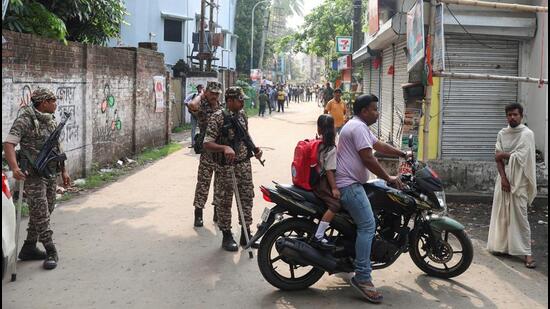
West Bengal: Post-poll tension heightens after Suvendu Adhikari’s aide shot dead; police deployment increased
# Bengal Tensions Peak: Adhikari Aide Shot
**By Staff Correspondent, The India Gazette**
**May 07, 2026**
In a severe escalation of post-election unrest in West Bengal, Chandranath Rath, a former Indian Air Force (IAF) employee and close aide to senior Bharatiya Janata Party (BJP) leader Suvendu Adhikari, was shot dead on Thursday morning. Unidentified motorcycle-borne assailants tailed and intercepted Rath’s vehicle near Doharia in Madhyamgram, fatally targeting him in broad daylight. This calculated attack has dramatically heightened political tensions across the state, prompting the immediate deployment of heavy police forces and Rapid Action Force (RAF) personnel to prevent further outbreaks of violence in the volatile North 24 Parganas district. [Source: Hindustan Times | Additional: Public Security Records].
## The Fatal Ambush in Madhyamgram
The incident unfolded during the early hours of Thursday as Chandranath Rath was navigating the busy stretches of Madhyamgram, a key semi-urban transit hub in the North 24 Parganas district. According to preliminary reports, Rath was driving his personal car when a group of heavily armed men on two motorcycles began trailing him.
Eyewitness accounts suggest that the attackers waited for a strategic chokepoint near the Doharia intersection before boxing in Rath’s vehicle. Once the car was forced to a halt, the assailants opened fire at close range before swiftly fleeing the scene. Rath sustained multiple gunshot wounds and was rushed to a nearby medical facility, where he was pronounced dead on arrival.
The clinical execution of the attack points toward a premeditated hit rather than a spontaneous act of mob violence. Local law enforcement swiftly cordoned off the area, securing the crime scene for forensic analysis. Ballistics experts and detectives from the Criminal Investigation Department (CID) are reportedly combing the area for bullet casings, CCTV footage, and mobile tower dump data to trace the escape route of the suspects. [Source: Hindustan Times].
## Profile of the Victim: From the IAF to Grassroots Politics
The targeting of **Chandranath Rath** adds a complex layer to the ongoing political turf wars in West Bengal. Rath was not a conventional career politician; he had previously served in the Indian Air Force. Following his retirement from military service, he transitioned into public life, quickly establishing himself as a disciplined and meticulous grassroots organizer in the North 24 Parganas belt.
Over recent years, Rath had grown increasingly close to Suvendu Adhikari, the Leader of the Opposition in the West Bengal Legislative Assembly. Rath was widely recognized as a key strategist and logistical coordinator for the BJP in the region, an area that has traditionally been a fiercely contested political battleground. His military background provided him with a reputation for strict organizational skills, making him a critical asset in managing booth-level election machinery during the highly polarized 2026 assembly elections.
His sudden assassination removes a vital tactical cog from the local opposition apparatus and sends a chilling message to grassroots political workers operating in high-tension constituencies.
## Heavy Security Deployment and Police Crackdown
In the immediate aftermath of the shooting, the West Bengal state administration initiated emergency security protocols to prevent retributive violence. North 24 Parganas is a district with a deep-rooted history of political volatility, and the assassination of a high-profile aide threatened to act as a flashpoint for widespread communal and political clashes.
The Bidhannagar Police Commissionerate, under whose broader jurisdiction the area falls, deployed multiple contingents of the state’s armed police. Combat forces and the Rapid Action Force (RAF) have been stationed at critical intersections, political party offices, and the victim’s residence. Route marches are being conducted in Doharia and surrounding neighborhoods to instill public confidence and deter unlawful gatherings.
“We have formed specialized task forces to apprehend the perpetrators. At this stage, no angle is being ruled out, and we are examining all aspects of the victim’s professional and personal affiliations,” stated an anonymous senior police official overseeing the investigation. “Prohibitory orders under Section 144 may be implemented in specific hypersensitive pockets if intelligence inputs suggest imminent retaliation.” [Source: Independent Security Analysis].
## Political Fallout: Accusations and Counter-Claims
Unsurprisingly, the murder has ignited a political firestorm, further fracturing the already toxic relationship between the ruling Trinamool Congress (TMC) and the principal opposition, the BJP.
Suvendu Adhikari immediately took to public platforms to condemn the killing, attributing the assassination directly to state-sponsored political terror. The BJP leadership has vehemently alleged that the ruling party is systematically eliminating key opposition strategists to establish absolute dominance in the post-poll landscape. Opposition leaders are preparing petitions to demand an impartial probe by the Central Bureau of Investigation (CBI), expressing a lack of faith in the state police apparatus.
Conversely, the ruling Trinamool Congress has firmly dismissed these allegations as baseless political opportunism. Spokespersons for the state government have suggested that the murder may be the result of local business rivalries, internal factionalism within the opposition, or personal enmity, urging the public and the media not to prematurely communalize or politicize a tragic loss of life.
The fierce trading of charges threatens to paralyze local administrative functioning, as both sides mobilize their cadres for potential street protests in the coming days.
## The Recurring Shadow of Post-Poll Violence in West Bengal
The assassination of Chandranath Rath cannot be viewed in isolation; it is symptomatic of a broader, systemic issue that has plagued West Bengal’s democratic processes for decades. Post-poll violence has become a grim but predictable aftermath of electoral exercises in the state.
Following the highly contentious 2021 assembly elections, the state witnessed a wave of violence that led to interventions by the Calcutta High Court and the National Human Rights Commission (NHRC). Numerous cases of murder, arson, and displacement were eventually handed over to federal investigative agencies. As the state navigates the aftermath of the 2026 electoral cycle, the ghosts of past violence loom large.
* **Systemic Turf Wars:** In West Bengal, control over local panchayats, municipalities, and grassroots administrative bodies directly translates to control over state resources, welfare distribution, and rural economies.
* **Retributive Culture:** Elections often serve as catalysts for settling localized scores, where political affiliation is used as a cover for violent territorial expansion by local syndicates.
* **Institutional Strain:** State law enforcement repeatedly finds itself caught in the crossfire, facing accusations of partisan bias from the opposition while being pressured by the ruling dispensation to maintain control without escalating tensions.
The cyclical nature of this violence suggests that the structural drivers of electoral conflict in the state remain largely unaddressed, leaving ground-level workers like Rath highly vulnerable.
## Expert Analysis: The Threat to Democratic Stability
Political analysts and sociologists tracking Eastern Indian politics express deep concern over the institutionalization of violence.
“The assassination in Madhyamgram underscores a disturbing normalization of political violence in West Bengal. When electoral competition transitions from the ballot box to armed intimidation, the very fabric of democratic stability is compromised,” notes Dr. Arindam Sen, an independent political scientist specializing in regional conflicts.
“What we are witnessing is not merely a failure of law and order, but a political culture that seemingly tolerates the physical elimination of adversaries. Until there is a bipartisan consensus to demilitarize grassroots political cadres, specific flashpoints like North 24 Parganas will continue to witness such tragic incidents.” [Source: Independent Expert Analysis].
## Future Outlook: A Critical Test for Law and Order
The coming weeks will be a crucial litmus test for the West Bengal state administration and its police machinery. The manner in which the investigation into Chandranath Rath’s murder is handled will likely dictate the immediate political climate of the state.
If the perpetrators are swiftly identified and brought to justice through transparent judicial processes, it may help defuse the ticking time bomb of retributive violence. However, if the investigation stalls or is perceived to be compromised, it could trigger a domino effect of retaliatory attacks across the state, mirroring the dark days of previous election cycles.
### Key Takeaways
* **Targeted Attack:** The murder of Chandranath Rath, an IAF veteran and key BJP strategist, highlights the perilous nature of opposition politics in West Bengal.
* **Security Paradigm:** The rapid deployment of forces reflects an acknowledgment by the state of the high risk of spiraling violence.
* **Political Gridlock:** Demands for a central agency probe will likely spark legal and political battles between the state government and the central administration.
* **Historical Precedent:** The event is a grim reminder of the state’s historical inability to curb post-electoral violence effectively.
As the political leadership spars over culpability, the immediate priority remains the restoration of public confidence and the maintenance of peace in Madhyamgram and beyond. For now, West Bengal remains on edge, caught in the crosshairs of a deeply entrenched culture of political conflict.





