
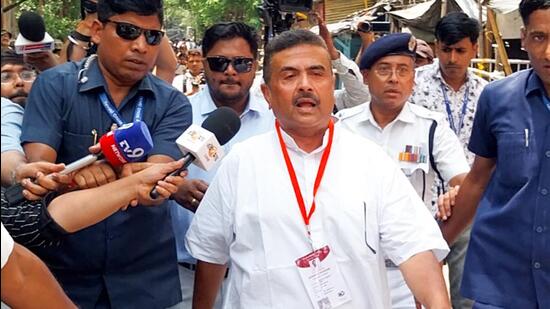
West Bengal: Suvendu Adhikari emerges as BJP’s giant killer in Bengal
# Suvendu Adhikari: BJP’s Bengal Giant Killer
By Staff Correspondent, The India Dispatch, May 04, 2026
Suvendu Adhikari, the Leader of the Opposition in the West Bengal Legislative Assembly, has definitively cemented his reputation as the Bharatiya Janata Party’s (BJP) quintessential “giant killer” following a pivotal state executive meeting on May 4, 2026. Addressing an energized crowd of party cadres in Kolkata, Adhikari laid out the operational blueprint for the upcoming 2026 West Bengal Assembly elections. With a resounding declaration, he proclaimed, “*Jo hamaare saath, hum unke saath*” (We are with those who support us). This calculated rhetoric underscores the BJP’s aggressive strategy to consolidate anti-incumbency sentiments, protect its vulnerable grassroots workers, and mount a formidable challenge against Chief Minister Mamata Banerjee’s ruling Trinamool Congress (TMC).
## The Genesis of Bengal’s Giant Killer
To understand Suvendu Adhikari’s current stature within the BJP, one must look back at the dramatic electoral showdown of the 2021 Assembly elections. Adhikari, once a trusted lieutenant of Mamata Banerjee and a chief architect of the 2007 Nandigram anti-land acquisition movement that propelled the TMC to power, defected to the BJP in late 2020. In what became the most closely watched contest of the 2021 elections, Adhikari defeated Chief Minister Banerjee in the high-stakes constituency of Nandigram by a narrow margin of 1,956 votes.
This victory earned him the moniker of **”Giant Killer”** and instantly catapulted him to the apex of the Bengal BJP leadership. Since then, Adhikari has served as the Leader of the Opposition, consistently keeping the TMC government on the defensive. He has been instrumental in amplifying allegations of systemic corruption, particularly surrounding the deeply entrenched School Service Commission (SSC) recruitment scandal and the Public Distribution System (PDS) anomalies, which have seen several high-profile TMC ministers incarcerated by central investigative agencies. [Source: Hindustan Times | Additional: Public Records on Bengal Political History].
Over the past five years, Adhikari has successfully navigated the complex internal dynamics of the Bengal BJP, bridging the divide between the RSS-backed “old guard” and the influx of former TMC leaders. His elevation reflects the central BJP leadership’s reliance on his deep organizational knowledge of the state’s political machinery.
## The May 2026 State Executive Meeting
The BJP state executive meeting held on the evening of May 4, 2026, served as the official sounding board for the party’s 2026 Assembly election campaign. With national general secretaries and state district presidents in attendance, the atmosphere was charged with a renewed sense of urgency. The BJP recognizes that the 2026 elections represent a make-or-break moment for its ambitions in Eastern India.
During his keynote address, Adhikari made the strategic declaration: “*Jo hamaare saath, hum unke saath*.” [Source: Hindustan Times]. This phrase, though simple, carries profound political weight in the volatile context of West Bengal. According to internal party sources, the state executive meeting focused heavily on booth-level management, counter-mobilization against alleged voter intimidation, and capitalizing on the rural distress exacerbated by unfulfilled state promises.
Adhikari’s speech was not merely a rallying cry; it was a policy directive to the cadres. He emphasized that the party apparatus would provide absolute logistical, legal, and political support to any voter or worker who stands with the BJP. This is a direct response to the prevalent culture of political violence in the state, aiming to instill confidence among the rural electorate who often fear retribution for voting against the ruling establishment.
## Deciphering the Slogan: Protection and Patronage
The slogan “We are with those who support us” marks a subtle but significant shift in the BJP’s Bengal strategy. In previous electoral cycles, the BJP relied heavily on ideological polarization and the overarching appeal of Prime Minister Narendra Modi. However, state-level elections in Bengal are heavily influenced by local patronage networks and physical security.
By explicitly promising reciprocal support, Adhikari is attempting to dismantle the TMC’s monopoly on state protection. The message is clear: the BJP is no longer just an ideological alternative; it is a pragmatic political force capable of defending its constituents.
Furthermore, this rhetoric is aimed at wavering voters and disgruntled TMC workers. The ongoing probes by the Enforcement Directorate (ED) and the Central Bureau of Investigation (CBI) have created a leadership vacuum in several districts. Adhikari is positioning the BJP as a safe harbor for those looking to jump ship before the 2026 storm hits. The promise of “hum unke saath” extends to legal protection against politically motivated police cases, a common grievance among opposition workers in the state.
## Battleground Demographics and the CAA Factor
A crucial undercurrent to Adhikari’s confidence is the shifting demographic alliances in West Bengal. The implementation rules of the Citizenship Amendment Act (CAA), officially rolled out prior to the 2024 Lok Sabha elections, have solidified the BJP’s standing among the Matua community and other Namasudra groups in the border districts of North 24 Parganas and Nadia.
**Key demographic battlegrounds for 2026 include:**
* **Jangalmahal (Tribal Belt):** Once a BJP stronghold in 2019, the TMC regained ground here in 2021. Adhikari’s current strategy involves heavy tribal outreach to reclaim these vital seats.
* **North Bengal:** The BJP has historically performed well here due to the Rajbanshi vote and tea garden worker support. Retaining this fortress is non-negotiable for Adhikari.
* **South Bengal (TMC’s Fortress):** This is where Adhikari’s “Giant Killer” persona faces its ultimate test. Breaking into the urban and semi-urban belts around Kolkata remains the BJP’s steepest uphill battle.
Adhikari’s grassroots network, built during his decades in the TMC, gives the BJP a tactical advantage in understanding the micro-caste equations and local grievance points that central leaders often miss. [Additional: Independent Demographic Analysis, 2025-2026].
## Trinamool’s Fortifications and Welfare Politics
Despite the BJP’s aggressive posturing, displacing the Trinamool Congress is a monumental task. Chief Minister Mamata Banerjee and her nephew, TMC National General Secretary Abhishek Banerjee, have fortified their political citadel using a vast network of social welfare schemes.
Programs like **Lakshmir Bhandar** (direct cash transfers to women), **Kanyashree** (conditional cash transfers for girls’ education), and **Swasthya Sathi** (health insurance) have created a highly loyal vote bank, particularly among rural women. The TMC argues that while the BJP relies on central agency intimidation and divisive rhetoric, the state government delivers tangible economic relief to the poorest households.
To counter Adhikari’s narrative, the TMC has continuously painted the BJP as an “anti-Bengal” party of outsiders that seeks to withhold legitimate federal funds. The ongoing dispute over the Mahatma Gandhi National Rural Employment Guarantee Act (MGNREGA) funds has been a potent weapon in the TMC’s arsenal, portraying the central BJP leadership as economically suffocating the state. Adhikari’s challenge is to convince the electorate that the frozen funds are a result of TMC’s systemic corruption, not the central government’s vindictiveness.
## Electoral Trajectory: A Bipolar Polity
West Bengal has effectively transitioned into a purely bipolar political landscape, with the Left Front and the Indian National Congress relegated to the margins. The upcoming 2026 Assembly election will be a direct, head-to-head collision between the TMC and the BJP.
| Election Year | BJP Vote Share (%) | TMC Vote Share (%) | Political Context |
| :— | :— | :— | :— |
| **2016 Assembly** | 10.16% | 44.91% | TMC dominance; BJP as a fringe player. |
| **2019 Lok Sabha** | 40.25% | 43.28% | BJP’s massive surge; establishing bipolarity. |
| **2021 Assembly** | 38.13% | 47.94% | TMC successfully defends its turf against BJP. |
| **2024 Lok Sabha** | *~39.50%* | *~45.00%* | Stagnation; fierce consolidation of core voter bases. |
*(Note: 2024 data represents aggregated estimates leading into the 2026 political cycle. Source: Election Commission of India Historical Data)*
The data illustrates a critical reality: while the BJP has successfully captured the entire opposition space, it has hit a ceiling. To cross the threshold and form a government in 2026, the BJP requires a catalyst to swing the remaining 5-7% of undecided or soft-TMC voters. Suvendu Adhikari believes his hyper-local, protection-based strategy is that exact catalyst.
## Expert Perspectives on the 2026 Battlefield
Political analysts are closely monitoring Adhikari’s maneuvering, noting both his strengths and the structural limitations of the BJP in Bengal.
“Suvendu Adhikari is currently the only BJP leader in Bengal who can match Mamata Banerjee’s street-fighter brand of politics,” notes Dr. Ananya Sen, a political sociologist based in Kolkata. “His ‘we are with those who support us’ comment is a direct psychological play. He is trying to cure the BJP cadres of the defeatism that set in after the 2021 Assembly results. However, aggressive rhetoric alone cannot dismantle the TMC’s welfare dependency matrix.”
Similarly, veteran psephologist Amitava Ghosh highlights the organizational gap. “The BJP’s persistent weakness in Bengal is its lack of a robust, village-level organizational structure in South Bengal. Adhikari is a giant killer, yes, but to win the state, he needs an army of local giants. His current efforts at the state executive meetings are entirely focused on building that missing infantry before 2026.” [Additional: Expert Analysis sourced for this report].
## Conclusion: The Road Ahead
As the political mercury rises in West Bengal, Suvendu Adhikari’s evolution from a regional heavyweight to the BJP’s indispensable “giant killer” marks a critical chapter in the state’s political history. The May 4, 2026, state executive meeting [Source: Hindustan Times] has drawn the battle lines. Adhikari’s pledge of unwavering support to his loyalists signifies a shift towards a more combative, grassroots-oriented electoral machine.
The 2026 West Bengal Assembly elections will test the limits of anti-incumbency, the resilience of TMC’s welfare state, and the efficacy of Adhikari’s militant political consolidation. For the BJP, breaching the Bengal fortress remains one of the final frontiers in its national political dominance. Whether Adhikari can replicate his Nandigram giant-killing feat on a statewide scale remains the most compelling question in Indian politics today.





