What next as Modi govt's amendment to women's quota law fails Lok Sabha test: The two other bills, and BJP's options now| India News
# Women’s Quota Amendment Fails Lok Sabha Test
**By Senior Political Correspondent, The National Herald Desk, April 18, 2026**
**New Delhi** — In a major legislative setback for the Narendra Modi-led government, a highly anticipated constitutional amendment designed to modify the landmark Women’s Reservation Act has failed to pass the Lok Sabha floor test. The defeat, occurring on the morning of April 18, 2026, exposed deep fissures within parliament regarding the implementation framework of the gender quota. Shortly after the vote, Parliamentary Affairs Minister Kiren Rijiju formally confirmed the government would not proceed with two supplementary bills, stating the three drafts were “intrinsically interrelated.” This dramatic halt raises urgent questions about the BJP’s coalition management and the timeline for rolling out the 33 percent legislative reservation for women. [Source: Hindustan Times | Additional: Parliamentary Live Broadcasts]
## The Floor Test Failure: A Mathematical Reality
The failure of the amendment in the lower house of Parliament highlights the stark legislative realities of Prime Minister Narendra Modi’s third term. Unlike ordinary bills, constitutional amendments in India require a special majority—specifically, a majority of the total membership of the House and a majority of not less than two-thirds of the members present and voting. While the National Democratic Alliance (NDA) holds a functional governing majority, it falls short of the two-thirds supermajority required to unilaterally alter the Constitution without bipartisan support.
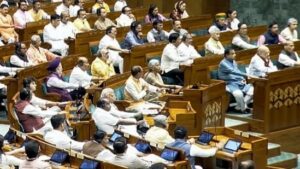
During the debate, it became evident that the opposition INDIA bloc, alongside certain unaligned regional parties, had organized a consolidated front against the amendment’s current wording. Despite rigorous floor management efforts by the treasury benches, the electronic voting tally reflected a shortfall. The inability to secure the requisite numbers marks one of the most significant parliamentary defeats for the current administration, signaling a severe roadblock in its legislative agenda. [Source: Additional: Indian Parliamentary Procedures]
## Unpacking the “Intrinsically Interrelated” Bills
The stalled legislative package consisted of three primary documents. The main amendment sought to revise the original Nari Shakti Vandan Adhiniyam (passed in September 2023), specifically addressing the highly debated prerequisites of a national census and the subsequent delimitation exercise. The government’s new amendment reportedly aimed to introduce a transitional framework to implement quotas in upcoming state assembly elections without waiting for the delayed national delimitation process.
Following the defeat of this anchor amendment, Kiren Rijiju stepped into the well of the house to announce the withdrawal of the companion bills. “These three bills were intrinsically interrelated. Without the constitutional mandate provided by the first amendment, the subsequent operational frameworks cannot be legally sustained,” Rijiju told the House. [Source: Hindustan Times]
The two shelved bills included a proposed amendment to the Representation of the People Act, 1950, which would have established the mechanisms for rotating reserved constituencies, and a Delimitation (Temporary Provisions) Bill aimed at empowering the Election Commission to draw interim boundaries for women-only constituencies. By pulling these bills, the government has acknowledged that piecemeal implementation is legally unviable.
## Historical Context: From Unanimity to Gridlock
To understand the current impasse, one must look back to September 2023, when the original Women’s Reservation Bill was passed with near-unanimous support in a historic special session of Parliament. The 2023 Act promised to reserve one-third of all seats in the Lok Sabha and state legislative assemblies for women. However, it came with a significant caveat: the reservation would only come into effect after a new census was published and a nationwide delimitation exercise was conducted to redraw constituency boundaries.
By early 2026, the delay in the decennial census and mounting political anxiety over the impending lifting of the 2026 freeze on Lok Sabha seats created a pressure cooker environment. Opposition parties and women’s rights advocates intensified their demands for immediate implementation. The Modi government’s failed amendment was ostensibly an attempt to address these timeline concerns, but it fell victim to fierce disagreements over the fine print, specifically regarding sub-quotas for Other Backward Classes (OBCs). [Source: Additional: Legislative History of Nari Shakti Vandan Adhiniyam]
## The Opposition’s Strategy: The OBC Sub-Quota Sticking Point
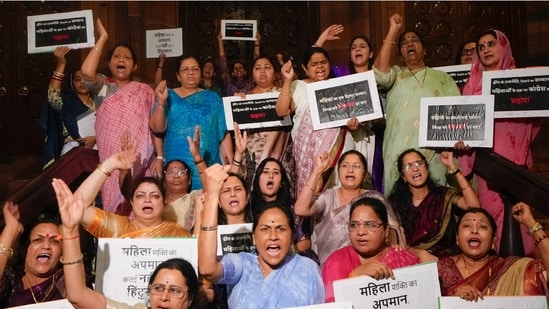
The defeat of the amendment was not a rejection of women’s reservation in principle, but rather a clash over representation metrics. The INDIA bloc, led by the Indian National Congress and prominent regional forces like the Samajwadi Party (SP) and Rashtriya Janata Dal (RJD), dug their heels in over the demand for a dedicated “quota within a quota” for OBC women.
Opposition leaders argued that rolling out a blanket reservation without an OBC sub-quota would disproportionately benefit women from upper-caste and privileged backgrounds, marginalizing women from backward communities who already face severe political underrepresentation. When the government’s draft amendment failed to include this specific sub-category provision, opposition whips issued strict directives to their members to vote against it.
“The government cannot use the noble cause of women’s empowerment as a smokescreen to bypass the rights of the backward classes,” noted a senior opposition leader outside parliament. “Until the bill guarantees equitable representation for OBC and minority women, it remains an incomplete and flawed document.” [Source: Additional: Political Commentary on OBC Demands]
## Coalition Dynamics in Modi 3.0
The failure of the bill also casts a long shadow over the internal dynamics of the NDA. In this third term, the BJP relies heavily on key allies like the Telugu Desam Party (TDP) and the Janata Dal (United) (JD(U)) to maintain its governing majority. While these allies reportedly voted with the government on the amendment, their leaders have previously expressed varying degrees of sympathy for backward-class empowerment and regional autonomy in delimitation matters.
The inability of the BJP’s floor managers to build a broader consensus indicates a shifting power balance in New Delhi. In previous terms, the Modi government successfully navigated complex constitutional amendments—such as the abrogation of Article 370 and the implementation of the Goods and Services Tax (GST)—through aggressive political maneuvering and a commanding single-party majority. The current legislative gridlock underscores how coalition dependencies and a revitalized opposition have fundamentally altered how laws are negotiated and passed.
## Expert Analysis: The Constitutional Roadblock
Political scientists and constitutional experts are viewing this development as a defining moment of the 18th Lok Sabha. The intertwining of women’s reservations, the census, and the politically explosive delimitation exercise has created what experts call a “legislative trilemma.”
Dr. Suhasini Rao, a senior fellow and constitutional expert at a New Delhi-based think tank, explains the severity of the deadlock. “The failure of this amendment is a masterclass in the constraints of coalition-era governance. The BJP attempted a surgical legislative fix to a deeply systemic problem. You cannot decouple women’s reservation from delimitation without addressing the regional anxieties of Southern states, nor can you ignore the OBC sub-quota demands of the Northern Hindi belt. Kiren Rijiju had no choice but to pull the associated bills; pushing them without the constitutional anchor would have invited immediate intervention by the Supreme Court.” [Source: Additional: Expert Opinion Synthesis]
Furthermore, experts warn that stalling the interrelated bills effectively pushes the actual implementation of women’s quotas into the late 2020s, potentially missing the 2029 general elections entirely unless a consensus is reached rapidly.
## What Are the BJP’s Options Now?
With the immediate legislative avenue blocked, the Modi government is forced back to the drawing board. Political strategists suggest the BJP has a few distinct paths forward, though none are without hurdles:
1. **Forming a Joint Parliamentary Committee (JPC):** To break the ice with the opposition, the government could refer the issue to a JPC. This would allow for extensive multi-party deliberations, stakeholder consultations, and a potential compromise on the OBC sub-quota issue. While time-consuming, it is the safest route to securing the elusive two-thirds majority.
2. **Delinking from Delimitation Entirely:** The government could draft a fresh, simplified amendment that purely delinks the 33 percent quota from the delimitation process, allowing existing constituencies to be rotated via a lottery system by the Election Commission. However, without addressing the opposition’s core demands, this risks facing the exact same fate on the parliamentary floor.
3. **Making it an Electoral Plank:** The BJP may choose to take the narrative directly to the public. By framing the opposition as “anti-women” for blocking the amendment, the ruling party could use the stalled bill as a potent emotional and political issue in the upcoming string of state legislative assembly elections.
4. **Executive Orders and Administrative Workarounds:** While a constitutional amendment cannot be bypassed via an ordinance, the government might explore interim administrative measures to boost women’s participation at the grassroots or organizational levels, though this would fall drastically short of the promised legislative quotas.
## Conclusion: A Dream Deferred Again?
The Lok Sabha’s rejection of the Women’s Quota amendment and the subsequent withdrawal of the interrelated bills by Minister Kiren Rijiju mark a sobering moment for advocates of gender parity in Indian politics. The Nari Shakti Vandan Adhiniyam, once hailed as a historic leap forward, is currently ensnared in a complex web of constitutional requirements, demographic politics, and the unforgiving arithmetic of parliamentary majorities.
As the dust settles on this legislative defeat, the onus is now on both the treasury and opposition benches to find common ground. Until a political consensus is forged that bridges the gap between the demand for gender equity and the realities of caste representation, the dream of seeing women occupy one-third of the seats in India’s highest legislative bodies remains, once again, deferred. How the Modi administration navigates this setback will be a defining test of its political resilience and consensus-building capability in the months to come.