
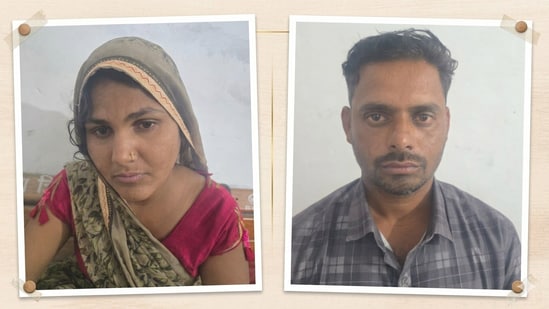
Woman, boyfriend kill husband in MP; body chopped, burnt and buried in a pit using a JCB| India News
# MP Murder: Wife & Lover Held for JCB Burial
By Senior Crime Desk, National Reporting Network | April 14, 2026
In a chilling demonstration of premeditated violence, law enforcement authorities in Madhya Pradesh have apprehended a woman and her paramour for the brutal murder of her husband. On Tuesday, April 14, 2026, officials confirmed that the accused not only executed the killing but also orchestrated a massive, logistically complex cover-up. To conceal the crime, the duo dismembered the victim’s body and attempted to incinerate the remains. When their efforts to reduce the evidence to ash failed, they engaged a JCB earthmover to excavate a deep trench, burying the partially burnt remains in a desperate bid to evade justice. Both suspects are currently in police custody as a comprehensive forensic investigation gets underway. [Source: Hindustan Times].
## The Anatomy of the Crime: Discovery and Initial Investigation
The unraveling of this macabre plot began when relatives of the deceased filed a missing person report after failing to establish contact with him for several days. In cases of sudden disappearances, law enforcement protocol dictates a thorough examination of the immediate family dynamics. The victim’s wife was subsequently brought in for questioning.
Initial interrogations revealed glaring inconsistencies in the woman’s account of her husband’s whereabouts. Investigators noted discrepancies in her timeline, which prompted them to look deeper into her background. Utilizing modern digital forensics, police analyzed Call Detail Records (CDRs) and digital footprints, which rapidly exposed an illicit, ongoing relationship between the wife and another man.
Upon bringing the boyfriend into custody for parallel questioning, the fabricated alibis began to collapse. Faced with mounting digital evidence—including location data that placed both suspects at the victim’s residence during the estimated time of death—the pair broke down and confessed to the murder. They subsequently led the police to the remote location where the victim’s remains had been interred. [Source: Hindustan Times | Additional: Standard Criminal Investigation Procedures].
## A Calculated Cover-Up: Fire and Heavy Machinery
What sets this case apart from typical domestic homicides is the extraordinary length to which the perpetrators went to conceal their tracks. The act of dismembering a human body requires significant physical effort and psychological detachment, pointing to a highly premeditated and cold-blooded operation.
According to police statements, the initial plan was to completely incinerate the victim’s dismembered remains. The accused gathered combustible materials and set the body parts on fire in a secluded area. However, they drastically underestimated the thermal energy required to cremate a human body. Standard crematoriums operate at temperatures between 1400°F to 1800°F for up to two hours to reduce a body to bone fragments. Improvised outdoor fires rarely reach these sustained temperatures, resulting in the failure of the accused’s primary cover-up strategy.
Panicking at the sight of the unburnt evidence, the duo escalated their efforts by hiring a JCB earthmover. The use of heavy industrial machinery introduces a chilling logistical element to the crime. It allowed them to dig a pit far deeper than what could be achieved with hand tools, ensuring the remains were buried deep enough to avoid detection by scavengers or casual passersby. Authorities are currently investigating the operator of the JCB to determine whether they were a complicit accomplice or an unwitting participant hired under false pretenses. [Source: Hindustan Times | Additional: Forensic Science Literature].
## The Role of Advanced Forensics in Securing Convictions
In cases where a body has been subjected to severe trauma, dismemberment, and fire, establishing a watertight legal case relies heavily on the expertise of forensic pathologists and anthropologists. The exhumation of the remains in Madhya Pradesh was conducted under strict scientific protocols, likely involving a magistrate’s oversight and continuous video recording to maintain the chain of custody.
**Key Forensic Challenges and Solutions in this Case:**
* **DNA Profiling:** Because the fire failed to destroy the remains completely, forensic teams will extract marrow from the long bones or utilize dental pulp to obtain a DNA profile. This will be cross-referenced with blood samples from the victim’s biological relatives to establish undeniable legal identity.
* **Forensic Odontology:** Even in high-heat environments, human teeth often survive. Dental records can provide rapid and conclusive identification.
* **Determining the Cause of Death:** Pathologists will examine the remains for perimortem (at or near the time of death) injuries, such as blunt force trauma, ligature marks, or deep tissue wounds, to establish exactly how the husband was murdered before the post-mortem mutilation occurred.
* **Tool Mark Analysis:** Forensic anthropologists will analyze the cut marks on the bones. The striations left behind can often be matched to the specific type of blade or saw used, further linking the recovered murder weapon to the suspects.
Dr. R.K. Varma, a senior independent forensic criminologist, explains the futility of such cover-ups in the modern era: *”Perpetrators often believe that by destroying the physical integrity of a body, they are destroying the crime itself. However, bone matrix, digital footprints, and chemical accelerant residues almost always survive improvised destruction attempts. Forensic science treats the destroyed remains not as an absence of evidence, but as a different, highly complex puzzle that we are fully equipped to solve.”*
## Extramarital Affairs and the Psychology of Extreme Violence
The underlying motive in this horrific crime—an illicit romantic relationship—is a tragically common catalyst for domestic homicides globally. However, the escalation from infidelity to calculated, gruesome murder requires a specific psychological dynamic.
Criminologists often point to the phenomenon of “shared criminal culpability” when two lovers conspire to kill a spouse. The relationship creates an echo chamber where moral boundaries are eroded, and the victim is dehumanized, viewed merely as an obstacle to the perpetrators’ shared future.
**Statistical Context:**
Data from the National Crime Records Bureau (NCRB) has historically shown that “illicit relationships” consistently rank among the top motives for murder in India, alongside property disputes and personal vendettas. What has shifted in recent years is the methodology of the cover-up. Inspired by true crime media or infamous historical cases, perpetrators increasingly attempt complex disposal methods—such as the grim trend of dismemberment—under the false assumption that without a body, there can be no conviction.
## Legal Implications Under the Bharatiya Nyaya Sanhita (BNS)
As this crime occurred in 2026, the suspects will be prosecuted under India’s modernized criminal code, the Bharatiya Nyaya Sanhita (BNS), which fully replaced the colonial-era Indian Penal Code (IPC) in 2024. The prosecution’s case will be built on several severe charges, reflecting both the act of murder and the elaborate subsequent cover-up.
| Offense | BNS Section | Description | Potential Penalty |
| :— | :— | :— | :— |
| **Murder** | Section 103 | Whoever commits murder shall be punished. | Death or imprisonment for life, and fine. |
| **Destruction of Evidence** | Section 238 | Causing disappearance of evidence of offense, or giving false information to screen offender. | Imprisonment up to 7 years and fine (when the capital offense is murder). |
| **Criminal Conspiracy** | Section 61 | When two or more persons agree to do an illegal act. | Punished in the same manner as if they abetted the offense. |
The state’s prosecution will rely on a framework of circumstantial evidence. Even if there are no eyewitnesses to the actual moment of the murder, the “Last Seen Together” theory, combined with the recovery of the body based on the suspects’ confessions (admissible as discovery evidence), forms an incredibly robust legal argument against the accused. [Source: Public Legal Records / BNS Framework].
## Societal Impact and Community Shock
The revelation of this crime has sent shockwaves through the local community in Madhya Pradesh. Crimes of this nature disrupt the social fabric, generating anxiety about the hidden realities of domestic life behind closed doors. The betrayal is twofold: the profound betrayal of marital trust, and the subsequent desecration of the human body.
Community leaders and local authorities often face the daunting task of restoring a sense of normalcy after such gruesome events come to light. The immediate area where the body was excavated has been cordoned off as a crime scene, serving as a grim, temporary monument to the tragedy that unfolded.
## Conclusion: Key Takeaways and Future Outlook
The arrest of the wife and her boyfriend in Madhya Pradesh stands as a stark testament to the effectiveness of modern police investigation techniques. While the perpetrators went to extraordinary, horrifying lengths—utilizing dismemberment, fire, and a JCB earthmover—to bury their sins, the combination of digital forensics, behavioral analysis, and relentless police work brought the truth to the surface.
**Key Takeaways from the Case:**
1. **Digital Footprints are Indelible:** The suspects were ultimately undone by their mobile phone data and Call Detail Records, proving that modern crimes are often solved in the digital realm before the physical evidence is even recovered.
2. **Forensic Resilience:** Improvised attempts to destroy human remains rarely succeed against modern pathological science. DNA and bone matrix analysis provide undeniable proof of identity and cause of death.
3. **The Futility of Extreme Cover-ups:** Escalating a crime from murder to the desecration of a corpse only guarantees harsher judicial penalties and rarely results in the “perfect crime” perpetrators envision.
As the case moves from the investigative phase to the judicial system, all eyes will be on the prosecution to deliver a watertight case. The state will seek to ensure that justice is served for the victim, reinforcing the societal mandate that no matter how deep evidence is buried—even with heavy machinery—the long arm of the law will ultimately unearth it.





