
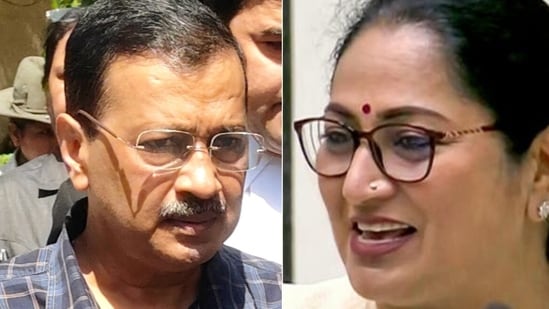
‘Aajkal vakeel…’: CM Rekha Gupta jabs Kejriwal as he personally argues for HC judge Sharma to drop off his case| India News
# Gupta Slams Kejriwal Over HC Judge Recusal Plea
**By Political Desk, National News Standard**
**April 14, 2026**
On Tuesday, April 14, 2026, Delhi’s political landscape witnessed a renewed and bitter clash as Chief Minister Rekha Gupta launched a scathing public critique of Aam Aadmi Party (AAP) leader Arvind Kejriwal. The controversy ignited after Kejriwal made a rare personal appearance before the Delhi High Court, directly arguing for Justice Sharma to recuse himself from an ongoing high-stakes case. Mocking the former Chief Minister’s courtroom maneuver, Gupta quipped, “Aajkal vakeel…” (Lawyers these days…), accusing Kejriwal of flagrantly disregarding democratic norms. She further alleged that he habitually attacks and questions the integrity of any government agency, constitutional body, or judicial officer that delivers findings contrary to his political interests. [Source: Hindustan Times]
## The Courtroom Drama: A Plea for Recusal
The unprecedented scenes unfolded early Tuesday morning at the Delhi High Court. Bypassing his usual battery of high-profile legal counsels, Arvind Kejriwal took the floor to personally argue an application seeking the recusal of Justice Sharma from hearing his ongoing legal matter.
While the specific details of the underlying case involve complex administrative and procedural disputes dating back to his tenure, Kejriwal’s central argument hinged on alleged “conflict of interest” and the apprehension of bias. Arguing his own case—a right granted to every Indian citizen under the Advocates Act, though rarely exercised by prominent political figures—Kejriwal submitted that justice must not only be done but must be seen to be done.
However, arguing for a judge’s recusal is highly sensitive in Indian jurisprudence. The Supreme Court has repeatedly cautioned that recusal requests cannot be used as a tool for “bench hunting” or intimidating the judiciary. By stepping into the courtroom to personally deliver these arguments, Kejriwal ensured maximum visibility, instantly turning a procedural legal hearing into a major national headline.
## “Aajkal Vakeel…”: CM Rekha Gupta’s Scathing Counter
The political reaction was swift and unforgiving. Chief Minister Rekha Gupta, seizing on the unusual visual of her political rival acting as his own advocate, convened a press briefing where she dismantled Kejriwal’s legal strategy.
“Aajkal vakeel toh unke liye chote pad gaye hain,” (These days, lawyers have fallen short for him), Gupta remarked sarcastically. Her statement sought to frame Kejriwal’s personal intervention not as an act of legal necessity, but as theatrical grandstanding designed to bully the judiciary. [Source: Hindustan Times]
Gupta did not stop at mocking his self-representation. She escalated the rhetoric by accusing the AAP leader of actively eroding the foundational pillars of Indian democracy. “Whenever a government agency, an investigative body, or a court of law speaks the truth or acts against him based on evidence, his immediate reaction is to question their credibility,” Gupta stated. “This is not the behavior of a democrat. It is the behavior of someone who believes he is above the law and the constitution.”
## A Historical Pattern of Confrontation
Chief Minister Gupta’s accusations tap into a long-documented history of friction between Arvind Kejriwal and various state and central institutions. Over the last decade, the AAP leadership has frequently found itself at loggerheads with investigative agencies, electoral bodies, and the administrative machinery.
To understand the context of Gupta’s allegations, it is essential to look at the historical timeline of AAP’s institutional clashes:
* **The Enforcement Directorate (ED) & CBI:** Throughout the prolonged investigations into the now-scrapped Delhi Excise Policy, Kejriwal and his cabinet continually accused central probe agencies of acting as political hitmen for the ruling dispensation.
* **The Lieutenant Governor’s Office:** The structural power struggle in Delhi has seen AAP routinely accuse the L-G of overstepping constitutional boundaries and obstructing the elected government’s mandates.
* **The Election Commission of India (ECI):** In past electoral cycles, AAP leaders have publicly questioned the impartiality of the ECI, particularly concerning EVM security and election scheduling.
Political analysts note that while questioning the neutrality of central agencies is a common tactic among opposition parties in India, Kejriwal has uniquely weaponized this narrative, branding his party as the sole victim of a massive, multi-agency conspiracy. Gupta’s Tuesday press conference was a direct attempt to use his courtroom behavior as proof of this institutional hostility. [Source: Historical public records; Independent Political Analysis]
## Legal Perspectives: The Optics and Legality of Self-Representation
From a legal standpoint, Kejriwal’s decision to personally argue his recusal application is a double-edged sword. While it is entirely constitutional, it places the presiding judge in a highly uncomfortable position.
Dr. Meenakshi Iyer, a Senior Advocate and Constitutional Law Expert based in New Delhi, explains the nuances of this strategy:
> *”Legally, any individual can represent themselves. However, when a high-profile politician personally asks a judge to step down, it is rarely just about jurisprudence. It is an exercise in political optics. It sends a message to his voter base that he is a lone warrior fighting a systemic bias. On the flip side, courts take a very dim view of recusal pleas that lack concrete, undeniable proof of bias. If Justice Sharma declines to recuse, the politician can immediately claim the court is prejudiced, thus reinforcing his political narrative.”*
Legal experts point out that the threshold for judicial recusal in India is exceptionally high. The test is whether a “reasonable man” would apprehend bias, not merely whether the litigant feels uncomfortable. By personally asserting this apprehension, Kejriwal risks drawing severe judicial censure if the court deems his plea frivolous or intimidating.
## Political Ramifications in the 2026 Landscape
The political implications of this clash extend far beyond the walls of the Delhi High Court. In the political ecosystem of April 2026, the power dynamics in the National Capital Region remain fiercely contested. CM Rekha Gupta’s administration is keen to consolidate its governance narrative by portraying the opposition—specifically AAP—as chaotic, institutionally disruptive, and perpetually embroiled in legal controversies.
By highlighting Kejriwal’s confrontation with Justice Sharma, the current administration is making a calculated play for moderate voters who value institutional stability. Gupta’s use of the phrase “disregarding democracy” is a deliberate rhetorical inversion, taking AAP’s traditional defense—that democracy is under threat from central agencies—and turning it back against them.
Conversely, AAP strategists likely view Kejriwal’s courtroom appearance as a masterstroke in grassroots messaging. In an era where opposition leaders often struggle to command daily news cycles without access to state machinery, creating a “David vs. Goliath” moment inside a courtroom ensures that Kejriwal remains the focal point of the political discourse.
## The Broader Impact on the Judiciary
Perhaps the most concerning aspect of Tuesday’s events is the increasing politicization of the judiciary. The crossfire between CM Gupta and Arvind Kejriwal over Justice Sharma’s bench highlights a growing trend where legal proceedings involving politicians are litigated as heavily in the court of public opinion as they are in the actual courtroom.
When politicians personally allege judicial bias, and their opponents publicly weaponize those allegations to score political points, the judiciary risks suffering collateral damage. The independence of the judiciary relies heavily on public trust. Continuous debates over whether judges are compromised or biased—fueled by viral soundbites and press conferences—can slowly erode the sanctity of the legal process.
Legal commentators have repeatedly urged political leaders to respect the boundaries of legal protocol. While the right to seek recusal is fundamental, utilizing it as a stepping stone for political theatrics challenges the decorum of the courts.
## Key Takeaways and Future Outlook
As the dust settles on Tuesday’s dramatic developments, several key implications emerge for the immediate future:
1. **Judicial Decision:** All eyes are now on Justice Sharma. The judge must formally rule on Kejriwal’s recusal application. A denial will likely prompt Kejriwal’s legal team to appeal to the Supreme Court, prolonging the procedural deadlock.
2. **Escalated Rhetoric:** CM Rekha Gupta has firmly established her stance, signaling that her administration will not passively watch AAP control the media narrative. We can expect more aggressive press briefings from the ruling party whenever Kejriwal attempts to bypass traditional protocols.
3. **AAP’s Next Move:** Arvind Kejriwal’s strategy of personal intervention is risky but calculated. It remains to be seen whether this approach will galvanize his voter base or alienate moderate supporters who prefer procedural propriety over courtroom dramatics.
In the high-stakes theater of Delhi politics, the lines between legal defense and political campaigning have never been more blurred. As CM Gupta and Arvind Kejriwal continue to trade barbs, the true test will be whether the democratic institutions they both claim to defend can withstand the intense, partisan crossfire.





