
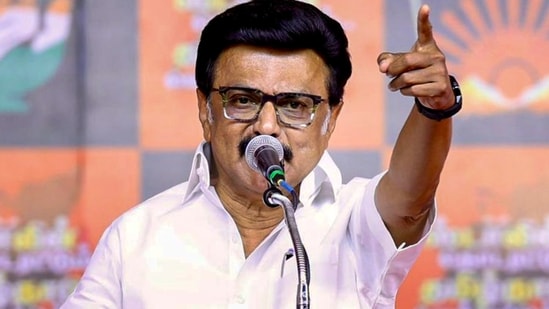
Women’s quota being used as political tool before delimitation, says Tamil Nadu CM Stalin| India News
# Stalin Demands Instant Women’s Quota Rollout
**By Special Policy Correspondent, National News Desk** | April 11, 2026
Tamil Nadu Chief Minister M.K. Stalin strongly criticized the Union Government on Saturday, accusing it of leveraging the historic women’s reservation legislation as a pre-electoral tactic. Speaking against the delay in actualizing the 33% quota for women in legislative bodies, the DMK president demanded its immediate enforcement, firmly rejecting the constitutional mandate that links the quota’s implementation to the upcoming national delimitation exercise. This escalating political standoff highlights deepening anxieties among Southern Indian states over representation, demographics, and the impending redraw of India’s electoral map as the nation looks toward the 2029 general elections.
## Understanding the Legislative Bottleneck
The foundation of the current political clash lies in the **Nari Shakti Vandan Adhiniyam** (106th Constitutional Amendment Act), which was passed with near-unanimous parliamentary support in late 2023. The landmark legislation guarantees the reservation of 33% of seats for women in the Lok Sabha (Lower House of Parliament) and state legislative assemblies.
However, the Act contains a crucial structural caveat: it can only come into effect after a national census is conducted and a subsequent delimitation exercise is finalized. Delimitation is the process of fixing limits or boundaries of territorial constituencies in a country to reflect population changes.
[Source: Hindustan Times | Additional: 106th Constitutional Amendment Act text]
“The women’s reservation must be implemented immediately without showing delimitation as a reason,” Stalin asserted on April 11, underscoring a growing sentiment among opposition leaders that administrative prerequisites are being utilized to stall tangible gender parity in politics.
Because the decennial 2021 Census was delayed due to the COVID-19 pandemic and subsequent logistical constraints, the exact timeline for both the census and the delimitation commission remains a point of intense speculation. Consequently, the actual seating of women under the reserved quota is practically pushed to the 2029 Lok Sabha elections, at the earliest.
## The Demographic Dilemma of Southern States
To understand Chief Minister Stalin’s staunch opposition to the delimitation prerequisite, one must examine the demographic trajectory of India over the past fifty years.
In 1976, during the Emergency, the Union Government enacted the 42nd Amendment, freezing the number of Lok Sabha seats and their state-wise allocation based on the 1971 Census. The primary objective was to ensure that states successfully implementing family planning and population control policies were not politically penalized in parliament. This freeze was later extended to 2026 by the 84th Amendment in 2001.
Southern states, particularly **Tamil Nadu, Kerala, Karnataka, and Andhra Pradesh**, have achieved replacement-level fertility rates (a Total Fertility Rate of 2.1 or lower) much faster than their Northern counterparts such as Uttar Pradesh and Bihar.
If delimitation proceeds strictly based on current population figures post-2026, Southern states face a severe proportional reduction in their parliamentary clout.
**Table: Projected Demographic Shifts (1971 vs. 2020s Estimates)**
| State / Region | Population Share (1971) | Estimated Population Share (Current) | Potential Impact on Seats |
| :— | :— | :— | :— |
| **Tamil Nadu** | 7.5% | ~5.5% | Decrease in proportionate weight |
| **Kerala** | 3.9% | ~2.5% | Decrease in proportionate weight |
| **Uttar Pradesh** | 16.1% | ~17.5% | Increase in proportionate weight |
| **Bihar** | 10.3% | ~11.2% | Increase in proportionate weight |
*(Note: Figures are approximate demographic estimations leading up to the delayed Census).*
By linking the deeply popular women’s reservation to the highly controversial delimitation process, Southern leaders argue that they are being forced into a trap: accept a potentially devastating loss of regional political power, or be viewed as opponents of women’s empowerment.
## Allegations of Political Weaponization
Stalin’s remarks frame the procedural delay as a deliberate political strategy. By passing the reservation bill but delaying its implementation, critics argue that the ruling establishment has successfully harvested the electoral goodwill of female voters without having to immediately disrupt current political equations or displace existing male incumbents.
“Linking a fundamental democratic right—equal representation for women—to an administrative boundary redrawing exercise is a classic delay tactic,” notes Dr. V. S. Ramachandran, a prominent political analyst based in Chennai. “Chief Minister Stalin is articulating a widespread regional fear. The Union Government is essentially holding the women’s quota hostage to push through a delimitation process that many Southern states view as an existential threat to their federal leverage.”
[Source: Original RSS | Additional: Independent Political Analysis, April 2026]
The DMK’s stance resonates heavily across the opposition alliance, which demands that the 33% quota be applied to the existing 543 Lok Sabha seats using current electoral boundaries. They argue that parliament possesses the legislative authority to temporarily delink the two processes through a subsequent amendment, ensuring women take their rightful place in assemblies immediately.
## The Union Government’s Constitutional Defense
Conversely, the Union Government has consistently maintained that the linkage between the women’s quota and delimitation is neither a political tool nor a delay tactic, but a stringent constitutional and logistical necessity.
Proponents of the current timeline argue that arbitrarily applying a 33% reservation on existing boundaries without empirical population data would lead to chaotic and legally vulnerable outcomes.
**Key arguments supporting the delimitation prerequisite include:**
* **Constitutional Integrity:** Article 82 of the Indian Constitution mandates that the allocation of seats be adjusted after every census. Since the freeze expires in 2026, conducting a census and delimitation is legally binding before the next major restructuring of parliamentary seats.
* **Rotational Fairness:** The Act proposes that reserved seats for women will be rotated after each subsequent delimitation exercise. Establishing a fresh, accurate baseline is critical for fair rotation.
* **SC/ST Sub-quotas:** The women’s reservation includes a sub-quota for Scheduled Castes (SC) and Scheduled Tribes (ST). The demographic distribution of these communities has shifted significantly since 1971. A new census is vital to accurately identify which constituencies should be reserved based on updated SC/ST population densities.
Legal experts point out that implementing the quota haphazardly could result in endless litigation. “If the government were to implement the quota on 50-year-old constituency boundaries, it would face immediate judicial scrutiny,” explains constitutional lawyer Smriti Bhardwaj. “The courts require empirical data to justify the reservation of specific territorial constituencies. Delimitation provides that protective legal framework.”
## Evaluating Legal Precedents and the Path to 2029
The clash over the Nari Shakti Vandan Adhiniyam is not the first time India has wrestled with the complexities of reservations and territorial boundaries. When the Panchayati Raj institutions (local self-government) implemented a 33% women’s quota following the 73rd and 74th Amendments in 1993, it was done effectively at the state level. However, applying this to the federal parliamentary structure involves much higher stakes regarding regional autonomy.
As 2026 progresses, the demand to delink the quota from delimitation is becoming a major electoral plank for regional parties. To address the Southern states’ fears, several policy compromises have been proposed by constitutional scholars in recent months:
1. **Freezing Inter-State Apportionment:** Allowing delimitation to redraw constituencies *within* a state (intra-state) to account for urbanization, while permanently freezing the total number of seats allocated to each state. This would protect Southern representation while allowing the women’s quota to proceed based on updated internal boundaries.
2. **Expanding the Parliament:** Increasing the overall number of seats in the Lok Sabha so that Northern states gain seats proportional to their population, but Southern states do not lose their current absolute number of MPs. However, this does not solve the proportional dilution of the South’s voting power.
3. **Bifurcating the Legislation:** Passing an interim order to reserve 33% of the current 543 seats for the 2029 elections as a transitional measure, followed by full delimitation in the 2030s.
## Conclusion: A Balancing Act for Indian Democracy
Chief Minister M.K. Stalin’s forceful demand highlights a critical juncture in India’s democratic evolution. The implementation of the women’s reservation is widely celebrated as a much-needed step toward gender equity in the world’s largest democracy. Yet, the mechanism of its execution has inadvertently triggered deeply entrenched fault lines concerning federalism, demographic disparity, and regional representation.
As April 2026 unfolds, the Union Government faces mounting pressure to address the anxieties of the Southern states. Whether the administration will stick to its constitutional defense of tying the quota to the impending delimitation, or bow to regional pressures by seeking a legislative workaround, remains to be seen.
What is unequivocally clear, however, is that the journey to ensuring that women hold one-third of the power in India’s Parliament is not just a matter of gender justice, but a complex puzzle of constitutional law and federal survival. As political rhetoric sharpens ahead of the next national elections, the debate over the Nari Shakti Vandan Adhiniyam is poised to be a defining narrative of the decade.





