
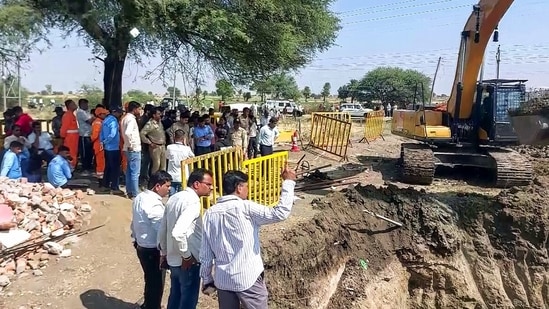
2-year-old pulled out dead from borewell in Madhya Pradesh after 22-hour rescue operation| India News
# MP Borewell Tragedy: Toddler Found Dead
**By Senior Correspondent, National News Desk | April 11, 2026**
In a heartbreaking incident highlighting the persistent dangers of uncovered agricultural infrastructure, two-year-old Bhagirath Dewasi was found dead on Saturday after falling into an abandoned borewell in Madhya Pradesh. Despite a massive 22-hour rescue operation involving national disaster response forces, medical teams, and local authorities, the toddler succumbed within hours of the fall. The tragedy, which concluded on the morning of April 11, 2026, has once again exposed critical lapses in rural safety protocols and the rampant negligence surrounding uncapped borewells across the state. [Source: Hindustan Times].
## The Incident and Immediate Response
The ordeal began on Friday morning when young Bhagirath, playing near agricultural fields where his parents worked as daily wage laborers, accidentally slipped into the narrow, unsealed shaft of an abandoned borewell. The borewell, estimated to be just six to eight inches in diameter, had been left uncovered after failing to yield water—a common but illegal practice in India’s agrarian heartlands.
Panic ensued when the child’s parents noticed his absence and heard muffled cries emanating from the dark shaft. Local police were immediately alerted, triggering a rapid deployment of earth-moving equipment and emergency medical personnel. Within an hour, local administrative officials arrived at the site, quickly escalating the situation to the State Disaster Response Force (SDRF) and the National Disaster Response Force (NDRF).
The primary objective was to sustain the child’s life while executing a highly complex extraction. Emergency teams immediately lowered oxygen pipes into the shaft to prevent asphyxiation in the confined, poorly ventilated space. High-resolution infrared cameras were also dropped into the borewell to ascertain the child’s exact depth and monitor his physical condition. [Source: Hindustan Times | Additional: Public records on NDRF protocols].
## The Grueling 22-Hour Rescue Operation
Rescuing a child from a borewell is an intricate engineering challenge. Because the shafts are too narrow for an adult to enter, rescue teams must employ a parallel digging method. This involves excavating a massive trench parallel to the borewell shaft, reaching the approximate depth of the trapped child, and then carefully tunneling horizontally to intercept the borewell casing.
For 22 hours, heavy machinery, including multiple excavators and bulldozers, worked relentlessly through the day and night. However, the operation was fraught with environmental hazards. The local soil composition was loose and prone to cave-ins, requiring engineers to proceed with extreme caution to prevent the vibrations of the heavy machinery from collapsing the dirt onto the trapped toddler.
“The fundamental challenge in borewell rescues is the race against time coupled with the absolute necessity for precision,” explains Prakash Sharma, a former commandant with the National Disaster Response Force and a disaster management consultant. “If you dig too fast, the vibrations can cause the child to slip further down the shaft, or cause a catastrophic soil collapse. If you dig too slowly, the physiological toll of the confined space proves fatal.”
Despite the meticulous and tireless efforts of the rescue personnel, who manually dug the final horizontal tunnel to avoid heavy machine vibrations, the operation ended in tragedy. When teams finally reached Bhagirath on Saturday morning, he was unresponsive.
## Medical Findings: A Race Lost to Time
According to official statements, medical teams on site immediately examined the toddler upon extraction, but he was pronounced dead. Preliminary assessments indicate that Bhagirath Dewasi died within a few hours of falling into the shaft, long before the rescue teams could reach him. [Source: Hindustan Times].
The physiological environment inside a borewell shaft is exceptionally hostile. Dr. Rajiv Menon, an emergency care pediatrician, outlines the severe medical challenges victims face in these scenarios. “Children trapped in these narrow pipes face a multitude of life-threatening conditions almost instantly. The immediate threat is positional asphyxia, where the confined space prevents the chest from expanding, severely limiting breathing. Furthermore, the lack of ambient oxygen deep underground, combined with severe psychological trauma, hypothermia or hyperthermia depending on groundwater presence, drastically reduces the window of survivability.”
The revelation that the child had passed away in the early hours of the ordeal underscores the grim reality of borewell accidents: survival rates are statistically abysmal unless the extraction occurs within the first few hours.
## The Broader Context: India’s Groundwater Crisis
To understand why borewell accidents are so prevalent, one must look at the intersection of agriculture and India’s deepening water crisis. Madhya Pradesh, like many central and western Indian states, relies heavily on groundwater for irrigation. As water tables continually deplete due to over-extraction and erratic monsoon patterns, farmers are forced to drill deeper—often exceeding hundreds of feet—to find viable aquifers.
When a borewell fails to strike water, or when an existing well runs dry, the drilling contractors and landowners frequently abandon the site. Capping the well securely with welded steel plates requires a modest financial investment, one that struggling farmers often bypass to save costs. The result is a landscape dotted with thousands of invisible, lethal traps hidden by overgrown grass or topsoil. [Source: Ministry of Jal Shakti reports, India].
“The abandoned borewell is a direct byproduct of agrarian distress and groundwater depletion,” notes Dr. Anjali Deshmukh, a rural public policy analyst. “When a farmer spends their life savings drilling a dry hole, the last thing on their mind is spending more money to seal it. Without systemic government intervention to subsidize capping or heavily penalize negligence, these dry wells become graves.”
## Legal and Policy Failures
The tragedy of Bhagirath Dewasi is not an isolated incident but a symptom of widespread administrative failure. As far back as 2010, the Supreme Court of India issued strict guidelines to prevent children from falling into abandoned borewells. The directives are clear and legally binding:
* **Prior Notification:** Landowners must inform the local Sarpanch (village head) or agricultural department at least 15 days before drilling a borewell.
* **Signage and Barricades:** Warning signs and barbed wire fencing must be erected around the drilling site.
* **Mandatory Capping:** Any abandoned borewell must be completely filled with clay, sand, boulders, or securely capped with a heavy steel plate.
Despite these unambiguous legal mandates, enforcement on the ground is practically non-existent. Local village councils lack the manpower, resources, and digital infrastructure to track every drilling operation across vast rural districts. Furthermore, unregulated private drilling operators frequently bypass registration to avoid taxes and fees, leaving no paper trail for authorities to monitor. [Source: Supreme Court of India Public Directives].
Following this latest death, local police in Madhya Pradesh have initiated an investigation and are expected to file a First Information Report (FIR) against the landowner and the drilling contractor for negligence leading to death. While such post-incident punitive measures are standard, experts argue they do little to prevent future occurrences.
## Technological Solutions for a Persistent Menace
As public outrage mounts over the recurring loss of young lives, safety advocates are pushing for technological interventions to map and secure open borewells.
1. **Drone Mapping and AI:** Several state governments have initiated pilot projects using unmanned aerial vehicles (UAVs) equipped with thermal and spatial imaging to scan agricultural lands for uncapped shafts. Artificial intelligence can quickly analyze this visual data to identify potential hazards.
2. **IoT Sensors:** Modern drilling protocols could mandate the installation of cheap Internet of Things (IoT) sensors on borewell caps. If a cap is removed or tampered with, an alert could be automatically sent to local panchayat officials.
3. **Digital Registries:** Moving away from paper-based ledgers, a centralized, GPS-enabled digital registry for all drilling equipment and active borewells could allow district magistrates to track compliance in real-time.
## Socio-Economic Impact and Accountability
The demographic most affected by these tragedies continues to be the poorest segment of rural India. The victims are almost exclusively the children of landless laborers, marginalized farmers, and migrant workers who live and toil in the fields. Because these parents lack access to secure childcare facilities, toddlers are often brought to the fields, wandering near dangerous, unregulated infrastructure.
The state government is expected to announce an ex-gratia compensation package for the grieving Dewasi family. However, community leaders and child rights activists stress that financial compensation is a reactive measure that absolves the state of its preventative duties. There is a growing demand for criminal liability to be extended beyond the landowner to include local block development officers who fail to audit their jurisdictions.
## Conclusion and Future Outlook
The death of two-year-old Bhagirath Dewasi following a 22-hour rescue operation is a grim reminder of a systemic failure that continues to plague rural India. While the NDRF and state medical teams showcased immense dedication in their rescue efforts, the reality remains that prevention is the only viable cure for the borewell menace.
Moving forward, the Madhya Pradesh government, alongside central authorities, must bridge the gap between judicial guidelines and ground-level execution. Until strict punitive actions are taken against unregistered drilling contractors, and until comprehensive digital mapping of agricultural infrastructure is undertaken, the rural landscape will remain perilous. True accountability will only be achieved when no more children fall victim to the dark, forgotten shafts of India’s agrarian water crisis.





