
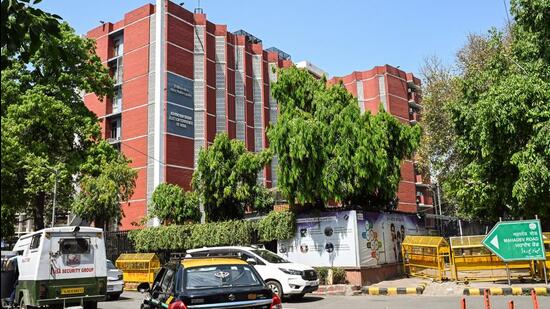
529 candidates who didn’t file accounts barred from voting for 3 years: ECI
# ECI Bans 529 Poll Defaulters for 3 Years
By Senior Correspondent, National News Desk, April 27, 2026
**NEW DELHI** — In a decisive move to enforce campaign finance transparency, the Election Commission of India (ECI) has disqualified 529 candidates from participating in electoral processes, effectively barring them for three years. Announced on Monday, April 27, 2026, this sweeping disciplinary action targets individuals who failed to file their mandatory election expenditure accounts within the legally stipulated timeframe. The disqualifications span candidates who contested in both recent Lok Sabha and state legislative assembly elections across multiple election cycles. By enforcing these stringent measures, the ECI aims to aggressively curb financial opacity, limit the influence of unaccounted funds, and hold political aspirants strictly accountable to India’s statutory election laws. [Source: https://www.hindustantimes.com/india-news/529-candidates-who-didn-t-file-accounts-barred-from-voting-for-3-years-eci-101777284835365.html | Additional: Representation of the People Act, 1951].
## Sweeping Crackdown on Financial Opacity
The latest mandate from the Election Commission of India marks one of the most substantial regulatory crackdowns on campaign finance violations in recent years. According to the official notification, the 529 individuals are now prohibited from contesting elections and, under stringent interpretations of electoral laws related to disqualified persons, barred from casting their votes for a continuous period of three years from the date of the order.
This mass disqualification is not isolated to a single state or a specific tier of government. The penalised candidates come from a geographically diverse pool, having participated in various state assembly elections and the broader parliamentary Lok Sabha elections. The ECI’s action highlights a systemic issue wherein numerous candidates, often after losing an election, neglect their post-election statutory duties, assuming that their electoral defeat absolves them of regulatory compliance.
The ECI has repeatedly emphasised that the obligation to maintain and submit accurate financial records is not contingent upon a candidate’s electoral success. Whether a candidate wins by a landslide or forfeits their deposit, the legal requirement to account for every rupee spent during the campaign remains absolute.
## The Statutory Mandate: Understanding the RP Act
The legal foundation for the ECI’s stringent action is primarily rooted in the **Representation of the People Act, 1951 (RP Act)**. Specifically, Section 78 of the Act mandates that every contesting candidate must lodge a true copy of their election expenses with the District Election Officer (DEO) within 30 days from the date of the declaration of the election results.
When a candidate fails to meet this deadline, or submits an account that is deemed incorrect or fabricated, **Section 10A of the RP Act** is invoked. This section empowers the Election Commission to disqualify the defaulting candidate for a period of three years. The disqualification bars them from being chosen as, and from being, a member of either House of Parliament or the Legislative Assembly or Legislative Council of a State. Furthermore, associated electoral offenses can result in the removal of the individual’s name from the electoral roll, effectively stripping them of their voting rights for the duration of the ban.
The meticulous nature of this requirement means candidates cannot simply submit a generic summary of their spending. The ECI requires a daily register of expenditures, supported by valid receipts, vouchers, and bank statements from a dedicated bank account opened exclusively for election purposes. The failure of these 529 candidates to provide such documentation triggered the automatic review and subsequent disqualification process.
## Demographics of the Defaulters and the “Dummy Candidate” Phenomenon
While the ECI’s list of 529 disqualified individuals is extensive, an analysis of historical electoral data suggests a recurring demographic among such defaulters. The vast majority of those penalised are typically independent candidates or representatives of smaller, unrecognised registered political parties.
Candidates from major national and state-recognised parties rarely feature on these disqualification lists. This is primarily because established political parties possess the institutional infrastructure, legal teams, and chartered accountants required to ensure strict compliance with ECI guidelines. In contrast, independent candidates often lack the financial literacy, resources, or administrative support to maintain rigorous daily expenditure registers.
Furthermore, this crackdown sheds light on the pervasive issue of “dummy candidates” in Indian elections. Political analysts note that major political players often field independent proxies to split opposition votes, circumvent vehicle limits, or bypass campaign expenditure caps. Once the election concludes, these proxy candidates—having served their purpose—routinely vanish from the political radar, entirely ignoring the mandatory requirement to file their expenditure reports. By barring 529 such individuals, the ECI is directly targeting the ecosystem that enables these electoral malpractices.
## Financial Limits and the Compliance Framework
To understand the scale of the compliance required, it is essential to look at the election expenditure limits set by the ECI, which have been periodically revised to reflect inflation and the increasing costs of campaigning.
The current legal maximums that a candidate can spend on their campaign are structured based on the size and population of the constituency:
* **Lok Sabha Elections:** Candidates in larger states can spend up to **₹95 lakh**, while those in smaller states and certain Union Territories have a cap of **₹75 lakh**.
* **State Assembly Elections:** Candidates in larger states have an expenditure limit of **₹40 lakh**, whereas candidates in smaller states are capped at **₹28 lakh**.
These funds cover everything from public rallies, campaign materials, and advertising to the hiring of vehicles and campaign staff. To monitor this, the ECI deploys specialized Expenditure Observers—typically senior officers from the Indian Revenue Service (IRS)—to track candidate spending in real-time. The failure of the 529 disqualified candidates to reconcile their stated expenses with the shadow observation registers maintained by these IRS officers ultimately led to their three-year ban.
## The Broader Campaign Finance Transparency Drive
The disqualification of these 529 candidates is part of a much broader, multi-year initiative by the ECI to cleanse the electoral system of black money. Over the past few election cycles, the Commission has significantly upgraded its technological and administrative capabilities to monitor illicit cash flows, liquor distribution, and freebies intended to bribe voters.
The introduction of digital portals for filing nominations and expenses, alongside citizen-facing applications like **c-VIGIL**—which allows voters to anonymously report Model Code of Conduct (MCC) and expenditure violations—has severely restricted the operational space for financial irregularities.
[Source: Election Commission of India Public Directives | Additional: Independent Electoral Watchdog Reports]. The ECI’s message is unequivocal: political participation in India comes with stringent financial responsibilities, and the shield of anonymity or electoral irrelevance will no longer protect non-compliant candidates from severe punitive action.
## Expert Perspectives on Electoral Reforms
Political scientists and electoral reform advocates have largely welcomed the ECI’s uncompromising stance. Dr. Rajesh Varma, a New Delhi-based constitutional law expert and researcher on political finance, noted the significance of the move.
“The barring of 529 candidates is a necessary administrative shock to the system,” Dr. Varma stated. “For decades, the filing of election returns was treated as a mere bureaucratic formality, frequently ignored by candidates who knew they had no chance of winning. By enforcing Section 10A of the RP Act so robustly, the ECI is dismantling the casual attitude towards campaign finance. However, the true test will be whether the Commission can apply this same level of rigorous scrutiny to the hidden, un-invoiced expenditures of major political heavyweights.”
Similarly, transparency advocates emphasize that while targeting individual candidates is vital, the broader issue of electoral bonds, corporate funding, and party-level expenditures—which are distinct from candidate-level expenditures—requires equal legislative attention to truly level the playing field.
## Recourse and the Path Forward
For the 529 disqualified candidates, the road back to electoral politics is severely restricted, though not entirely closed. Under **Section 11 of the Representation of the People Act, 1951**, the Election Commission retains the discretionary power to remove or reduce the period of disqualification.
Candidates who wish to appeal the decision must submit a formal representation to the ECI, providing a compelling and verifiable justification for their failure to file the accounts. Acceptable justifications have historically been limited to severe, documented medical emergencies, natural disasters, or demonstrable administrative failures on the part of the returning officer. Ignorance of the law or a lack of administrative support are not accepted as valid defenses. Until such an appeal is explicitly granted, the names of these individuals will remain on the centralized list of disqualified persons, preventing them from filing nomination papers or participating in any state or national election until 2029.
## Conclusion
The Election Commission of India’s decision to bar 529 candidates from voting and contesting for three years serves as a powerful testament to its commitment to electoral integrity. As India prepares for a critical series of state assembly elections in late 2026 and 2027, this mass disqualification sends a chilling warning to all prospective political aspirants.
**Key Takeaways:**
* **Zero Tolerance:** The ECI will strictly enforce the 30-day post-election deadline for filing expenditure accounts, regardless of a candidate’s electoral success or failure.
* **Systemic Cleanup:** The action heavily impacts independent proxies and “dummy candidates,” potentially reducing ballot crowding in future elections.
* **Mandatory Compliance:** The ruling reinforces that financial transparency is a non-negotiable prerequisite for democratic participation in India.
Ultimately, the barring of these candidates reinforces the foundational democratic principle that the privilege of seeking public office must be inextricably linked to the highest standards of financial accountability and transparency.





