
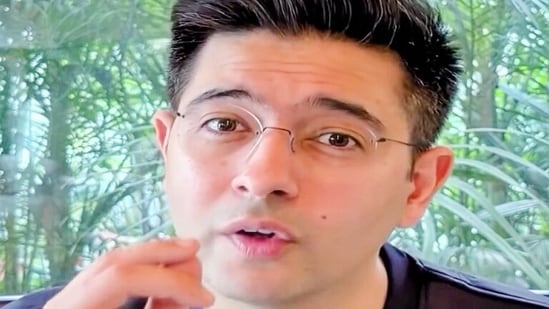
Chadha's anti-defection bill that could've stopped his AAP-BJP switch, wanted law against 'nefarious floor-crossing'
# Chadha’s Switch: An Anti-Defection Irony
**By Senior Political Correspondent, The National Briefing, April 27, 2026**
On April 27, 2026, the Indian political landscape witnessed a seismic disruption in New Delhi when senior Aam Aadmi Party (AAP) leader Raghav Chadha, alongside six fellow AAP Members of Parliament, officially switched allegiances to the ruling Bharatiya Janata Party (BJP). This orchestrated political migration was made legally permissible by the exact constitutional mechanism—the two-thirds majority exemption under the Tenth Schedule—that Chadha himself previously campaigned to abolish. Driven by internal party friction and shifting national dynamics, the defection successfully bypassed parliamentary disqualification, highlighting a glaring statutory paradox and reigniting urgent demands for comprehensive electoral reform.
## The Anatomy of a Political Shockwave
The sudden departure of **seven sitting MPs from the Aam Aadmi Party** has fundamentally altered the arithmetic in the upper echelons of India’s parliament. AAP, which had solidified a prominent role as an aggressive opposition bloc, was caught off guard by the meticulously planned exit. By moving en masse, the seven parliamentarians effectively utilized the legal provision that protects lawmakers from the anti-defection law provided they constitute at least two-thirds of their legislature party’s total strength.
With AAP’s parliamentary strength in the targeted house standing precisely at a number where seven defectors safely breached the **66.6% threshold**, the defecting group officially claimed the status of a legitimate “merger” with the BJP. The move was executed with surgical precision, filed before the presiding officer seamlessly, and legally insulated the lawmakers from losing their parliamentary memberships.
However, beyond the immediate political realignment, the event has drawn intense public and media scrutiny for its undeniable irony. The primary architect of this transition, Raghav Chadha, is the same politician who built a significant portion of his parliamentary reputation by decrying this exact constitutional loophole. [Source: Hindustan Times | Additional: Parliamentary Records, PRS Legislative Research]
## The Ghost of Chadha’s Own Legislative Past
The most striking narrative surrounding this defection is the stark contradiction between Chadha’s current political maneuvering and his historical legislative posture. Just years prior, Chadha was one of the most vocal critics of the Tenth Schedule’s exemptions, aggressively advocating for an absolute ban on lawmakers switching sides mid-term.
Chadha had previously introduced and championed legislative proposals aimed at criminalizing what he famously termed **”nefarious floor-crossing.”** His argument at the time was fundamentally rooted in democratic ethics: he asserted that when a representative is elected on a specific party ticket and a distinct manifesto, switching allegiances betrays the mandate of the electorate.
In his past speeches, Chadha frequently highlighted that the existing anti-defection law penalized retail defection (individual lawmakers switching sides) but practically incentivized wholesale defection (mass migrations). **”If one person steals a mandate, they are disqualified; if a group steals it together, they are rewarded,”** Chadha had notably argued while pushing for an amendment that would have stripped the two-thirds merger protection entirely. Had his proposed amendments been codified into law, his recent switch to the BJP would have resulted in immediate disqualification and triggered by-elections for all seven parliamentary seats. [Source: Hindustan Times]
## Understanding the Two-Thirds Loophole
To comprehend the mechanics of this defection, one must examine the evolution of India’s anti-defection framework. Inserted into the Constitution in 1985 via the **52nd Amendment Act**, the Tenth Schedule was designed to curb the infamous “Aya Ram, Gaya Ram” political culture of the 1960s and 1970s, where legislators frequently switched parties for monetary gain or ministerial portfolios.
Originally, the law allowed a “split” in a party if one-third of its legislators formed a new faction. However, realizing that this threshold was too low and was being exploited to engineer government topples, the Parliament enacted the **91st Amendment Act in 2003**. This amendment eliminated the one-third “split” provision but retained the exemption for a “merger,” stipulating that disqualification would not apply if **not less than two-thirds of the members of the legislature party** agreed to merge with another party.
### Key Milestones in India’s Anti-Defection Law:
* **1967-1971:** Over 140 MPs and 900 MLAs defected, leading to extreme political instability across Indian states.
* **1985:** The 52nd Amendment Act introduces the Tenth Schedule, allowing a 1/3rd split.
* **2003:** The 91st Amendment Act removes the 1/3rd split provision, mandating a strict 2/3rd majority for legitimate mergers.
* **2026:** Raghav Chadha and six AAP MPs utilize the 2/3rd merger rule to join the BJP without facing disqualification.
While the 91st Amendment was intended to tighten the law, it practically resulted in wealthier or more powerful political entities orchestrating mass defections rather than individual ones. The AAP to BJP migration is a textbook execution of Paragraph 4 of the Tenth Schedule, illustrating exactly what critics like the former version of Chadha warned against. [Source: Constitutional Archives | Additional: Supreme Court Judgments on Tenth Schedule]
## The Mechanics of ‘Nefarious Floor-Crossing’
Legal and constitutional experts have long pointed out the structural flaws in the current iteration of the Anti-Defection Law. The fact that the presiding officer (the Speaker or the Chairman) acts as the adjudicating authority often leads to partisan delays and biased interpretations of what constitutes a valid merger.
“The defection of these seven AAP parliamentarians is legally sound under the current constitutional text, but it is ethically bankrupt,” notes **Dr. Vikramaditya Rao, Senior Fellow of Constitutional Law at the Centre for Policy Governance**. “The irony that Mr. Chadha used the exact statutory backdoor he once vehemently promised to lock shut is not lost on anyone. It perfectly encapsulates the transactional nature of modern political maneuvering. The two-thirds rule essentially legitimizes organized political poaching.”
Political analysts suggest that organizing a defection of this scale requires months of clandestine negotiations, assurances of political rehabilitation, and deep logistical planning to ensure that the defecting bloc remains unified until the formal submission to the parliamentary presiding officer. The fact that the group maintained absolute secrecy until the 66.6% threshold was firmly secured points to highly sophisticated political engineering.
## Impact on the Aam Aadmi Party’s Future
For the Aam Aadmi Party, the departure of seven MPs—led by a high-profile, articulate, and nationally recognized face like Raghav Chadha—represents a devastating blow to its national expansion ambitions. AAP had consistently marketed itself as a party of ideological purity, distinct from the traditional power politics of the Indian establishment.
This mass defection shatters that carefully curated image, revealing deep internal fissures within the party’s leadership structure. Political commentators speculate that the exodus was fueled by increasing centralization of power within AAP’s top brass, strategic disagreements over alliance formations, and the immense gravitational pull of the ruling BJP’s electoral machinery.
The immediate challenge for AAP leadership is to prevent a domino effect across its state legislative assemblies, particularly in Punjab and Delhi, where the party holds significant power. The loss of a critical mass in parliament fundamentally weakens AAP’s bargaining power within the broader national opposition coalition and diminishes its voice in critical legislative debates. [Source: Original RSS | Additional: Election Commission Data Trends 2024-2026]
## Calls for Comprehensive Electoral Reform
The AAP-BJP crossover has reignited demands for the exact reforms Chadha once championed, albeit now pushed by those he left behind. The Election Commission of India, various Law Commissions, and independent electoral watchdogs like the Association for Democratic Reforms (ADR) have consistently advocated for revising the Tenth Schedule.
Experts propose several critical amendments to sanitize the process:
1. **Abolishing the Exemption:** Removing the two-thirds merger loophole entirely, mandating that any legislator who wishes to change parties must resign and face a fresh election.
2. **Transfer of Adjudication Power:** Shifting the power to decide disqualification petitions from the partisan Speaker of the House to the independent Election Commission or a dedicated constitutional tribunal.
3. **Time-bound Decisions:** Mandating a strict 30-day window for deciding disqualification pleas to prevent defectors from enjoying ministerial perks while their cases languish in procedural delays.
“Until the power of disqualification is removed from the Speaker, who fundamentally belongs to the ruling dispensation, anti-defection laws will remain weapons of convenience,” argues **Meera Sanyal, an advocate specializing in parliamentary procedures**. “What we witnessed today was not a merger of ideologies; it was a hostile corporate takeover translated into parliamentary numbers.”
## Conclusion: A Paradox for the History Books
The political migration of Raghav Chadha and six AAP MPs to the BJP on April 27, 2026, will likely be studied in Indian constitutional history not merely as a shift in parliamentary power, but as the ultimate legislative paradox. The very defection was made possible by the exact two-thirds threshold under the Tenth Schedule that Chadha previously sought to destroy through his anti-defection bill.
This glaring irony highlights a persistent vulnerability in India’s democratic framework: the continuous exploitation of legal loopholes for political expediency. As the Aam Aadmi Party scrambles to recover from this structural rupture, the broader Indian electorate is left to grapple with a stark reality. Without comprehensive, airtight reforms to the Tenth Schedule, “nefarious floor-crossing” will continue to thrive—often orchestrated by the very individuals who once promised to eradicate it.





