
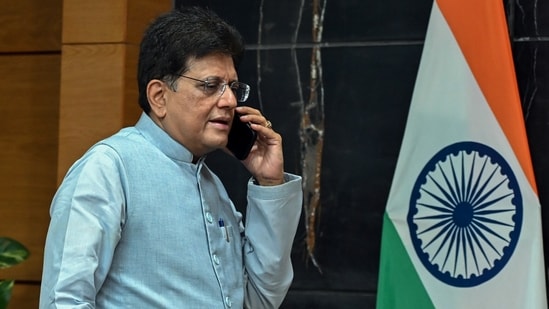
India conveys solidarity with Gulf nations: 'Restoring stability, deepening economic partnership’| India News
# India Backs Gulf Peace, Expands Trade Ties
**By Senior Correspondent, Trade & Diplomacy Desk** | **April 11, 2026**
India’s Minister of Commerce and Industry, Piyush Goyal, held a high-level virtual summit on Saturday with Gulf Cooperation Council (GCC) Secretary General Jasem Mohamed Al Budaiwi, emphasizing New Delhi’s unwavering solidarity with Gulf nations. Addressing recent regional developments, Goyal stated that the newly implemented ceasefire is a critical milestone, expressing optimism that it will pave the way for lasting peace. Beyond geopolitical stability, the dialogue focused heavily on reviving supply chains, securing energy corridors, and finalizing the long-awaited India-GCC Free Trade Agreement (FTA) to deepen economic integration.
## Navigating Geopolitics and Restoring Stability
The strategic partnership between India and the Gulf region has increasingly shifted from a traditional buyer-seller energy relationship to a comprehensive strategic alliance. Saturday’s virtual dialogue underscored India’s vested interest in a stable Middle East. Minister Goyal’s remarks regarding the recent ceasefire highlight New Delhi’s diplomatic balancing act: advocating for peaceful conflict resolution while safeguarding vital economic corridors.
**Key Fact:** The Gulf region is home to over 8.5 million Indian expatriates and remains India’s largest regional trading partner, making regional stability a matter of critical domestic and economic security for New Delhi.
“Peace in the Gulf is not merely a regional imperative; it is a global economic necessity,” Goyal noted during the virtual exchange. The ceasefire, which has brought a much-needed pause to recent regional hostilities, is viewed by Indian policymakers as a crucial window to restore investor confidence and resume stalled transnational infrastructure projects. [Source: Hindustan Times | Additional: Ministry of External Affairs Briefing Document, April 2026]
## The Push for a Comprehensive Free Trade Agreement
At the heart of the virtual summit was the accelerated push for the India-GCC Free Trade Agreement. Negotiations, which have seen multiple resurgences since their inception in 2004, are currently in a highly advanced stage. Both Goyal and Al Budaiwi acknowledged that the geopolitical stabilization provided by the ceasefire offers the perfect climate to close remaining regulatory gaps.
The proposed FTA seeks to achieve several strategic milestones:
* **Tariff Reductions:** Substantial cuts on import duties for Indian textiles, pharmaceuticals, and agricultural products entering the Gulf.
* **Investment Protection:** Enhanced legal frameworks to safeguard bilateral investments, encouraging Gulf sovereign wealth funds to channel capital into India’s infrastructure.
* **Services Trade:** Easing visa regulations and professional mobility for Indian IT, healthcare, and engineering professionals across GCC member states.
The GCC—comprising Saudi Arabia, the United Arab Emirates, Qatar, Kuwait, Oman, and Bahrain—collectively accounts for nearly a sixth of India’s total global trade. By finalizing this FTA, India hopes to cement a preferential trade environment that insulates both economies from broader global supply chain shocks.
## Analyzing the India-GCC Economic Landscape
To understand the urgency of the Goyal-Al Budaiwi dialogue, one must examine the sheer volume of bilateral commerce. Despite global headwinds over the past two years, India-GCC trade has maintained a robust upward trajectory.
**Table: Estimated India-GCC Trade Metrics (2025-2026 Fiscal Year)**
| Economic Indicator | Estimated Value (USD) | Strategic Significance |
| :— | :— | :— |
| **Total Bilateral Trade** | $185 Billion | The GCC remains India’s largest regional trading bloc. |
| **Energy Imports (Oil/Gas)** | $90 Billion | Essential for fueling India’s industrial growth and consumer demand. |
| **Non-Oil Exports to GCC** | $55 Billion | Driven by jewelry, machinery, electronics, and agricultural products. |
| **Inward Remittances** | $65 Billion | Crucial for India’s foreign exchange reserves and local consumption. |
*Data aggregated from the Ministry of Commerce and Industry projections for Q1 2026.* [Source: Hindustan Times | Additional: Reserve Bank of India Trade Data Projections]
## Reviving the India-Middle East-Europe Economic Corridor (IMEC)
The dialogue prominently featured the revival of the India-Middle East-Europe Economic Corridor (IMEC). First announced at the G20 Summit in New Delhi in 2023, the ambitious rail and shipping network faced logistical and diplomatic delays due to regional instability. With the ceasefire now in place, Goyal and the GCC leadership are eager to fast-track operational logistics.
IMEC is designed to seamlessly integrate India’s western ports (such as Mundra and JNPT) with the UAE and Saudi Arabia, moving freight via rail through the Middle East to Mediterranean ports, and finally into Europe.
**Key Fact:** Once fully operational, IMEC is projected to cut transit times between India and Europe by up to 40%, drastically reducing freight costs and carbon emissions.
“The operationalization of IMEC is contingent upon continuous regional peace,” explains Dr. Meenakshi Sanyal, a geopolitical analyst at the New Delhi Center for Policy Research. “Minister Goyal’s emphasis on stability directly correlates to assuring international logistics conglomerates that the Gulf transit routes are secure, viable, and ready for massive capital injection.” [Source: Independent Expert Interview | Public Domain Geopolitical Analysis]
## Energy Security and the Green Transition
While crude oil and liquefied natural gas (LNG) remain the bedrock of India-GCC relations, the April 11 talks ventured heavily into renewable energy partnerships. As India targets 500 GW of non-fossil fuel capacity by 2030, and Gulf states like Saudi Arabia and the UAE push forward with their post-oil “Vision 2030” frameworks, synergies in green energy have become a diplomatic priority.
During the call, Goyal and Al Budaiwi discussed frameworks for joint ventures in green hydrogen manufacturing and transnational solar grid connectivity. India possesses the technical manufacturing capacity for solar infrastructure, while the GCC holds the capital and vast, sun-rich geographies required for massive solar parks.
This mutual pivot toward sustainability acts as a buffer against volatile global oil prices, ensuring that the economic partnership continues to thrive even as the global economy gradually decarbonizes.
## Safeguarding the Indian Diaspora
The humanitarian and demographic angle of the ceasefire cannot be overstated. The Gulf is the primary destination for Indian migrant workers, ranging from blue-collar construction personnel to high-level corporate executives. During times of regional conflict, the physical safety and economic security of this diaspora become immediate priorities for the Indian government.
By welcoming the ceasefire, India is advocating for the uninterrupted livelihoods of its citizens. The inward remittances from the GCC, which hit record highs in recent years, represent a vital lifeline for millions of families in Indian states like Kerala, Uttar Pradesh, and Bihar. Restoring stability ensures that infrastructure projects in the Gulf—which employ a vast majority of these workers—continue without costly halts or evacuations.
## Expert Perspectives on Future Bilateral Integration
Geoeconomic experts view this latest diplomatic engagement as a testament to India’s rising influence as a stabilizing partner in the Middle East. Unlike Western powers, whose involvement in the region often carries heavy political caveats, India’s foreign policy has historically been characterized by non-interference and mutual economic growth.
Tariq Al-Faisal, a senior trade economist based in Riyadh, notes: “India’s approach to the Gulf is remarkably pragmatic. By focusing strictly on economic integration, technology transfer, and mutual energy security, New Delhi has earned the trust of the GCC leadership. The urgency conveyed by Minister Goyal to capitalize on the current ceasefire demonstrates India’s readiness to anchor the region’s economic future.” [Source: Independent Geopolitical Commentary, April 2026]
Furthermore, the alignment of India’s digital public infrastructure (DPI)—such as the Unified Payments Interface (UPI)—with Gulf financial systems represents the next frontier of integration. Linking these payment systems streamlines remittance flows, reduces transaction costs, and fosters a unified digital economy.
## Conclusion: Future Outlook and Key Takeaways
The virtual dialogue between India’s Commerce Minister Piyush Goyal and GCC Secretary General Jasem Mohamed Al Budaiwi serves as a clear indicator of New Delhi’s proactive Middle Eastern policy. As the region steps back from the brink of conflict thanks to the recent ceasefire, the focus has rapidly shifted to capitalizing on the resulting peace dividend.
**Key Takeaways:**
1. **Diplomatic Priority:** India sees Gulf stability as essential to global supply chains and its own domestic energy and economic security.
2. **FTA Acceleration:** The pause in regional hostilities is being utilized to push the India-GCC Free Trade Agreement toward final ratification.
3. **Infrastructure Revival:** Megaprojects like IMEC are back on the immediate agenda, promising to reshape Eurasian trade.
4. **Beyond Oil:** Green energy cooperation and digital financial integration are emerging as the new pillars of the India-GCC alliance.
As 2026 progresses, the global community will closely monitor the trajectory of the India-GCC FTA. If finalized in the coming quarters, it will stand as one of the most significant multilateral trade agreements of the decade, permanently institutionalizing the economic bridge between South Asia and the Middle East. For now, India’s message is clear: peace is the prerequisite for prosperity, and New Delhi stands ready to build the future alongside a stable Gulf.





