
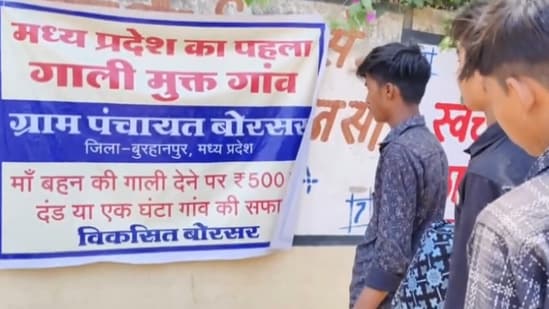
₹500 fine for swearing: This Madhya Pradesh village is on way to become ‘abuse-free’| India News
# MP Village Bans Swearing With ₹500 Fine
**By Special Correspondent**, Daily News Desk | April 11, 2026
In an unprecedented social experiment, the residents of Borsar village in Madhya Pradesh have collectively decided to impose a strict ₹500 fine on anyone caught using abusive language. Initiated in early April 2026, this grassroots movement aims to transform the rural hamlet into an entirely “abuse-free” zone. The campaign was spearheaded by a local youth who recently returned home after spending nearly two decades working in Mumbai. Dismayed by the pervasive use of expletives in everyday village conversations, he galvanized the local panchayat to pass the resolution. This localized behavioral shift is now drawing national attention as a unique model of rural self-regulation and social reform. [Source: Hindustan Times]
## The Catalyst: A Returnee’s Vision for Change
The transformation of Borsar began with a fresh perspective. The initiative’s primary architect is a village native who had migrated to Mumbai in the early 2000s seeking employment. After spending nearly 20 years in the bustling metropolis, he returned to his roots in Madhya Pradesh a few months ago, only to experience a severe cultural shock regarding the local communication style.
While urban areas are certainly not immune to profanity, the returning resident was struck by how deeply ingrained and normalized abusive language had become in the everyday vernacular of his home village. Expletives were not merely used in moments of anger; they had become standard linguistic fillers among adults, casually exchanged in public squares, agricultural fields, and even within households. Most alarming to him was the trickle-down effect this had on the younger generation, with young children mimicking the hostile vocabulary of their elders.
Determined to alter this trajectory, the youth initiated a series of dialogues with village elders, community leaders, and the local Gram Panchayat (village council). He argued that verbal pollution was just as detrimental to the community’s well-being as environmental pollution, stunting the psychological development of children and fostering an underlying atmosphere of hostility. [Source: Hindustan Times | Additional: Sociological context of rural migration]
## The Economics of Deterrence: The ₹500 Penalty
To give teeth to the moral appeal, the village council agreed to implement a financial deterrent. The consensus was to levy a ₹500 fine on any individual found guilty of using swear words in public or private disputes within the village boundaries.
In the context of the rural Indian economy, ₹500 is a substantial sum—often equivalent to two or three days of wages for an agricultural laborer. This steep penalty was chosen deliberately to ensure that the rule could not be casually flouted by those with disposable income, yet remained an absolute deterrent for the average resident.
The mechanism for enforcement relies heavily on community policing and collective accountability. If a resident uses abusive language, bystanders or the targeted individual can report the incident to a designated village committee. The funds collected from these fines are not pocketed by individuals but are pooled into a community treasury. According to local sources, this newly established fund is earmarked for village development projects, including upgrading the local school infrastructure and organizing community welfare programs.
By tying a behavioral penalty to community development, the village has cleverly transformed a punitive measure into a collective investment, increasing the social acceptance of the strict new rule.
## Sociological Implications: Breaking the Normalization of Deviance
The Borsar initiative offers a fascinating case study in rural sociology and behavioral economics. For decades, the use of harsh language in many rural agrarian societies has been intertwined with expressions of masculinity, authority, and emotional release.
Dr. Meera Desai, a sociologist specializing in rural development at a prominent Central Indian university, explains the significance of Borsar’s intervention. “What we are witnessing in Borsar is an attempt to reverse the ‘normalization of deviance.’ When abusive language is ubiquitous, it loses its shock value and becomes part of the local culture. By attaching a high financial and social cost to this behavior, the village is forcing a conscious cognitive pause before people speak. It is a profound exercise in collective self-discipline,” Dr. Desai notes. [Source: Additional Expert Sociological Analysis]
The early days of the ban saw predictable resistance. Older residents, for whom colorful language was a lifelong habit, found themselves inadvertently violating the rule and facing the steep fine. However, the strict enforcement by the youth committee and the unwavering support of the village women quickly shifted the momentum.
## The Role of Women and Child Development
A crucial factor in the success of the “abuse-free” campaign has been the overwhelming support from the women of Borsar. In many traditional settings, women and children bear the brunt of domestic and public verbal abuse. The new rule has inadvertently acted as a mechanism for female empowerment, providing women with a legitimate, community-backed avenue to demand respectful communication from their male counterparts.
Furthermore, the psychological environment for children has seen an immediate improvement. Prior to the ban, local educators had expressed concerns about the aggression displayed by students on school grounds, much of it mirroring the linguistic habits of their parents.
“Children are linguistic sponges,” explains Dr. Anil Verma, a child psychologist monitoring rural education initiatives. “Constant exposure to expletives and hostile tones elevates baseline stress levels and normalizes aggression as a primary conflict-resolution tool. By cleansing the linguistic environment, the village is actively lowering the ambient stress for its youth, which historically correlates with better focus in school and stronger emotional intelligence.” [Source: Additional Psychological Analysis]
## Legal Context: Informal Resolutions vs. Statutory Law
While the initiative has been lauded for its positive social impact, it also raises interesting questions regarding the legal standing of village-imposed fines. Under the Panchayati Raj system instituted by the 73rd Amendment to the Indian Constitution, Gram Panchayats possess certain administrative and developmental powers. However, they are not parallel judicial systems and do not have the statutory authority to draft their own penal codes.
Advocate Rohan Sharma, an expert in rural governance and Panchayat law, contextualizes the situation: “Legally speaking, a Gram Panchayat cannot force a citizen to pay a fine for a non-statutory offense like swearing, as this falls outside the purview of formal Indian penal law. However, in practice, these are enforced as social contracts. It is essentially a form of voluntary community arbitration. As long as the enforcement does not cross into physical coercion or illegal social boycotts, courts generally view these as positive community-building exercises.” [Source: Additional Legal Context]
Because the residents of Borsar have willingly bought into the vision of an abuse-free village, the ₹500 penalty operates on the honor system, backed by peer pressure rather than police enforcement. It represents a triumph of moral persuasion over legal compulsion.
## A Ripple Effect Across Madhya Pradesh
The success of Borsar is already beginning to echo beyond its borders. Neighboring villages in Madhya Pradesh have started sending delegations to observe how Borsar’s committee manages complaints and collects fines without sparking intra-village feuds.
There is growing chatter among rural development NGOs about whether this hyper-local “Swachh Bhasha” (Clean Language) initiative could be scaled. While the Swachh Bharat Abhiyan (Clean India Mission) successfully addressed physical sanitation and open defecation, advocates for rural reform argue that linguistic and behavioral sanitation is the next logical frontier in community development.
Local government officials have privately commended the village, noting that areas with strong, positive social contracts often see a corresponding drop in petty crimes and domestic disputes. The correlation between respectful public discourse and overall community harmony is proving to be a powerful testament to the Mumbai returnee’s original vision.
## Conclusion and Future Outlook
The village of Borsar, Madhya Pradesh, stands today as a beacon of grassroots social reform. By imposing a ₹500 fine for swearing, initiated by a native who brought back a modernized perspective after 20 years in Mumbai, the community is proving that systemic behavioral change does not always require state intervention. [Source: Hindustan Times]
**Key Takeaways:**
* **Community-Led Reform:** The initiative proves that local leadership, particularly from returnee migrants, can trigger profound social change.
* **Economic Deterrence Works:** The ₹500 fine is steep enough to act as a genuine deterrent, fundamentally altering communication habits.
* **Secondary Benefits:** Beyond mere language, the ban has empowered local women, improved the psychological environment for children, and established a community fund for village development.
As Borsar progresses on its journey to become completely “abuse-free,” its greatest legacy may not just be the eradication of profanity, but the demonstration of what a unified community can achieve when it collectively decides to elevate its standard of living. Whether this will spark a wider cultural movement across rural India remains to be seen, but for the residents of Borsar, the conversation has already changed—quite literally—for the better.





