
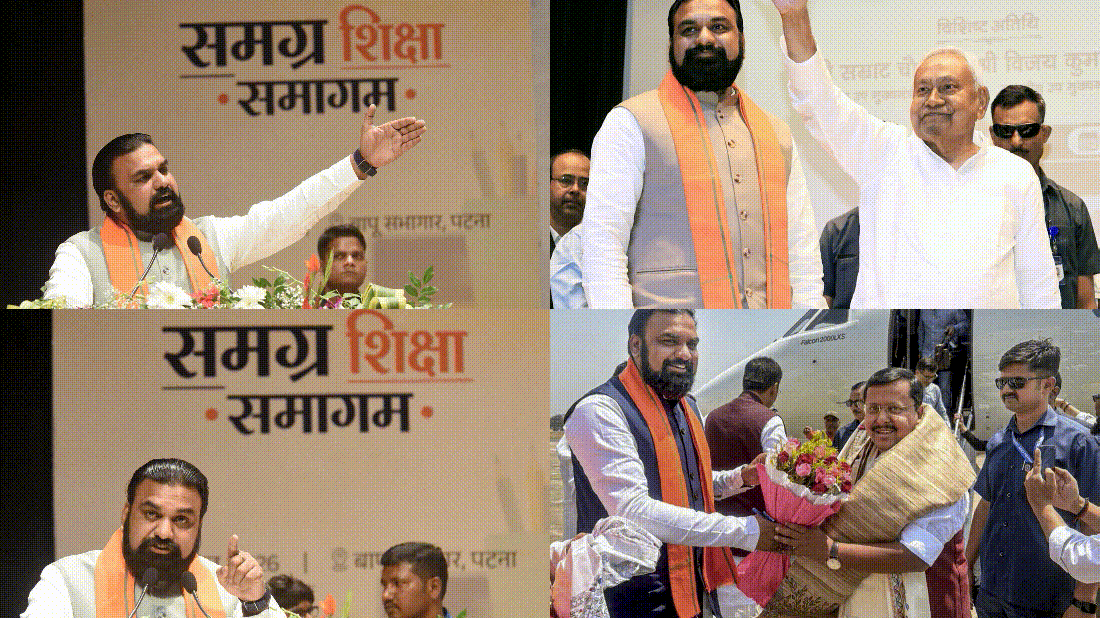
Samrat Choudhary: First BJP CM in Bihar comes with family legacy; was Rabri's minister in RJD govt, also in JD(U)| India News
# Bihar’s First BJP CM: Samrat Choudhary
**By Senior Political Correspondent, India Politics Desk | April 14, 2026**
On Tuesday, April 14, 2026, Bihar’s political landscape witnessed a historic tectonic shift as Samrat Choudhary was sworn in as the state’s first-ever Chief Minister from the Bharatiya Janata Party (BJP) in Patna. The elevation of the seasoned leader marks the culmination of the BJP’s decades-long ambition to rule Bihar independently, finally stepping out of the shadows of regional allies. A veteran politician with a formidable family lineage, Choudhary brings a unique trajectory to the state’s top office, having previously served as a minister in both Rabri Devi’s Rashtriya Janata Dal (RJD) government and Nitish Kumar’s Janata Dal (United) administration. This strategic appointment signals a redefined caste calculus and the dawn of a new political era for Bihar. [Source: Hindustan Times]
## A Deeply Rooted Political Dynasty
To understand Samrat Choudhary’s ascent to the highest office in Bihar, one must look at the deeply entrenched political roots of his family. He does not emerge from a political vacuum but rather inherits a robust legacy carved out of Bihar’s complex socialist movements of the late 20th century. His father, **Shakuni Choudhary**, was a political heavyweight and a **six-time Member of the Legislative Assembly (MLA)**, recognized widely as a founding pillar of the Samata Party and a prominent socialist voice. His mother, **Parvati Devi**, was also a respected former MLA, representing the family’s stronghold in the Tarapur constituency. [Source: Hindustan Times | Additional: Bihar Vidhan Sabha Archives]
The family belongs to the Kushwaha (Koeri) community, an agrarian Other Backward Class (OBC) demographic that forms a crucial voting bloc in Bihar. Historically, the Kushwahas, alongside the Kurmis, formed the formidable “Luv-Kush” alliance that served as the bedrock of Nitish Kumar’s prolonged political hegemony. By inheriting his family’s mantle, Samrat Choudhary commanded immediate respect and grassroots mobilization capabilities, providing him with a significant head start in the notoriously unforgiving arena of Bihar politics.
## The Early Years: Baptism by Fire in the RJD
Samrat Choudhary’s initiation into frontline politics was characterized by both rapid elevation and immediate controversy. He began his journey under the tutelage of Lalu Prasad Yadav, the patriarch of the RJD. In 1999, Choudhary was remarkably inducted as the Minister for Agriculture in the **Rabri Devi-led RJD government**.
However, his appointment became the center of a major political storm. Opposition leaders and civil society watchdogs raised alarms regarding his age, alleging that he had not yet reached the constitutionally mandated age of 25 required to hold a ministerial position or serve as an MLA. The controversy eventually forced him to step down, but the episode firmly established him in the public consciousness.
“Choudhary’s early days in the RJD were a masterclass in heartland realpolitik. He learned the mechanics of mass mobilization, caste arithmetic, and bureaucratic maneuvering directly from the socialist old guard,” notes Dr. Rajesh Sinha, a Patna-based political scientist and author of *The Bihar Blueprint*. [Source: Independent Expert Analysis]
## Shifting Allegiances: The Pragmatic Survivor
What distinguishes the new Chief Minister from his peers is his sheer adaptability. Choudhary’s political compass has consistently aligned with shifting power dynamics, allowing him to survive and thrive across party lines. In 2014, recognizing a stagnation within the RJD, Choudhary orchestrated a rebellion. He led a splinter group of RJD legislators and eventually merged his faction with Nitish Kumar’s **Janata Dal (United)**.
His tenure in the JD(U) was marked by a stint as the Minister for Urban Development and Housing. Yet, the alliance was short-lived. During the turbulent period when Jitan Ram Manjhi temporarily assumed the Chief Ministership and subsequently formed the Hindustani Awam Morcha (HAM), Choudhary closely aligned himself with the Manjhi faction.
It was in 2018 that Choudhary finally found a permanent home in the **Bharatiya Janata Party (BJP)**. The BJP, eager to expand its footprint beyond its traditional upper-caste voter base, welcomed the Kushwaha strongman with open arms. He was quickly appointed as the Vice President of the state unit and nominated to the Legislative Council, signaling the party’s long-term investment in his leadership. [Source: Hindustan Times | Additional: Election Commission of India Records]
## The BJP’s Masterstroke: Dismantling the Luv-Kush Equation
The decision of the BJP high command to elevate Samrat Choudhary to the Chief Minister’s post in 2026 is being hailed as a tactical masterstroke. For nearly three decades, Bihar’s political narrative has been a binary dictated either by the RJD’s Muslim-Yadav (MY) combination or Nitish Kumar’s Extremely Backward Classes (EBC) and Luv-Kush coalition.
By crowning a Kushwaha leader as Chief Minister, the BJP has effectively driven a wedge into the traditional JD(U) vote bank. The Kushwaha community constitutes roughly 7-8% of the state’s electorate, a decisive margin in closely contested assembly seats.
Furthermore, Choudhary proved his mettle during his tenure as the State BJP President and subsequently as the Deputy Chief Minister. He adopted an aggressively anti-RJD and anti-Nitish stance, capturing the imagination of the party cadres. He famously donned a saffron turban, publicly taking a vow that he would only remove it once Nitish Kumar was unseated from power—a symbol of his relentless political theater that deeply resonated with the BJP’s core demographic.
## Challenges Ahead for the New Administration
While the swearing-in ceremony on April 14, 2026, was a moment of unprecedented jubilation for the saffron party, the path ahead for Chief Minister Samrat Choudhary is fraught with systemic challenges.
1. **Economic Revitalization:** Bihar continues to languish at the bottom of national development indices. The state faces chronic issues of unemployment, mass labor migration, and a lack of large-scale industrial investment. The BJP has consistently campaigned on the promise of a “Double Engine” government (aligning state and central leadership). Choudhary must now deliver tangible economic growth.
2. **Law and Order:** Combating organized crime and maintaining social harmony remains a persistent challenge in Bihar. The new CM will be under intense scrutiny to uphold the strict law-and-order model championed by BJP governments in neighboring states like Uttar Pradesh.
3. **Balancing Factions:** Choudhary is a relatively recent entrant to the BJP compared to the party’s ideologically rooted RSS cadres. He will need to delicately balance the aspirations of the old guard upper-caste BJP leaders with the newly courted OBC and EBC constituencies.
“Samrat Choudhary has proven he knows how to win power. The real test over the next term will be whether he knows how to govern a complex, deeply stratified state like Bihar without the crutch of regional satraps,” stated senior political commentator Neerja Shekhar during a televised panel. [Source: Independent Expert Analysis]
## A New Chapter in Bihar Politics
The ascension of Samrat Choudhary to the Chief Minister’s office represents more than just a change in leadership; it is a paradigm shift in Hindi heartland politics. For the first time since the Mandal Commission reshaped the socio-political realities of India, the BJP has managed to install its own Chief Minister in Patna, entirely breaking the 35-year alternating monopoly of Lalu Prasad Yadav and Nitish Kumar.
Choudhary’s journey—from the controversies of his youth as Rabri Devi’s underage minister, through the pragmatic corridors of the JD(U), to becoming the torchbearer of the BJP’s total consolidation in Bihar—is a testament to his resilience and the fluid nature of Indian democracy.
As the new government settles into the Secretariat, the national political apparatus will be watching closely. If Samrat Choudhary successfully merges his vast OBC vote base with the BJP’s developmental agenda, he may not only redefine Bihar’s future but also solidify an impenetrable fortress for the party in eastern India for decades to come.





