
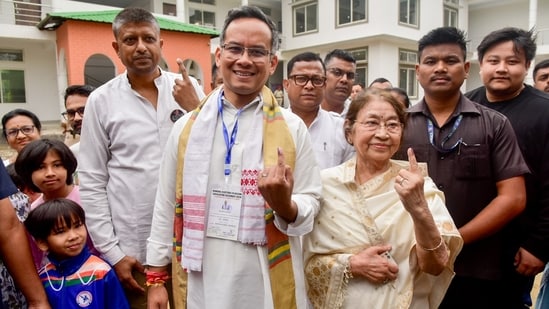
Assam Assembly Elections 2026: Gaurav Gogoi leads Congress push for comeback against BJP| India News
# Assam 2026: Gogoi Leads Congress Fight vs BJP
By Senior Political Correspondent, National Desk | April 14, 2026
As the Assam Assembly Elections 2026 approach, the political landscape is bracing for a high-stakes showdown. Gaurav Gogoi, the Assam Pradesh Congress Committee (APCC) chief and prominent Jorhat Member of Parliament, has officially positioned himself as the chief ministerial face to lead the Congress’s comeback. Pitted against the formidable incumbent Chief Minister Himanta Biswa Sarma of the Bharatiya Janata Party (BJP), Gogoi aims to revitalize the grand old party by capitalizing on anti-incumbency sentiments, regional identity politics, and his late father’s enduring legacy. [Source: Hindustan Times | Additional: Public Electoral Data].
## A Historic Rivalry Renewed
The 2026 assembly election is not merely a battle of political ideologies; it is a profound personal and historical rivalry coming full circle. Gaurav Gogoi represents the legacy of his late father, **Tarun Gogoi**, who served as the Chief Minister of Assam for 15 consecutive years from 2001 to 2016. Conversely, **Himanta Biswa Sarma**, the current Chief Minister and the BJP’s paramount strategist in the Northeast, was once Tarun Gogoi’s most trusted lieutenant before a bitter fallout led him to join the BJP in 2015.
Gaurav Gogoi’s elevation to the APCC presidency and his projection as the chief ministerial candidate follows his resounding victory in the **Jorhat constituency** during the 2024 Lok Sabha elections. In that crucial contest, Gogoi defeated the BJP candidate despite the ruling party deploying its entire state machinery, proving his mettle and mass appeal in Upper Assam.
“Gaurav Gogoi’s emergence as the undisputed face of the Congress in Assam brings a degree of clarity the party has lacked since 2016,” notes Dr. Ananya Sharma, a political sociologist based in Guwahati. “For the first time in a decade, the Congress is projecting a direct challenger to Himanta Biswa Sarma, turning the 2026 polls into a presidential-style contest.” [Source: Independent Political Analysis].
## Congress’s Revival Blueprint: Grassroots and Alliances
Following consecutive assembly defeats in 2016 and 2021, the Congress party in Assam underwent a period of deep introspection. Under Gogoi’s leadership, the APCC has engineered a revival blueprint focused heavily on grassroots mobilization and the consolidation of opposition forces.
The core of this strategy revolves around the **United Opposition Forum Assam (UOFA)**, a coalition bringing together the Congress, the Assam Jatiya Parishad (AJP) led by Lurinjyoti Gogoi, and the Raijor Dal led by Akhil Gogoi. This alliance is designed to prevent the fracturing of anti-BJP votes, a phenomenon that severely hampered the opposition in previous electoral cycles.
Gogoi’s campaign trail has prominently featured extensive outreach to marginalized communities, specifically focusing on the **tea tribe community**, which commands decisive influence in over 35 of the state’s 126 assembly seats. The Congress has pledged to significantly raise the daily minimum wage for tea garden workers and guarantee land rights—long-standing demands that have historically swayed election outcomes in Upper Assam.
## The Saffron Fortress: Incumbency and Infrastructure
Unseating the incumbent BJP government remains an uphill battle of immense proportions. Chief Minister Himanta Biswa Sarma has meticulously fortified the BJP’s position in Assam through a potent combination of robust welfarism, aggressive infrastructure development, and Hindutva-aligned cultural nationalism.
The BJP’s flagship welfare initiative, the **Orunodoi scheme**, which provides direct cash transfers to over 2.7 million economically disadvantaged women, has created a formidable vote bank of female beneficiaries. Leading into the 2026 polls, the Sarma administration has expanded the scope of this scheme, coupling it with microfinance loan waivers and the *Lakhpati Baideo* initiative aimed at fostering women’s rural entrepreneurship.
Furthermore, the state has witnessed an unprecedented infrastructure boom. The inauguration of multiple bridges over the Brahmaputra River, massive expansion of national highways, and the establishment of new medical colleges in remote districts form the backbone of the BJP’s “development narrative.”
Rajesh Barua, an independent election analyst, observes, “The BJP’s electoral machinery in Assam is incredibly resilient. CM Sarma’s ability to communicate directly with the masses, combined with tangible infrastructural delivery, provides a strong shield against standard anti-incumbency factors.”
## Demographic Calculus and the Impact of Delimitation
The 2026 elections will be the first assembly polls in Assam conducted under the newly drawn constituency boundaries following the **2023 Election Commission delimitation exercise**. This restructuring significantly altered the demographic calculus of the state.
The delimitation process protected indigenous voter majorities in several constituencies, particularly in Upper and Central Assam, while effectively reducing the concentration of minority-dominated seats in Lower Assam and the Barak Valley.
| Region | Electoral Significance post-Delimitation (2026) |
| :— | :— |
| **Upper Assam** | The ultimate battleground. Heavily indigenous and tea-tribe populated. Congress’s Gogoi and BJP’s Sarma are both aggressively courting this bloc. |
| **Lower Assam** | Traditionally a stronghold for minority-backed parties. The delimitation has fragmented some vote banks, forcing new strategic alliances. |
| **Barak Valley** | A linguistically distinct Bengali-speaking region. The BJP maintains a strong edge here, balancing both Hindu consolidation and regional development promises. |
| **Hill Districts** | Dominated by autonomous councils. Local alliances with tribal leaders will dictate the outcome of these crucial seats. |
For Gogoi and the Congress, winning back the indigenous Assamese heartland in Upper Assam is non-negotiable for a victory. The delimitation has made it mathematically impossible for any party to form the government relying solely on the state’s ~34% minority vote, forcing the Congress to reclaim its historical base among indigenous communities. [Source: Election Commission of India Data / Historical Delimitation Reports].
## The CAA Factor and Indigenous Identity
The controversial **Citizenship Amendment Act (CAA)**, whose rules were officially notified by the central government in early 2024, remains a volatile undercurrent in Assam politics. Unlike the rest of India, opposition to the CAA in Assam is deeply rooted in ethnic and linguistic anxieties—the fear that granting citizenship to post-1971 refugees will threaten the cultural identity and political rights of the indigenous Assamese population.
Gaurav Gogoi has strategically leveraged this sentiment. Under his guidance, the Congress manifesto promises to utilize constitutional mechanisms to prevent the implementation of the CAA in Assam if voted to power. By aligning with regional anti-CAA stalwarts like the AJP and Raijor Dal, Gogoi aims to channel the dormant outrage of the 2019-2020 protests into electoral momentum.
Conversely, the BJP has sought to assuage these fears by emphasizing the strict fulfillment of Clause 6 of the Assam Accord, which guarantees constitutional safeguards for the indigenous population. Chief Minister Sarma has repeatedly framed the BJP as the sole protector of native rights against demographic invasions, effectively pivoting the narrative toward border security and eviction drives against illegal encroachments.
## Economic Pledges vs. Cultural Nationalism
As the campaign trails heat up, the dichotomy between the two primary contenders is stark.
Gaurav Gogoi’s campaign is heavily tilted toward socio-economic issues. He consistently highlights **youth unemployment**, which remains a critical pain point in the state, despite the state government’s drives to fill government vacancies. Gogoi has also centered his discourse on the perennial issue of devastating annual floods, promising a comprehensive, scientifically-backed water management framework and increased central accountability—accusing the current regime of utilizing “band-aid solutions.”
In contrast, Himanta Biswa Sarma continues to masterfully blend rapid economic modernization with potent cultural nationalism. The BJP’s narrative constantly reminds voters of the “dark days” of insurgency and economic stagnation prior to their ascent to power, contrasting it with the relative peace and rapid growth of the past decade.
## Implications for National Politics
The outcome of the Assam Assembly Elections 2026 will resonate far beyond the boundaries of the Northeast. For the Indian National Congress, wresting control of Assam from the BJP would be a monumental morale booster, signaling a successful template for regional revival through strong local leadership and strategic alliances. It would instantly elevate Gaurav Gogoi into the upper echelon of national opposition leaders.
For the BJP, retaining Assam is crucial to maintaining its undisputed hegemony over the Northeast. Assam serves as the gateway to the region; its political stability directly impacts the BJP’s fortunes in neighboring states like Arunachal Pradesh, Meghalaya, and Tripura. A victory for Himanta Biswa Sarma would further solidify his status as one of the most powerful regional satraps in modern Indian politics.
## Conclusion and Future Outlook
As Assam approaches the ballot box in 2026, the state is witnessing a classic democratic confrontation. On one side stands Gaurav Gogoi, representing a rejuvenated Congress machinery determined to reclaim its historic bastion by leveraging economic anxieties, unified opposition, and indigenous rights. On the other stands Himanta Biswa Sarma, steering a well-oiled BJP juggernaut powered by unmatched welfare delivery, infrastructure growth, and deep-rooted ideological messaging.
Whether Gogoi’s impassioned push for change can breach the saffron fortress, or if Sarma’s incumbency advantage will secure another term for the BJP, remains the defining question of this electoral cycle. The coming weeks of intense campaigning will ultimately determine the trajectory of Assam’s political future for the rest of the decade.





