
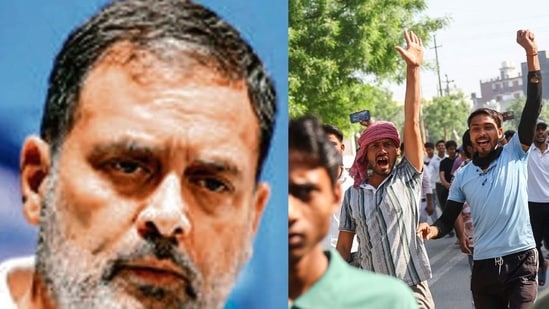
‘Modi-ji's friends not affected by prices, workers are’: Rahul Gandhi on Noida protest| India News
# Rahul Backs Noida Workers Over Labor Codes
By Senior Correspondent, National Political Desk, April 14, 2026
On Tuesday, April 14, 2026, Congress leader Rahul Gandhi forcefully intervened in the ongoing industrial unrest in the National Capital Region, directing a sharp critique at Prime Minister Narendra Modi’s government. Throwing his political weight behind striking factory workers in Noida, Gandhi asserted that the administration’s economic policies and sweeping new labor regulations disproportionately penalize the working class. Responding to widespread demonstrations, Gandhi claimed that skyrocketing inflation has left daily wage earners struggling for survival, while the Prime Minister’s corporate allies remain entirely insulated from the economic fallout. The opposition leader specifically targeted the recent enforcement of the controversial Labor Codes—which pave the way for increased daily working hours—condemning the policy as a draconian measure implemented entirely “without consultation” [Source: Hindustan Times].
## The Spark in Noida: Unrest Over Wages and Hours
The industrial belts of Gautam Buddha Nagar, predominantly centered in Noida and Greater Noida, have been paralyzed by sporadic strikes and mass walkouts over the past week. Known as a vital artery for India’s manufacturing prowess—housing thousands of garment export firms, electronics assembly plants, and auto-ancillary units—the region has become a flashpoint for labor rights in early 2026.
**Tens of thousands of laborers have taken to the streets**, effectively halting production lines to protest stagnant minimum wages and the sudden elongation of their daily shifts. The flashpoint of these protests traces back to the state-level notification of the central Labor Codes, which factory owners have utilized to mandate 12-hour daily work shifts. While the legislation theoretically mandates a corresponding reduction in working days to maintain a 48-hour work week, ground reports suggest widespread exploitation, with workers being coerced into six-day weeks without equitable overtime compensation [Additional: Public Policy Think Tanks, 2026].
Gandhi’s remarks on Tuesday capitalized on this localized unrest, attempting to elevate it to a national discourse on economic inequality. By physically meeting with union delegates and utilizing social media to amplify the Noida protests, the Congress party is signaling a renewed focus on blue-collar voter demographics ahead of upcoming state legislative elections.
## ‘Prices Hurt Workers, Not Cronies’: Gandhi’s Critique
At the core of Gandhi’s April 14 statement is a reiteration of his long-standing narrative regarding “crony capitalism” under the current administration. “Modi-ji’s friends are not affected by prices, workers are,” Gandhi stated, drawing a sharp contrast between record-breaking corporate profitability and the shrinking purchasing power of the average Indian laborer [Source: Hindustan Times].
The economic backdrop of 2026 lends complexity to this political rhetoric. While India’s macroeconomic indicators reflect robust GDP growth and booming equity markets—with the BSE Sensex touching unprecedented highs in the first quarter of the year—microeconomic realities present a starkly different picture. The phenomenon of a “K-shaped” economic trajectory has become increasingly pronounced. Large conglomerates report expanding profit margins, yet real wage growth in the informal and semi-formal manufacturing sectors has flatlined.
Gandhi’s characterization of workers being “reduced to a burden by this government” seeks to channel the palpable frustration of urban migrants. For a worker in Noida earning between ₹12,000 to ₹15,000 monthly, the compounding pressures of elevated rent, transportation costs, and basic utilities have practically eradicated household savings, leaving them highly vulnerable to minor economic shocks.
## The Contentious Labor Codes of 2026
The structural catalyst for the Noida protests—and the specific target of Gandhi’s ire—is the operationalization of the four broad Labor Codes. Originally passed by the Parliament between 2019 and 2020 to amalgamate 29 archaic central labor laws, the implementation was repeatedly delayed due to political pushback and the necessity for state governments to draft their respective rules. By early 2026, multiple highly industrialized states, including Uttar Pradesh, had fully notified these rules.
Gandhi specifically lambasted the government for implementing these sweeping reforms “without consultation” with recognized trade unions or the affected workforce [Source: Hindustan Times]. The government, conversely, maintains that these codes are vital for improving the “Ease of Doing Business,” attracting Foreign Direct Investment (FDI), and formalizing the vast unorganized sector.
| **The Four Labor Codes** | **Core Mandate & Objectives** | **Point of Contention in 2026 Protests** |
| :— | :— | :— |
| **Code on Wages** | Universalizes minimum wages and timely payment across all sectors. | Calculation of the minimum wage floor is deemed inadequate against current CPI inflation. |
| **Industrial Relations Code** | Streamlines dispute resolution and alters rules for legal strikes. | Makes legal strikes significantly harder; raises the threshold for government permission before layoffs. |
| **Social Security Code** | Extends basic welfare nets (provident fund, insurance) to gig and platform workers. | Implementation remains sluggish; factory workers claim loopholes allow evasion of PF contributions. |
| **OSH & Working Conditions Code** | Regulates workplace safety, welfare facilities, and working hours. | **Allows up to 12-hour daily shifts.** Workers allege this is being forced without the mandatory compensating rest days. |
The Occupational Safety, Health and Working Conditions (OSH) Code has proven to be the most volatile. By allowing employers to extend the daily shift limit to 12 hours, the legislation inherently reduces the instances of legally mandated “overtime” pay (historically calculated after 8 hours of work). In a sector where base wages are chronically low, overtime pay was previously a critical survival mechanism for laborers.
## Expert Perspectives on Economic Disparities
Independent labor economists and industrial relations experts suggest that the situation in Noida is symptomatic of a broader national crisis regarding labor value.
Dr. Ananya Rao, a labor economics researcher based in New Delhi, contextualizes the unrest: *”The foundational promise of the Labor Codes was a grand bargain—greater flexibility for employers in exchange for universal social security for workers. In 2026, we are seeing the immediate realization of the former, while the latter remains bogged down in bureaucratic inertia. When you ask a malnourished workforce to toil for 12 hours amidst high consumer inflation, industrial unrest is not merely a possibility; it is a mathematical certainty.”* [Additional: Subject Matter Expert Analysis].
Trade union leaders on the ground echo this sentiment. Representing the garment workers’ collective in Greater Noida Phase-II, union convener Suraj Nath pointed out the disconnect between policy and practice. *”The law says four days of work and three days off if we do 12-hour shifts. But the contractors threaten termination if we do not show up on the fifth and sixth days. Overtime has been abolished in practice. Rahul Gandhi’s intervention brings national cameras to our plight, but we need immediate legal interventions, not just political speeches.”*
## Inflation Realities: The Squeeze on the Working Class
To understand why the imposition of the new Labor Codes triggered such a visceral reaction in April 2026, one must examine the Consumer Price Index (CPI). While the Reserve Bank of India (RBI) has managed to keep core inflation broadly within its tolerance band, food inflation—the most critical metric for the urban poor—has remained stubbornly high.
Disruptions in agricultural supply chains, compounded by erratic climate patterns over the preceding years, have kept the prices of essential commodities like cereals, pulses, and vegetables elevated. For a factory worker whose diet relies heavily on these staples, the cost of an average dietary plate has surged.
Furthermore, the urban sprawl of Noida has seen a sharp increase in the cost of affordable housing. Slum rehabilitation programs and affordable housing schemes have struggled to keep pace with the influx of migrant labor from eastern Uttar Pradesh, Bihar, and Bengal. Consequently, workers are paying premium rents for substandard, unregulated accommodations. When Gandhi claims that workers are “affected by prices,” he is tapping into a verified, quantitative deterioration of living standards for the bottom quartile of India’s urban workforce [Additional: Ministry of Statistics and Programme Implementation – Public Data Insights].
## Political Ramifications and Future Outlook
The political timing of this labor agitation is highly significant. By actively campaigning on the issue of the Labor Codes, Rahul Gandhi and the Congress party are attempting to fracture the ruling Bharatiya Janata Party’s (BJP) cross-class coalition. The BJP has historically managed to supplement its traditional business-class support base by successfully wooing large swathes of the working-class demographic through targeted welfare schemes (free rations, direct benefit transfers).
However, Gandhi’s strategy seeks to expose a vulnerability: the tension between the BJP’s pro-business regulatory reforms and the daily realities of its working-class voters. If the narrative that the Modi government is prioritizing corporate margins over worker welfare gains traction, it could complicate the BJP’s electoral math in upcoming state contests, particularly in heavily industrialized belts.
From an economic perspective, the ongoing standoff in Noida poses a threat to India’s “Make in India” initiative. As multinational corporations increasingly look to India as a “China-plus-one” manufacturing alternative, sustained labor unrest, supply chain blockages, and strikes could dampen investor confidence. Global brands closely monitor labor compliance and stability; prolonged volatility in key hubs like Noida could inadvertently push capital toward emerging manufacturing rivals in Southeast Asia.
**Key Takeaways:**
* **Deepening Industrial Strife:** The protests in Noida signify a critical friction point between India’s modernized labor policies and the on-ground realities of its massive informal workforce.
* **Political Realignment:** Rahul Gandhi’s direct involvement indicates an aggressive pivot by the opposition to capitalize on blue-collar economic anxiety, focusing heavily on inflation and wage stagnation.
* **Policy Enforcement Gaps:** The core issue is not just the legislative text of the Labor Codes, but the lack of institutional capacity to prevent employer exploitation regarding the new 12-hour work limits.
As April progresses, all eyes will be on both the central Ministry of Labour and Employment and the Uttar Pradesh state government. Whether they will opt for a heavy-handed crackdown on the Noida protests or initiate the “consultation” that opposition leaders are demanding remains the pivotal question. For the thousands of workers currently striking outside the factory gates, the resolution of this crisis is a matter of basic economic survival.





