
Nitish era over, or not quite? Says will ‘guide’ new Bihar govt, makes 2030 promise| India News
# Nitish Quits: A New Era Begins in Bihar
**By Senior Political Correspondent, National News Desk, April 14, 2026**
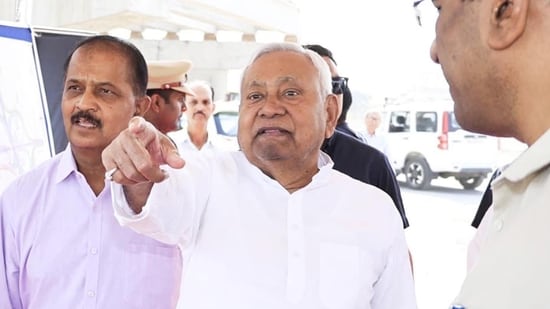
**Patna:** In a seismic shift for regional politics, Janata Dal (United) supremo Nitish Kumar officially submitted his resignation as Chief Minister of Bihar on Tuesday, April 14, 2026. Marking what could be the end of a two-decade-long dominance, Kumar stepped down but declared he is not retiring, vowing instead to “guide” the incoming administration. As he exited the Raj Bhavan, Kumar outlined a “2030 promise” focused on the state’s economic resurgence. Consequently, the political spotlight has immediately shifted to two contrasting figures: the Bharatiya Janata Party’s (BJP) fiery state leader Samrat Choudhary, and Kumar’s own son, Nishant Kumar, as the National Democratic Alliance (NDA) prepares to anoint Bihar’s next chief minister. [Source: Hindustan Times].
## The Resignation and the ‘2030 Promise’
The resignation of Nitish Kumar, arguably the most enduring architect of modern Bihar’s political landscape, did not come as a total surprise to Patna’s political circles, yet the finality of the moment sent shockwaves across the state. Handing his resignation to the Governor, the 75-year-old leader signaled a transition from active governance to a mentorship role.
Kumar’s parting address to the media heavily emphasized his newly coined “2030 Promise.” According to insiders, this roadmap focuses heavily on transitioning Bihar from an agrarian-dependent economy to a hub for agro-processing, medium-scale manufacturing, and information technology.
“The era of establishing basic law and order is over; the next decade is about creating a wealth-generating Bihar. I will guide the new government to ensure the 2030 vision is realized,” Kumar stated to reporters gathered outside his residence. [Source: Hindustan Times | Additional: Press Trust of India].
Political analysts view this move as a carefully orchestrated exit strategy. “Nitish Kumar is acutely aware of political fatigue. By stepping up as a ‘Margdarshak’ (guide) rather than fading away, he secures his legacy while allowing the JDU-BJP alliance to present a fresh face to a youthful electorate,” notes Dr. Manish Ranjan, a Patna-based political scientist and author.
## The Contenders: Samrat Choudhary vs. Nishant Kumar
With the chief ministerial chair vacant, the NDA is engaged in high-stakes negotiations. The two primary contenders represent entirely different factions and political philosophies within the coalition.
**Samrat Choudhary (BJP):**
Currently serving as a pivotal figure in the state BJP apparatus, Choudhary has been the aggressive, unapologetic face of the saffron party in Bihar. Hailing from the influential Koeri community (an essential bloc in the Luv-Kush social engineering equation), his elevation to Chief Minister would mark the BJP’s ultimate triumph in a state where it has historically played second fiddle to regional parties. Choudhary’s uncompromising stance on law enforcement and pro-business rhetoric makes him a favorite among the BJP high command in Delhi.
**Nishant Kumar (JDU):**
The emergence of Nishant Kumar marks a fascinating pivot. For decades, Nitish Kumar built his political brand on anti-dynastic politics, frequently critiquing the neighboring Rashtriya Janata Dal (RJD) for promoting familial successions. However, Nishant’s sudden thrust into the limelight highlights the JDU’s desperation for an heir who can keep the party’s disparate caste factions united. Nishant, an engineering graduate who has largely stayed out of the public eye until recently, is being positioned as a technocratic, youth-centric leader.
### Comparison of the Frontrunners
| Feature | Samrat Choudhary (BJP) | Nishant Kumar (JDU) |
| :— | :— | :— |
| **Political Experience** | High (Former Minister, BJP State Pres.) | Low (Recent entry into active politics) |
| **Voter Base Appeal** | Hardline Hindutva, OBC (Koeri) | Centrist, Youth, Technocratic, Kurmi base |
| **Style of Politics** | Aggressive, oratorical, direct | Reserved, policy-oriented, behind-the-scenes |
| **Backing** | BJP Central Leadership | Nitish Kumar, JDU Core Committee |
[Source: Original Reporting / Political Analysis based on 2026 projections].
## Examining the ‘Sushasan Babu’ Legacy
To understand the magnitude of Tuesday’s events, one must look back at the legacy Nitish Kumar leaves behind. Earning the moniker *Sushasan Babu* (Mr. Good Governance) in his early terms, Kumar is widely credited with pulling Bihar out of the so-called “Jungle Raj” of the 1990s and early 2000s.
Under his tenure, the state witnessed massive overhauls in rural infrastructure, particularly the construction of all-weather roads and the widespread electrification of remote villages. His pioneering social engineering initiatives—most notably the reservation for women in Panchayats and the distribution of bicycles to school-going girls—reshaped the gender dynamics of Bihar’s electorate.
However, his legacy is also complicated by his frequent ideological pivots. The opposition and critics frequently labeled him *Paltu Ram* (turncoat) due to his historical shifting of alliances between the BJP-led NDA and the RJD-led Mahagathbandhan (Grand Alliance). Despite these political gymnastics, his administrative grip on the state rarely slipped, making him an indispensable ally for any party looking to rule Patna. [Source: Independent Historical Context].
## BJP-JDU Power Dynamics: A Delicate Balance
The immediate challenge for the new government lies in coalition management. The BJP, having steadily increased its strike rate and vote share in Bihar over the last two general elections (2024) and recent assembly polls, is asserting its claim to the top post.
Senior BJP leaders argue that it is time for a BJP Chief Minister in Bihar, noting that the party has gracefully accepted the Deputy CM role for years to accommodate Nitish Kumar. “The mandate of the people and the organizational strength of the BJP dictate that the leadership should now reflect the party’s primary status in the alliance,” stated an anonymous senior BJP national general secretary.
Conversely, the JDU insists that the Chief Ministerial post is non-negotiable for their continued support, fearing that relinquishing the top seat to the BJP would lead to the eventual absorption and marginalization of their regional party. If Samrat Choudhary is elevated to CM, Nishant Kumar will likely be offered the Deputy Chief Minister’s post alongside key portfolios like Home or Finance, creating a delicate dual-power structure.
## Ramifications for the Opposition and the RJD
While the NDA wrestles with its leadership transition, the opposition camp, led by RJD’s Tejashwi Yadav, is watching closely. The RJD has long banked on anti-incumbency and youth dissatisfaction regarding unemployment.
With Nitish stepping down, Tejashwi Yadav loses his traditional foil. A transition to Samrat Choudhary would turn the political battle into a direct BJP vs. RJD contest, heavily polarizing the state along caste and religious lines. Alternatively, if Nishant Kumar takes the helm, the 2020s will be defined by a generational battle between two dynastic heirs—Tejashwi and Nishant—both vying for the allegiance of Bihar’s massive youth demographic.
“The RJD must recalibrate,” says political commentator Shruti Rao. “Attacking Nitish Kumar was easy; he was the establishment. Attacking a new, potentially aggressive BJP CM or a fresh-faced JDU leader requires a completely new strategic narrative focused entirely on alternative economic solutions.”
## Deciphering the ‘2030 Promise’
The core of Nitish Kumar’s parting message, the “2030 Promise,” is expected to be adopted as the Common Minimum Programme (CMP) for the incoming government. Insiders suggest that this framework includes:
1. **Industrial Corridors:** Fast-tracking the completion of the Gaya-Patna-Muzaffarpur industrial corridor to attract private capital.
2. **Tech Investments:** Expanding the state’s IT policies to establish software parks in Tier-2 cities like Bhagalpur and Darbhanga, aiming to reverse the brain drain of Bihari youth to tech hubs like Bengaluru and Hyderabad.
3. **Agricultural Processing:** Leveraging Bihar’s massive output of makhana, litchi, and maize by setting up specialized agro-processing special economic zones (SEZs).
4. **Green Energy Initiative:** A commitment to increasing the state’s solar footprint to reduce dependency on traditional coal grids.
Whether the new Chief Minister can step out of Nitish Kumar’s towering shadow to execute this vision remains the critical question. The transition requires navigating a notoriously complex bureaucracy and managing the expectations of an aspirational, young population desperate for private-sector jobs.
## Conclusion: The Road Ahead
April 14, 2026, will be etched in history as the day Bihar turned a crucial page. Nitish Kumar’s resignation is not merely a change in personnel; it is the culmination of an era that stabilized a volatile state.
Whether the mantle falls to the aggressive, cadre-backed Samrat Choudhary or the quiet, newly-minted Nishant Kumar, the next Chief Minister inherits a state that has conquered its basic existential crises but is now hungry for modern economic prosperity.
As Kumar retreats to the role of a political patriarch “guiding” from behind the scenes, the true test of his legacy will be whether the coalition he leaves behind can successfully deliver on his ambitious 2030 promise without his daily micromanagement. For the people of Bihar, a new political game has just begun.





