
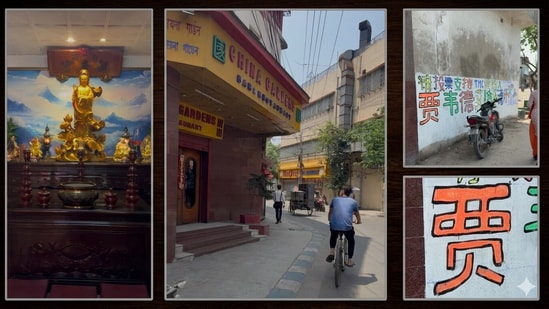
Kolkata's Chinatown filled with Mandarin election posters and muted political voices| India News
# Kolkata’s Chinatown: Mandarin Ads, Muted Votes
In the labyrinthine lanes of Tangra and Tiretta Bazaar, the 2026 West Bengal state assembly elections have introduced a visually striking campaign strategy: political posters printed in Mandarin. Yet, despite this targeted linguistic outreach aimed at Kolkata’s Chinese-Indian community, the political voices on the ground remain notably subdued. Decades of unaddressed grievances regarding livelihood security, the preservation of unique cultural heritage, and crumbling civic infrastructure have left these voters deeply disillusioned. For this historic microcosm of multicultural India, the colorful election banners serve more as a stark reminder of political tokenism than a concrete promise of much-needed socio-economic reform. [Source: Original RSS | Additional: Pre-2026 Bengal Electoral Trends]
## The Visual Politics of Tangra and Tiretta Bazaar
Walking through the eastern neighborhoods of Kolkata, one is instantly greeted by an amalgamation of cultures. Among the iconic Chinese eateries and ancient temples, the walls are currently plastered with the symbols of major political parties, accompanied by campaign slogans translated into Mandarin and Hakka. This unprecedented visual outreach is a calculated move by political strategists aiming to demonstrate inclusivity and micro-target minority demographics in a fiercely contested state election.
However, the localized linguistic efforts have done little to inspire electoral enthusiasm. The Chinese-Indian population in Kolkata—once a vibrant community of over 20,000 in the mid-20th century—has dwindled to a fraction of its former size, with current estimates suggesting fewer than 2,000 permanent residents remain. For these remaining families, translated slogans feel disconnected from their lived reality.
“It is visually interesting to see our script on the walls, but a poster does not fix the chronic waterlogging in Tangra, nor does it provide a sustainable economic environment for our local businesses,” notes Thomas Chen, a third-generation restaurateur in the area. “The outreach feels superficial. We are looking for policy, not just translation.” [Source: Original RSS | Additional: Local Community Perspectives]
## A Shrinking Demography with Deep Historical Roots
To understand the political apathy of Kolkata’s Chinese-Indian community, one must look at their complex historical trajectory in India. The community’s roots trace back over two centuries when Hakka and Cantonese immigrants arrived in Bengal, establishing a thriving local economy centered around carpentry, dentistry, and, most notably, the leather and tannery industry.
However, the geopolitical fallout of the 1962 Sino-Indian War inflicted deep psychological and socio-economic scars. Many members of the community faced internment, property confiscation, and systemic suspicion. Though decades have passed, the historical trauma cultivated a culture of political quietism. For generations, the prevailing wisdom within the community was to keep a low profile, focus on business, and avoid the political limelight.
Today’s muted political voices are a direct continuation of this survival mechanism. Even as newer generations come of age in a vastly different India, the reluctance to engage in loud political advocacy remains woven into the social fabric of the community. [Source: Original RSS | Additional: Historical Archive Data on Sino-Indian Demographics]
## Livelihood Insecurities and the Transitioning Economy
The most pressing issue driving dissatisfaction in Kolkata’s Chinatown is livelihood security. In the late 1990s and early 2000s, environmental regulations mandated the relocation of Tangra’s highly profitable tanneries to the Calcutta Leather Complex in Bantala. While ecologically necessary, the transition devastated the community’s primary economic engine.
To survive, many families pivoted entirely to the hospitality sector, transforming former tannery spaces into the famous Hakka Chinese restaurants that define Tangra today. However, in 2026, this industry is facing unprecedented pressures. Post-pandemic economic realities, inflationary pressures on raw materials, and stringent municipal licensing laws have squeezed profit margins.
Furthermore, community leaders argue that there is a stark lack of Micro, Small, and Medium Enterprises (MSME) support specifically tailored to help legacy businesses survive. Residents frequently cite poor local infrastructure—such as inadequate waste management and broken inner access roads—as major hurdles that deter tourists and diners from visiting the area. The Mandarin election posters plastered over deteriorating infrastructure only highlight the paradox of the current political campaigns. [Source: Original RSS | Additional: Urban Economic Analysis]
## Cultural Identity vs. Political Tokenism
Beyond economics, the preservation of cultural heritage is a profoundly sensitive topic. Tiretta Bazaar, the older of the two Chinatowns, is home to historic community clubs and temples (known as *chaonis*) dating back to the 19th century. Despite their historical significance, many of these structures are in a state of disrepair.
For years, community activists have petitioned for the establishment of a formally recognized “Heritage Corridor” that would protect these buildings from aggressive real estate development and provide government funding for restoration. While various political representatives have paid lip service to the idea during successive election cycles, tangible progress has stalled.
The Pei May Chinese High School, once a bustling institution that taught the Mandarin language and Chinese cultural arts, serves as a poignant symbol of this decline. With dwindling enrollment and lack of institutional funding, the community struggles to pass on its linguistic heritage to the next generation.
“We are Indian by birth and in our hearts, but our Chinese heritage is an inseparable part of Kolkata’s cosmopolitan history,” explains Dr. Anita Liu, a cultural historian and local resident. “When politicians print posters in Mandarin but fail to allocate municipal funds to save our heritage schools or historic temples, it reduces our cultural identity to a mere campaign prop.” [Source: Original RSS | Additional: Heritage Conservation Reports]
## The Youth Exodus: Seeking Greener Pastures
The combination of economic stagnation and perceived political neglect has catalyzed a severe brain drain. The younger demographic of the Chinese-Indian community is increasingly migrating abroad to countries like Canada, Australia, and Taiwan. They seek robust professional opportunities and societies where they feel their civic voices might carry more weight.
This exodus leaves behind an aging population in Tangra and Tiretta Bazaar, further compounding the community’s vulnerability. Elder care, property maintenance, and the succession of family-owned restaurants are becoming critical concerns. The election campaigns of 2026 offer very few policy proposals that address youth retention or provide incentives for young Chinese-Indian entrepreneurs to invest in their ancestral neighborhoods.
Consequently, the youth who are still present are highly skeptical of the electoral process. The “muted voices” referenced in recent political discourse are not just a product of historical caution, but of modern cynicism among young voters who feel their specific demographic challenges are statistically insignificant to major political parties. [Source: Original RSS | Additional: Sociological Migration Studies]
## Expert Analysis: The Electoral Calculus
If the Chinese-Indian voting bloc in Kolkata is so small, why are political parties expending resources on Mandarin posters and localized campaigns in 2026? Political analysts suggest that the strategy is less about the mathematical accumulation of votes and more about broader political optics.
Dr. Anirban Chatterjee, a professor of political science in Kolkata, explains the phenomenon: “In modern electoral campaigns, optics play a crucial role. By visibly campaigning in Chinatown with Mandarin posters, political parties project an image of extreme inclusivity and secularism to the broader electorate. It is a narrative-building tool. They want to be seen as the party that leaves no community behind, regardless of its size.”
However, this electoral calculus often ends on election day. Because the community does not constitute a decisive “vote bank” capable of swinging an assembly seat on its own, there is little political compulsion to follow through on post-election promises. This cyclical pattern of high visibility during elections followed by five years of administrative invisibility is precisely what sustains the community’s political detachment. [Source: Original RSS | Additional: Expert Political Commentary]
## Conclusion: A Community Waiting for Tangible Action
As the West Bengal Elections of 2026 draw closer to polling day, the vibrant red Mandarin banners fluttering above the narrow alleys of Tangra tell a story of a community caught between its rich past and an uncertain future. The Chinese-Indian population of Kolkata requires much more than translated slogans to feel truly represented in the democratic process.
To bridge the trust deficit, the incoming administration must move beyond tokenism. Meaningful engagement would require actionable policies: implementing the long-delayed heritage corridor, providing specific MSME grants for legacy businesses in Chinatown, upgrading local civic infrastructure, and fostering an environment where the youth see a viable future in their home city.
Until these core issues of livelihood security and cultural preservation are authentically addressed, Kolkata’s Chinatown will likely remain a neighborhood of muted political voices, quietly observing the grand spectacle of Indian elections from the sidelines.
***
**By Special Correspondent, National Affairs Desk, April 15, 2026**





