
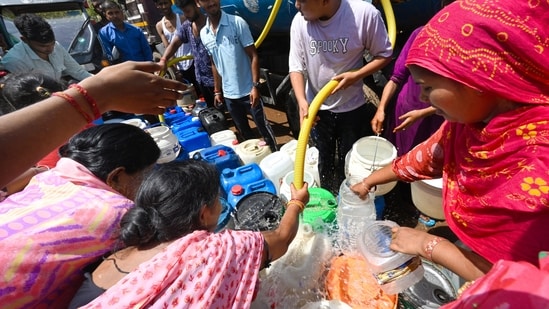
Water supply in key Delhi areas to be disrupted till tomorrow due to Chandrawal plant shutdown
# Delhi Water Cut: Key Areas Dry Till Thursday
**By Staff Reporter, Metro News Desk | April 15, 2026**
Residents across central and northern parts of the national capital will face a significant 24-hour water supply disruption starting Wednesday, April 15, 2026, owing to an emergency shutdown at the Chandrawal Water Treatment Plant. The Delhi Jal Board (DJB) has initiated critical maintenance to repair a major interconnection on the primary supply line, forcing operations to halt until Thursday morning. While the disruption coincides with the onset of Delhi’s harsh summer heat, authorities have assured citizens that the impact will be highly localized and less severe than previous outages, with an extensive fleet of water tankers already deployed to affected neighborhoods. [Source: Hindustan Times]
## The Chandrawal Plant Shutdown: What We Know
The Chandrawal Water Treatment Plant, one of the oldest and most vital cogs in Delhi’s water distribution network, temporarily ceased operations on Wednesday morning to facilitate urgent repairs. According to statements released by the Delhi Jal Board, the maintenance involves fixing a significant vulnerability in the primary header line that connects the plant’s treated water reservoir to the zonal distribution mains.
Operating at a standard capacity of approximately 90 Million Gallons per Day (MGD), the Chandrawal facility treats raw water sourced from the Yamuna River and supplies it to some of the city’s most densely populated and politically significant districts. A failure to address the infrastructural wear and tear on this interconnection could have resulted in a catastrophic pipeline burst during the peak summer months of May and June, when water demand naturally surges to its annual maximum.
A senior DJB official told Hindustan Times earlier today that the necessary repair work is highly technical but straightforward, and engineers are working around the clock to ensure it is completed as swiftly as possible. The official noted that “the impact is expected to be less severe than last month, and the repair work should be completed quickly.” [Source: Hindustan Times]
## Full List of Affected Areas
The shutdown will lead to low pressure or complete cessation of piped water supply in several key zones. The DJB has issued advisories urging residents in the following locations to use stored water judiciously until normal supply is restored by Thursday afternoon:
* **Central Delhi:** Karol Bagh, Paharganj, Dev Nagar, Rajinder Nagar, Patel Nagar, and the surrounding commercial hubs.
* **North Delhi:** Civil Lines, Kamla Nagar, Roop Nagar, Shakti Nagar, Hindu Rao Hospital precinct, and the Delhi University North Campus areas.
* **NDMC Areas:** Portions of the New Delhi Municipal Council (NDMC) zone, including Gole Market, Bengali Market, parts of Connaught Place, and adjacent diplomatic and government residential enclaves.
* **Old Delhi:** Chandni Chowk, Jama Masjid, Daryaganj, and Kashmere Gate.
**Note:** Hospitals and emergency services located within these zones, such as Hindu Rao Hospital and Lady Hardinge Medical College, have been prioritized for continuous tanker deliveries to ensure no medical operations are disrupted. [Source: Public DJB Advisories / Additional Context]
## Why This Maintenance is Critical Now
Conducting a planned shutdown in the middle of April—when daily maximum temperatures in Delhi routinely breach the 38-degree Celsius (100-degree Fahrenheit) mark—is a calculated risk by the DJB. However, urban infrastructure experts argue that preemptive maintenance is vastly superior to reactive crisis management.
“The Chandrawal water network relies on pipelines that, in some sectors, date back several decades,” explains Dr. Arvind Mehra, an urban water management specialist at the Institute for Sustainable Cities. “During the summer peak, the pressure inside these distribution mains is maximized to meet the soaring demand. If a weakened interconnection gives way under that immense pressure in late May, you are looking at an uncontrolled shutdown that could last days, not hours. Fixing it now, in a controlled 24-hour window, is standard operating procedure for municipal resilience.”
The DJB has strategically timed the repair work to begin immediately following the morning supply hours on Wednesday, with the goal of restoring partial pressure by Thursday morning’s supply cycle. This scheduling minimizes the duration households will have to rely strictly on their rooftop storage tanks.
## Comparing Past Disruptions: A Silver Lining?
Contextualizing today’s outage requires a look back at the severe water disruptions Delhi faced just a month ago in March 2026. Last month, unseasonal drops in the Yamuna River’s water levels, combined with dangerous spikes in industrial ammonia pollution from upstream sources in neighboring Haryana, forced the DJB to curtail production at both the Chandrawal and Wazirabad treatment plants simultaneously.
That specific crisis lasted for nearly four days, plunging vast swathes of north, central, and south Delhi into a severe water deficit. Because the March disruption was caused by raw water contamination rather than planned mechanical maintenance, the DJB had no control over the timeline, leading to widespread panic and depleted reservoirs.
In stark contrast, the current April shutdown is purely mechanical and internally managed. As the DJB official pointed out to HT, because the raw water supply from the Yamuna remains stable at present, the plant can immediately resume full-capacity purification the moment the pipe interconnection is welded and sealed. There is no waiting for river pollutants to disperse. [Source: Hindustan Times | Additional: Historical Municipal Data]
## Delhi’s Perennial Summer Water Crisis
While this specific shutdown is temporary, it highlights the broader fragility of Delhi’s water supply matrix. As an inland megacity with a burgeoning population exceeding 32 million, Delhi requires approximately 1,300 MGD of water. However, the DJB’s maximum production capacity hovers around 1,000 MGD, creating a persistent structural deficit that becomes acutely painful during the arid summer months.
Delhi generates very little raw water of its own. It is heavily dependent on neighboring states—specifically Haryana (via the Yamuna River and carrier-lined channels) and Uttar Pradesh (via the Upper Ganga Canal). Any fluctuation in these interstate water-sharing agreements, or any spike in upstream industrial effluent, instantly threatens Delhi’s domestic supply.
To combat this, the Delhi government has been investing in decentralized water augmentation, including the rejuvenation of local lakes, the installation of high-yield tube wells in floodplains, and the aggressive promotion of rainwater harvesting. Yet, the centralized treatment plants like Chandrawal remain the absolute backbone of the city’s hydration. Any operational hiccup at these plants sends ripples through the entire municipal ecosystem.
## Mitigation Strategies: How DJB is Helping
To alleviate the stress on residents during this 24-hour dry spell, the Delhi Jal Board has activated its summer emergency protocol.
1. **Water Tanker Fleet:** Over 200 dedicated water tankers have been re-routed to the affected zones. These include both DJB-owned vehicles and contracted private tankers.
2. **Central Control Room:** The DJB’s central control room is operating 24/7 to field emergency requests.
3. **Zonal Helplines:** Dedicated telephone numbers have been established for Karol Bagh, Civil Lines, and Paharganj to streamline tanker dispatch. Residents can request emergency tanker deliveries by calling the DJB’s toll-free customer care number (1916) or using the DJB mobile application.
Authorities have strongly advised the public to avoid hoarding water, as panic storing can artificially drain the residual pressure in the underground reservoirs, delaying the eventual stabilization of the network once the plant restarts. Citizens are encouraged to use water strictly for drinking, cooking, and basic sanitation, deferring non-essential uses like washing vehicles or watering gardens until the weekend.
## Long-Term Infrastructure Goals
The repeated stress on the Chandrawal plant has not gone unnoticed by municipal planners. Originally commissioned in the pre-independence era to serve a fraction of Delhi’s current population, the plant has undergone numerous retrofits. Currently, the DJB is in the advanced stages of executing a comprehensive Master Plan aimed at overhauling the entire Chandrawal command area.
This long-term project includes the construction of modern, automated pumping stations and the replacement of hundreds of kilometers of corroded cast-iron pipes with durable ductile iron mains. Furthermore, the DJB has been working on implementing a Supervisory Control and Data Acquisition (SCADA) system. Once fully operational, SCADA will allow engineers to digitally monitor water pressure across the city in real-time, detecting leaks and vulnerabilities long before they necessitate emergency plant shutdowns.
Until these sweeping modernizations are completed, however, residents must navigate the reality of an aging infrastructure being pushed to its absolute limits by a booming population and shifting climate patterns.
## Conclusion and Future Outlook
The immediate takeaway for Delhiites in the central and northern districts is to practice stringent water conservation through Thursday. The rapid mobilization of repair crews at the Chandrawal Water Treatment Plant indicates that the Delhi Jal Board is treating this interconnection vulnerability with the urgency it demands.
While the temporary dry taps will undoubtedly cause inconvenience in the sweltering April heat, the successful completion of this maintenance work is crucial for securing a stable, uninterrupted water supply for the grueling summer months ahead. By addressing this mechanical fault now, authorities are trading a day of managed disruption for a season of relative stability. As climate pressures intensify and urban demand grows, this proactive, albeit disruptive, approach to infrastructure management will become an increasingly common reality for residents of the national capital.





