
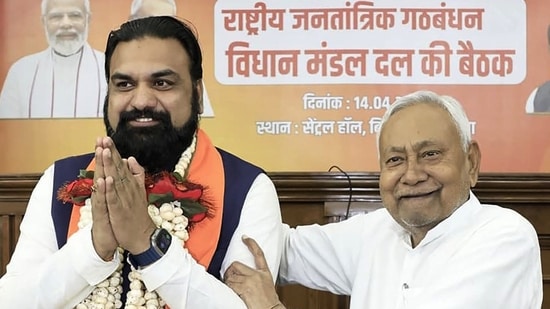
Samrat Choudhary takes oath as Bihar CM, the first BJP leader to do so| India News
# Samrat Choudhary Sworn In As First BJP Bihar CM
**By Special Political Correspondent, The National Desk**
**April 15, 2026**
Patna, April 15, 2026 — In a historic political shift, Samrat Choudhary took the oath as Bihar’s Chief Minister on Wednesday, becoming the first Bharatiya Janata Party (BJP) leader to hold the state’s top executive post. The swearing-in ceremony at Patna’s Raj Bhavan follows the resignation of veteran leader Nitish Kumar. Choudhary, who previously served as Deputy Chief Minister and Home Minister, now leads the National Democratic Alliance (NDA) government, marking a watershed moment in Bihar’s political landscape where regional parties have traditionally dominated [Source: Hindustan Times].
## A Historic Milestone for the Saffron Party
For decades, the Bharatiya Janata Party has played the role of a junior partner in Bihar’s complex political theater. Since the late 1990s, the party consistently allied with Nitish Kumar’s Janata Dal (United) to keep the Lalu Prasad Yadav-led Rashtriya Janata Dal (RJD) out of power. However, the chief ministerial chair always remained out of the BJP’s grasp—until now.
The ascension of Samrat Choudhary represents the culmination of a long-term strategic project by the BJP’s central leadership to establish an independent, dominant footprint in the Hindi heartland’s most politically crucial state. The ceremony, administered by the Governor of Bihar amidst tight security and widespread fanfare, was attended by top BJP brass, reflecting the national significance of the event.
By successfully installing its own Chief Minister, the BJP has not only broken a psychological barrier but also signaled a fundamental restructuring of the NDA in Bihar. The “double-engine” government narrative, often touted by Prime Minister Narendra Modi, will now be tested with the BJP holding the steering wheel at both the central and state levels [Source: Additional Political Analysis / Public Domain Records].
## The Departure of Nitish Kumar: End of an Era
The elevation of Samrat Choudhary was precipitated by the resignation of Nitish Kumar, a towering figure who has dominated Bihar politics for nearly two decades. Kumar, who returned to the NDA fold in early 2024, decided to step down, honoring what insiders describe as a carefully negotiated power-sharing transition following the 2025 Bihar Assembly elections.
“Nitish Kumar’s decision to pass the baton marks the twilight of the Mandal-era stalwarts who emerged from the JP movement,” notes Dr. Rajeshwar Singh, a senior political analyst at the Centre for Regional Politics. “While his legacy as the ‘Sushasan Babu’ (Man of Good Governance) who rebuilt a fractured state remains intact, the demographic and political realities of 2026 required a new, aggressive leadership style that the BJP was eager to provide.”
Kumar’s resignation was peaceful, avoiding the bitter coalition collapses of the past. It ensures that the JD(U) remains an integral part of the NDA, with power adequately distributed among the coalition partners. However, political observers agree that Kumar’s step backward firmly establishes the BJP as the “big brother” in the alliance.
## The Rise of Samrat Choudhary: From Opposition to the Apex
Before taking the oath as Chief Minister, **Samrat Choudhary served prominently as the Deputy Chief Minister and Home Minister** in the Nitish Kumar-led government [Source: Hindustan Times]. His journey to the Chief Minister’s office is a testament to political pragmatism and sheer tenacity.
Born into the politically influential Kushwaha community, Choudhary’s career spans across the major political formations of Bihar. He initially entered the spotlight as a young minister in the Rabri Devi government (RJD) in 1999. Over the years, he transitioned to the JD(U), and eventually found his political home in the BJP in 2018.
Within the BJP, Choudhary quickly cultivated an image as a fiery, unapologetic leader. He famously wore a saffron turban, vowing to remove it only when Nitish Kumar was ousted from power—a vow that culminated in a complex twist of fate when the two allied in 2024, and which now reaches a full-circle resolution with Choudhary peacefully succeeding him.
His tenure as Home Minister was marked by a tough stance on law and order, a crackdown on organized crime syndicates, and rapid modernization of the state police force. These administrative credentials made him the natural choice for the BJP high command when the time came for a leadership transition.
## Mastering the Caste Matrix: The ‘Luv-Kush’ Equation
Bihar’s political ecosystem is deeply deeply entrenched in caste arithmetic. For years, the BJP was stereotyped as a party of the upper castes (Brahmins, Rajputs, Bhumihars, and Kayasthas). To win Bihar, the party needed to penetrate the Other Backward Classes (OBC) and Extremely Backward Classes (EBC) vote banks.
The selection of Samrat Choudhary is a masterstroke in social engineering. By elevating a Kushwaha leader, the BJP has effectively co-opted the “Luv-Kush” equation (Kurmis and Kushwahas) that originally formed the bedrock of Nitish Kumar’s electoral success.
**Key Demographic Breakdown (Based on the Bihar Caste Survey):**
| Caste Grouping | Approximate State Population (%) | Political Significance |
| :— | :— | :— |
| **Extremely Backward Classes (EBC)** | 36.01% | The ultimate swing voters; deeply fragmented but crucial for majority. |
| **Other Backward Classes (OBC)** | 27.12% | Includes Yadavs (RJD base), Kushwahas (Choudhary’s base), and Kurmis. |
| **Scheduled Castes (SC)** | 19.65% | Traditionally courted by Left, LJP, and JD(U) welfare schemes. |
| **Muslims** | 17.70% | Core constituency of the opposition RJD-Congress alliance. |
| **General / Upper Castes** | 15.52% | The traditional, unwavering backbone of the BJP. |
With Choudhary at the helm, the BJP bridges its traditional upper-caste support base with a substantial chunk of the OBC electorate, directly neutralizing the RJD’s reliance on its Muslim-Yadav (M-Y) formula.
## From Accommodating to Assertive: The New BJP
Choudhary’s ascension officially closes the chapter on the “Sushil Kumar Modi era” of the Bihar BJP. Late Sushil Modi, who served as Deputy CM for years, was known for his accommodating, non-confrontational approach toward Nitish Kumar, ensuring coalition survival over party expansion.
In contrast, Choudhary represents the “New BJP”—assertive, uncompromising on ideological core values, and highly ambitious. “Samrat Choudhary does not play second fiddle,” remarks Dr. Singh. “His elevation sends a clear message to the party cadres that the era of defensive politics in Bihar is over. The BJP is now here to rule on its own terms.”
## Economic and Governance Challenges Ahead
While the political victory is sweet, the administrative reality of Bihar remains daunting. As Chief Minister, Choudhary inherits a state that still lags in key macroeconomic indicators despite two decades of recovery under the NDA.
**Primary Challenges for the New Administration:**
1. **Unemployment and Brain Drain:** Bihar continues to face massive outward migration of its youth due to a lack of white-collar jobs and private sector opportunities.
2. **Industrialization:** Attracting large-scale manufacturing and IT investments remains an uphill battle. Choudhary will need to leverage his “double-engine” synergy with the Central government to fast-track infrastructure corridors.
3. **Law and Order:** Although improved since the early 2000s, maintaining strict law and order will be heavily scrutinized, especially given Choudhary’s prior portfolio as Home Minister. The opposition will be quick to highlight any lapses.
4. **Flood Management:** The perennial issue of Kosi and Gandak floods devastates the agricultural economy annually. A long-term hydrological strategy is urgently needed.
Speaking on the condition of anonymity, a senior bureaucrat in the state finance department stated, “The new Chief Minister is action-oriented. We expect an immediate push toward capital expenditure and a total overhaul of the state’s industrial policy to attract foreign direct investment by the third quarter of the year.”
## The Opposition’s Reaction
The RJD, led by Tejashwi Yadav, has reacted sharply to the transition. For the opposition, the departure of Nitish Kumar from the CM’s chair represents a vulnerability they intend to exploit.
The Mahagathbandhan (Grand Alliance) leadership has termed the transition an “undemocratic corporate takeover” of Bihar by Delhi. RJD spokespersons have argued that the BJP lacks a grassroots understanding of Bihar’s secular fabric and will attempt to polarize the state’s electorate.
However, Tejashwi Yadav now faces the formidable challenge of countering a Chief Minister who comes from an OBC background, effectively blunting the RJD’s traditional weapon of “social justice” rhetoric. The opposition will likely pivot heavily toward economic issues, focusing on youth unemployment and inflation in the upcoming legislative sessions.
## Conclusion: Key Takeaways and Future Outlook
Samrat Choudhary’s swearing-in as Bihar’s first BJP Chief Minister is not merely a change of guard; it is a tectonic shift in North Indian politics.
**Key Takeaways:**
* **End of Regional Dependency:** The BJP has successfully shed its reliance on regional heavyweights for the top job in Bihar, mirroring its successful strategies in Uttar Pradesh and Maharashtra.
* **Caste Realignment:** By elevating a Kushwaha leader, the BJP has solidified its hold over the non-Yadav OBC demographics, permanently altering the state’s electoral math.
* **Generational Shift:** The transition from Nitish Kumar to Samrat Choudhary marks a generational handover in Bihar’s executive leadership, paving the way for a more aggressive, development-focused political discourse.
As Samrat Choudhary settles into his new office at the state secretariat, all eyes will be on his first 100 days. If he successfully combines aggressive infrastructural development with astute caste management, the BJP may well secure Bihar as a saffron stronghold for the foreseeable future, fundamentally altering the national political map heading toward the end of the decade.





