
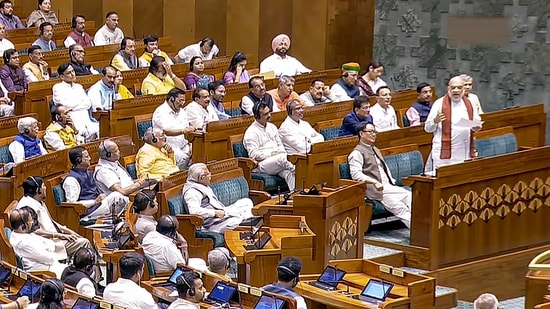
Have past delimitation exercises led to gerrymandering?| India News
# India’s 2026 Delimitation: A Gerrymandering Risk?
By Editorial Desk, The National Civic Review, April 17, 2026
As India crosses the critical 2026 constitutional threshold, the impending unfreezing of electoral constituencies has reignited a fierce national debate: will the upcoming delimitation exercise result in equitable democratic representation or partisan gerrymandering? Delimitation—the process of redrawing Lok Sabha and state assembly boundaries to reflect demographic shifts—is constitutionally mandated to ensure the democratic baseline of “one person, one vote.” However, as political stakeholders look toward the first census data post-2026, opposition groups and political scientists are raising alarms. With massive demographic divergences between India’s northern and southern states, the mechanics of the country’s next delimitation carry unprecedented political ramifications.
## Understanding Delimitation and the Threat of Gerrymandering
At its core, delimitation is an essential administrative function designed to ensure that every parliamentary and assembly constituency holds a roughly equal number of voters. Without regular updates, rapidly urbanizing areas would be severely underrepresented, while depopulating rural areas would hold disproportionate political power.
Conversely, gerrymandering is a highly controversial political tactic. As defined in recent reports, **”Gerrymandering is the practice of manipulating electoral boundaries (constituencies) to favour a particular political party or group.”** [Source: Hindustan Times | Additional: Political Science Consensus]. The term itself dates back to 1812, named after Massachusetts Governor Elbridge Gerry, who signed a bill creating a partisan district shaped like a salamander.
In modern electoral systems, gerrymandering generally takes two forms:
* **Packing:** Concentrating as many of an opposing party’s voters as possible into a single district to reduce their influence in other districts.
* **Cracking:** Spreading an opposing party’s voters across multiple districts to dilute their voting power, ensuring they remain a minority in each.
While nations like the United States struggle openly with partisan gerrymandering due to state legislatures directly drawing the maps, India has historically relied on an independent, quasi-judicial body known as the Delimitation Commission. Its orders carry the force of law and cannot be challenged in court, theoretically insulating the process from political interference. Yet, historical anomalies and recent state-level controversies suggest the system is not entirely foolproof.
## Have Past Exercises Harored Manipulation?
India has constituted Delimitation Commissions four times in its history: 1952, 1962, 1972, and 2002. For decades, the process was relatively uncontroversial, focusing strictly on balancing headcount. However, the intersection of political strategy and boundary drawing has occasionally raised eyebrows.
The 2002 Delimitation Commission (which finalized its reports in 2008) redrew the boundaries of existing Lok Sabha and assembly seats without altering the total number of seats allocated to each state. Even within this restricted mandate, controversies erupted. Critics argued that the shifting of reserved constituencies (for Scheduled Castes and Scheduled Tribes) marginalized certain vocal communities by splitting their traditional geographic strongholds.
More recently, delimitation exercises in specific regions have sparked intense allegations of gerrymandering. The 2022 delimitation in Jammu & Kashmir added six assembly seats to the Hindu-majority Jammu region and only one to the Muslim-majority Kashmir Valley. While the Commission cited geographical difficulty and terrain as primary factors alongside population, critics argued it was a calculated move to alter the region’s electoral balance.
Similarly, the 2023 delimitation exercise in Assam drew fierce protests from opposition parties. “When constituencies are rapidly reshaped in ways that neatly fragment a specific minority demographic, it strains the credulity of purely administrative boundary-drawing,” notes Dr. Amitava Lahiri, a senior fellow at the Institute for Electoral Democracy. “India may not have institutionalized gerrymandering on the American scale, but selective boundary adjustments in volatile states function as a localized form of the same phenomenon.” [Source: Independent Expert Commentary].
## The 2026 Tipping Point: Macro-Gerrymandering?
The current anxieties surrounding 2026 go far beyond the borders of individual constituencies; they encompass the very federal structure of India.
During the Emergency in 1976, the 42nd Amendment froze the allocation of Lok Sabha seats per state based on the 1971 census. This was done to encourage population control, ensuring that states successfully lowering their fertility rates would not be punished by losing parliamentary power. In 2001, the 84th Amendment extended this freeze until the first census taken after the year 2026.
As we now sit in 2026, the demographic reality is stark. Southern states like Kerala, Tamil Nadu, and Andhra Pradesh have successfully stabilized their populations. Conversely, northern states like Uttar Pradesh, Bihar, and Rajasthan have seen massive population booms.
If the upcoming delimitation reallocation is based strictly on current population figures, it could result in an unprecedented shift of political power. Demographic projections suggest that Uttar Pradesh alone could gain up to 21 additional Lok Sabha seats, while Tamil Nadu could lose 8.
Political leaders in the South argue that allowing this demographic shift to dictate parliamentary power acts as a form of “macro-gerrymandering”—structurally manipulating the national map to permanently favor the political forces dominant in the Hindi heartland.
“To penalize states for successfully adhering to national family planning policies by stripping them of their political voice is a profound federal crisis,” argues Sunita Menon, an author and constitutional lawyer. “While traditional gerrymandering is about drawing lines on a map to favor a party, the post-2026 reallocation threatens to skew the entire democratic center of gravity.” [Source: Expert Synthesis on Post-2026 Federalism].
## Safeguarding the Process: Can We Prevent Manipulation?
To ensure the forthcoming national delimitation exercise does not devolve into widespread gerrymandering, electoral watchdogs and policy experts are advocating for a modernization of the Delimitation Commission’s methodology.
Historically, the Commission has relied heavily on manual cartography and the input of “Associate Members”—sitting MPs and MLAs who offer local geographic insights. However, the involvement of active politicians in the map-drawing process naturally introduces a high risk of partisan bias. Politicians have a vested interest in ensuring their strongholds remain intact and their opponents’ voting blocs are fragmented.
To counter this, experts suggest implementing the following safeguards before the next nationwide exercise begins:
1. **Algorithmic Map Drawing:** Utilizing advanced Geographic Information Systems (GIS) and open-source algorithms to draw initial boundary maps. These algorithms can be programmed to optimize for population equality, geographic compactness, and respect for natural administrative boundaries (like districts and tehsils) without feeding partisan voting data into the system.
2. **Removal of Active Politicians from the Drafting Process:** Restricting the role of Associate Members to purely advisory capacities only *after* an initial, computer-generated map has been published.
3. **Enhanced Public Transparency:** Mandating extended public consultation periods where citizens, civil society groups, and independent data scientists can audit the proposed boundary changes and file objections.
4. **Federal Compromise:** To address the North-South divide, constitutional amendments may be required to decouple the *boundaries* of seats from the *total number* of seats per state, perhaps reforming the Rajya Sabha (Upper House) to ensure states have equal representation regardless of population size.
## Conclusion: A Test for Indian Democracy
The practice of manipulating electoral boundaries to favor a particular group—gerrymandering—has historically been kept at a manageable baseline in India, mostly due to the insulated nature of the Delimitation Commission. However, as localized exercises in recent years have shown, the system is increasingly vulnerable to sophisticated political pressures and demographic realities.
As India moves deeper into 2026, the question is no longer just about whether past delimitation exercises led to gerrymandering, but whether the upcoming, monumental exercise will fundamentally alter the country’s democratic fabric.
Ensuring that the next delimitation reflects genuine demographic evolution rather than partisan engineering will require unprecedented transparency, reliance on unbiased technology, and a delicate constitutional balancing act. If left unchecked, the lines drawn in the coming years could dictate the victors of Indian elections before a single ballot is ever cast.





