
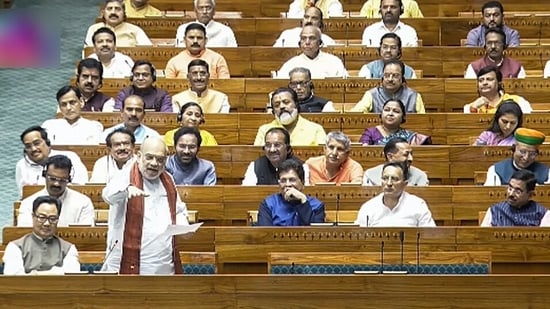
INDIA bloc MPs meet to make strategy over delimitation, women’s quota bills ahead of day 2 of Lok Sabha session| LIVE| India News
# Historic Lok Sabha Vote on Quota, Delimitation
**By Senior Political Correspondent | National News Desk | April 17, 2026**
On Friday, April 17, 2026, India’s Lok Sabha convened for a watershed special session to debate and vote on two transformative legislative measures: the Constitution (One Hundred and Thirty-First Amendment) Bill, 2026, ensuring a 33 percent parliamentary quota for women, and the highly anticipated Delimitation Bill, which aims to increase the Lower House’s capacity to 850 seats. With the decisive vote scheduled for 4:00 PM IST, the ruling government and the opposition are engaged in fierce debates over the demographic and political implications of redrawing electoral boundaries. This dual legislative push represents the most significant restructuring of India’s parliamentary democracy since independence [Source: Hindustan Times].
## A Historic Afternoon in Parliament
The atmosphere inside the new Sansad Bhavan on Friday was electric as lawmakers gathered for a special parliamentary session that promises to rewrite the rules of Indian electoral politics. The day’s agenda, culminating in the 4:00 PM vote, tackles two issues that have historically faced deep political gridlock but are now inexorably linked by demographic realities and constitutional timelines.
Prime Minister Narendra Modi and Home Minister Amit Shah spearheaded the government’s push, emphasizing that the dual bills represent a necessary evolution of the world’s largest democracy. On the other side of the aisle, Leader of the Opposition Rahul Gandhi and various regional heavyweights raised urgent questions regarding regional representation and social sub-quotas. The live proceedings, broadcast across national television, highlighted a deeply engaged House wrestling with the sweeping changes that will redefine how 1.4 billion Indians are represented.
## The 131st Amendment: Bridging the Gender Gap
The Constitution (One Hundred and Thirty-First Amendment) Bill, 2026, builds upon decades of activism and previous legislative attempts to ensure adequate female representation in the highest echelons of Indian policymaking. Commonly referred to as the Women’s Reservation Bill, this legislation mandates that 33 percent of all seats in the Lok Sabha and State Legislative Assemblies be reserved for women.
While the Nari Shakti Vandan Adhiniyam was passed in late 2023, its implementation was legally tethered to the next census and subsequent delimitation exercise. With those prerequisites now underway in 2026, the 131st Amendment serves as the operational mechanism to bring the quota to life. If the Delimitation Bill successfully expands the Lok Sabha to 850 seats, the women’s quota will guarantee that at least 280 of those seats are occupied by female parliamentarians.
“This is not merely a legislative adjustment; it is a profound social correction,” notes Dr. Meenakshi Sanyal, a constitutional scholar at the Centre for Policy Research. “For decades, women have constituted nearly half the electorate but hovered around 14 to 15 percent in Parliament. Pushing this number to 33 percent simultaneously with the expansion of the House will create an entirely new paradigm of grassroots female leadership” [Source: Hindustan Times | Additional: Centre for Policy Research Analysis].
However, the passage of the bill is not without its internal friction. Opposition leaders have repeatedly demanded “quotas within quotas,” insisting that the 33 percent reservation must include specific carve-outs for women from Other Backward Classes (OBCs) and minority communities, arguing that a blanket reservation might disproportionately benefit affluent, upper-caste women.
## Delimitation 2026: Redrawing Political Power
Running parallel to the women’s reservation debate is the monumental Delimitation Bill. Article 82 of the Indian Constitution requires the reallocation of Lok Sabha seats to the states based on the latest census data to ensure that the ratio of citizens to representatives remains roughly equal across the country.
However, through the 42nd Amendment in 1976 and the 84th Amendment in 2001, the number of Lok Sabha seats was frozen at 543, based on the 1971 census. This freeze was intended to last until the first census taken after 2026. The rationale behind the freeze was to avoid penalizing states that had successfully implemented family planning and population control measures.
With the 2026 timeline now active, the government has introduced the Delimitation Bill to increase the Lok Sabha’s strength to 850 seats. This expansion was architecturally anticipated; the new Parliament building, inaugurated in 2023, was deliberately designed with a Lok Sabha chamber capable of seating 888 members [Source: Hindustan Times | Additional: Central Vista Project Documents].
Increasing the seats to 850 means that the average size of a parliamentary constituency, which currently hovers around 2.5 million to 3 million citizens, will be reduced to a more manageable 1.6 million. Proponents argue this will bring elected representatives closer to their constituents and drastically improve governance and accountability.
## The North-South Demographic Divide
The proposed expansion to 850 seats has triggered intense anxiety among political leaders in India’s southern states, exposing a deep fault line in the nation’s federal structure.
States like Kerala, Tamil Nadu, Andhra Pradesh, and Karnataka have achieved replacement-level fertility rates and stabilized their populations over the last four decades. In contrast, northern Hindi-speaking states like Uttar Pradesh, Bihar, and Rajasthan have seen their populations surge. Under a strictly proportional delimitation based on the current population, the northern states stand to gain a massive number of new seats, significantly diluting the political clout of the South.
During the debate leading up to the 4:00 PM vote, regional leaders from the South vehemently argued that their states are being “punished for their progress.” If proportional representation is strictly applied, Uttar Pradesh alone could see its seat count jump from 80 to over 140, while a state like Kerala might only see a marginal increase, dramatically shifting the balance of power in New Delhi.
Prof. Arvind Ramanathan, a political sociologist at the National Institute of Advanced Studies, explains the gravity of the situation: “The Delimitation Bill is walking a constitutional tightrope. The foundational principle of ‘one person, one vote’ dictates that seats should reflect population. Yet, the federal principle dictates that states driving the nation’s economic engine and human development indices should not be marginalized in national decision-making. The government’s formula for these 850 seats must include safeguards, or it risks fracturing the federal consensus.”
## Voices from the Floor: Debates and Dissents
As the clock ticked toward 4:00 PM, the Lok Sabha witnessed fiery speeches. Members of the ruling coalition defended the Delimitation Bill as a triumph of democratic representation. They argued that a constituency of 3 million people is practically unmanageable and that freezing boundaries indefinitely is undemocratic to the citizens of populous states who suffer from under-representation.
Opposition figures, notably Rahul Gandhi, demanded transparency on the mathematical formula being used by the Delimitation Commission. “We are not opposed to empowering women or improving representation,” Gandhi reportedly stated during the session, “but we are fundamentally opposed to a gerrymandered delimitation that seeks to permanently centralize power in one geographic region while ignoring the demographic achievements of the South” [Source: Hindustan Times].
Home Minister Amit Shah countered these apprehensions, assuring the House that the government is committed to a consultative process. He indicated that the forthcoming Delimitation Commission would be empowered to consider both population metrics and geographical/economic factors to ensure an equitable distribution of the 850 seats.
## Implementation Challenges and Electoral Impact
Should both bills pass the 4:00 PM vote—a likely outcome given the government’s numbers, though dependent on cross-party consensus for constitutional amendments—the true challenge will shift from legislation to logistics.
The Election Commission of India (ECI) will face an unprecedented undertaking. The Delimitation Commission, headed by a retired Supreme Court judge, will have roughly two to three years to redraw the boundaries of 850 constituencies across the vast geography of India before the next scheduled general elections in 2029.
This process involves:
* **Micro-level mapping:** Analyzing district and tehsil-level population data to draw contiguous, demographically balanced constituencies.
* **Quota allocation:** Identifying which of the newly drawn 850 constituencies will be reserved for Scheduled Castes (SC), Scheduled Tribes (ST), and, critically, the new 33 percent reservation for women.
* **Public consultations:** Holding thousands of hearings across states to address local grievances regarding boundary shifts.
The reservation of constituencies for women will likely operate on a rotational basis, meaning different seats will be reserved for women in subsequent election cycles. This rotational system ensures that male candidates are not permanently locked out of specific constituencies, though it also raises concerns about whether political parties will invest long-term in constituencies where the reservation status fluctuates.
## Conclusion: A New Era for Indian Democracy
The 4:00 PM vote on April 17, 2026, will be recorded as an inflection point in India’s modern history. By moving simultaneously on the Constitution (131st Amendment) Bill and the Delimitation Bill, the Lok Sabha is addressing a long-overdue gender imbalance while confronting the complex realities of an exploding population.
The success of these initiatives will not be judged merely by the digital tally board inside the Parliament. The true test will lie in the implementation—ensuring that the historic inclusion of nearly 300 women in the Lok Sabha translates into meaningful, gender-sensitive policy-making, and guaranteeing that the expansion to 850 seats honors the democratic right to equal representation without alienating the progressive southern states.
As India anticipates the final vote count, the world watches an evolving democracy attempting to re-engineer its highest legislative body. The road ahead promises rigorous cartographic exercises, intense political maneuvering, and a profound reshaping of the Indian electoral landscape.





