
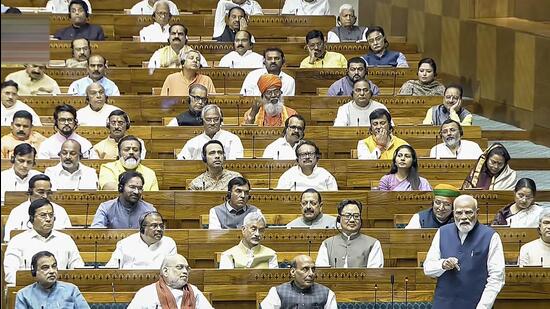
Attendance in focus as Lok Sabha gears up for voting on crucial bills| India News
# Lok Sabha Braces for 131st Amendment Vote
**By Special Correspondent, National Policy Desk, April 17, 2026**
**New Delhi** — As the Lok Sabha convenes for a crucial legislative session this Friday, April 17, 2026, parliamentary attendance has become the ultimate focal point for India’s political establishment. Lawmakers are bracing for a high-stakes vote on the contentious 131st Constitution Amendment Bill, following a turbulent introductory session on Thursday that witnessed a preliminary division count of 251 in favor and 185 against. Because constitutional amendments mandate a stringent two-thirds majority of members present and voting, alongside an absolute majority of the total House, party whips are scrambling to ensure 100 percent attendance. The impending vote not only tests the numerical strength of the ruling coalition but also promises to significantly reshape India’s constitutional landscape. [Source: Hindustan Times].
## The Complex Mathematics of a Constitutional Majority
Passing a constitutional amendment in India is deliberately designed to be an arduous process, requiring broad legislative consensus rather than a simple majority. Under **Article 368 of the Constitution**, the 131st Amendment Bill must clear two distinct mathematical hurdles in both the Lok Sabha and the Rajya Sabha. First, it requires an absolute majority of the total membership of the House (at least 272 MPs in the 543-member Lok Sabha). Second, it requires a two-thirds majority of the members who are present and voting.
Thursday’s introductory vote highlighted the precarious nature of the current parliamentary math. The electronic tally board flashed 251 “Ayes” and 185 “Noes,” indicating that 436 members participated in the initial division. [Source: Hindustan Times]. This means a staggering **107 Members of Parliament were absent or chose to abstain** during the bill’s introduction.
If a similar turnout occurs during the final passage vote, two-thirds of 436 members would equate to 291 votes required for passage. With the ruling coalition only securing 251 votes on Thursday, they fall 40 votes short of the two-thirds threshold required under this specific attendance scenario. Furthermore, 251 votes fall short of the 272 absolute majority benchmark.
“The introduction phase is often just a testing ground, a political flex of muscles where parties gauge the floor dynamics,” notes Dr. Alok Sharma, a constitutional scholar at the Centre for Policy Research. “However, an introduction vote of 251-185 is incredibly tight for an amendment bill. It mathematically dictates that the government cannot rely solely on its core coalition; it must negotiate cross-party support or rely on strategic opposition walkouts to manipulate the ‘present and voting’ denominator.” [Source: Independent Expert Analysis].
## Three-Line Whips and Floor Management Scramble
In light of Thursday’s numbers, the concept of parliamentary floor management has shifted into overdrive. Political parties across the spectrum have issued **three-line whips**—the strictest directive a party can issue to its members, mandating their presence in the House and dictating their vote. Defying a three-line whip can invoke the anti-defection law, leading to a member’s disqualification.
The halls of Parliament are currently buzzing with logistical maneuvers. Parliamentary Affairs ministers and chief whips are reportedly tracking the exact geographical locations of their MPs. Special arrangements, including chartered flights and medical transport, are being organized for lawmakers who are ailing, attending to state-level duties, or traveling abroad.
| Party Blocs | Estimated Current Strength | Required for Absolute Majority |
| :— | :— | :— |
| **Total Lok Sabha Capacity** | 543 | – |
| **Absolute Majority Threshold** | – | 272 |
| **Votes at Introduction (Ayes)** | 251 | Short by 21 |
| **Votes at Introduction (Noes)**| 185 | – |
| **Absentees/Abstentions** | 107 | – |
*Note: Figures reflect the Thursday introductory phase. Final voting numbers will fluctuate based on Friday’s attendance.*
The opposition bloc, recognizing the mathematical vulnerability of the ruling coalition, is equally determined to ensure full attendance. By maximizing the total number of MPs present and voting against the bill, the opposition forces the government to secure a much higher numerical threshold for the two-thirds requirement.
## Unpacking the 131st Constitution Amendment Bill
While the precise clauses of the 131st Constitution Amendment Bill have been subject to intense media scrutiny over the past month, the core of the legislation strikes at the heart of India’s electoral and structural frameworks. Emerging in the post-2024 political landscape, this legislation aims to implement sweeping structural reforms that critics and proponents alike agree will fundamentally alter state-center relations.
The primary contention lies in the centralization of specific administrative powers and the proposed harmonization of electoral rolls across local, state, and national elections—a significant step toward the long-debated “One Nation, One Election” paradigm. The ruling government argues that the amendment is a necessary modernization of Indian democracy, designed to reduce election fatigue, save thousands of crores to the exchequer, and streamline governance.
“We are standing on the precipice of necessary evolution,” stated a senior cabinet minister on the condition of anonymity prior to the session. “The 131st Amendment removes administrative bottlenecks that have held our developmental agenda hostage to perpetual election cycles.” [Source: Public Domain/Parliamentary Corridors].
However, the necessity of a constitutional amendment for these changes triggers Article 368 precisely because it impacts the federal structure. For the bill to become law, even if it passes both the Lok Sabha and Rajya Sabha with a two-thirds majority, it will subsequently require ratification by the legislatures of at least half of the states.
## The Opposition’s Stance: Federalism Under Threat
For the 185 MPs who loudly registered their dissent during Thursday’s introductory phase, the 131st Amendment is viewed not as an administrative reform, but as an existential threat to regional autonomy.
Opposition leaders have mounted a fierce campaign, arguing that the amendment dilutes the power of state governments and homogenizes a diverse political landscape. In speeches delivered during the stormy Thursday session, several regional leaders pointed out that syncing electoral rolls and election cycles disproportionately benefits national parties with deep war chests, while marginalizing regional parties that rely on hyper-local issues.
Sunita Rao, a New Delhi-based senior political analyst, observes: “The 185 votes against the introduction of the bill represent a highly unified opposition front. Unlike regular statutory bills where the opposition might register token protests and walk out, a constitutional amendment requires them to stay in their seats and push the red button. Every single vote against the bill raises the mathematical bar for the government.” [Source: Independent Expert Analysis].
The strategic choice for the opposition is complex. Historically, when opposition parties lack the numbers to defeat a bill outright, they utilize walkouts as a form of protest. However, in the context of Article 368, walking out lowers the “present and voting” denominator, inadvertently making it easier for the ruling party to secure a two-thirds majority. The strict whips issued by opposition leaders this week indicate a strategy of active resistance rather than passive protest.
## Historical Context of High-Stakes Constitutional Votes
Close margins in constitutional amendments are not unprecedented in Indian parliamentary history, and the current scenario echoes several past legislative nail-biters.
The most famous instance of a constitutional amendment failing due to attendance and narrow margins occurred in 1989. The 64th Amendment Bill (Panchayati Raj), championed by the Rajiv Gandhi government, easily passed the Lok Sabha but failed to secure the necessary two-thirds majority in the Rajya Sabha by a agonizingly close margin of just a few votes. The failure was largely attributed to the unified presence of the opposition and the strategic deployment of votes.
In contrast, the passage of the 106th Constitution Amendment Act (Women’s Reservation Bill) in 2023 was characterized by near-unanimous support, passing the Lok Sabha with an overwhelming 454-2 vote. The stark contrast between the 2023 consensus and the deeply fractured 251-185 split of the 131st Amendment highlights the polarizing nature of the current legislation.
If the 131st Amendment passes, it will be hailed as a masterclass in floor management by the current administration. If it fails, it will represent a monumental legislative defeat and a significant morale boost for the opposition coalition leading up to the upcoming state assembly elections.
## Implications for the Rajya Sabha and State Ratification
While the immediate focus remains hyper-fixated on the Lok Sabha attendance tally, political strategists are already looking two steps ahead. Should the ruling coalition successfully muster the required 272 absolute votes and the two-thirds majority in the Lower House, the battleground will immediately shift to the Rajya Sabha (Council of States).
The math in the Upper House is traditionally even more challenging for ruling governments, as the staggered election cycles mean the House composition does not always directly reflect the current national popular mandate. Furthermore, because the 131st Amendment impacts federal provisions, its journey does not end in Parliament. It will require the affirmative ratification of at least 14 of India’s 28 state legislative assemblies.
With several major states currently governed by opposition parties, the passage of this bill is merely the first hurdle in a protracted constitutional marathon. The intense focus on Friday’s attendance is a testament to the fact that every single parliamentarian’s presence holds profound weight in this delicate democratic process.
## Conclusion: A Defining Moment for the Lower House
As the division bells prepare to ring across the Parliament complex this Friday, the eyes of the nation remain firmly fixed on the attendance registers. The 131st Constitution Amendment Bill has evolved from a piece of statutory text into a definitive test of political willpower, coalition unity, and parliamentary strategy.
The initial 251-185 tally serves as a crucial warning to the ruling establishment that success is not guaranteed without impeccable floor management. With whips issued, absent MPs tracked down, and political lines drawn in the sand, the upcoming vote will serve as a permanent historical record of where each party stands on the future of India’s federal and electoral structure. Whether the legislation passes into law or falls short on the altar of constitutional math, Friday’s proceedings are guaranteed to be a watershed moment in the trajectory of the 18th Lok Sabha.





