
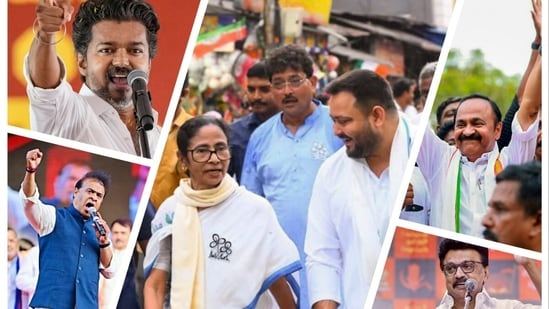
Election exit poll 2026 LIVE updates: Projections expected after 6:30 pm today
# 2026 Exit Polls: 4 States & UT Projections Today
By Staff Reporter, National News Desk, April 29, 2026
Millions of voters across **West Bengal, Tamil Nadu, Kerala, Assam, and the Union Territory of Puducherry** are eagerly awaiting the 2026 assembly election exit polls, scheduled for broadcast today after **6:30 PM IST**. The Election Commission of India (ECI) strictly prohibited the publication of any electoral projections from the commencement of phased voting on April 9 until the final ballots are cast today. As the strict embargo lifts this evening, leading polling agencies and news networks will release their analytical predictions, offering the nation its first glimpse into the potential political landscape ahead of official counting day. [Source: Hindustan Times].
## The End of the Embargo: Election Commission Mandates
The anticipation surrounding today’s release is heightened by the stringent enforcement of **Section 126A of the Representation of the People Act, 1951**. To ensure a fair democratic process uninfluenced by speculative data, the Election Commission instituted a blanket ban on all exit polls starting at **7:00 AM on April 9**, coinciding with the first phase of polling in Assam and West Bengal.
The rationale behind this embargo is to prevent early projections from swaying the electorate in states or regions that vote in later phases. With the final polling stations closing their doors in West Bengal at 6:00 PM today, the statutory restriction officially expires at 6:30 PM. Immediately following this deadline, major polling aggregators—including Axis My India, Today’s Chanakya, and CVoter—will begin disseminating their data across national and regional television networks. [Source: Hindustan Times | Additional: ECI Guidelines].
## West Bengal: A High-Stakes Battleground
Perhaps the most closely watched projections tonight will emerge from **West Bengal**, a state that has witnessed an intensely polarized and multi-phase electoral battle. The incumbent Trinamool Congress (TMC) government is seeking to defend its bastion against a formidable challenge from the Bharatiya Janata Party (BJP), while the Left-Congress alliance attempts to reclaim its lost political relevance in the state.
Throughout the campaign, the narrative has been dominated by debates over state welfare schemes, governance metrics, and socio-economic development. Turnout in the state has historically been high, and 2026 has proven no different, with early reports suggesting significant voter engagement across rural and urban constituencies alike. Exit polls will be scrutinized for indicators of anti-incumbency or the successful consolidation of localized vote banks. Psephologists will closely analyze the projected vote share in regions like Nandigram, the Matua-dominated belts, and the northern districts, which are expected to serve as key bellwethers for the final result.
## Tamil Nadu: Dravidian Giants Clash Again
In **Tamil Nadu**, the electoral battle remains a classic contest between the two Dravidian behemoths: the ruling Dravida Munnetra Kazhagam (DMK) and the opposition All India Anna Dravida Munnetra Kazhagam (AIADMK). The 2026 assembly elections have tested the strength of their respective alliances.
The DMK-led coalition has campaigned heavily on its record of social justice initiatives and infrastructure development, while the AIADMK has sought to capitalize on localized grievances and promises of enhanced state-level welfare. Additionally, the entry and growth of smaller regional parties and the BJP’s aggressive push to expand its southern footprint add layers of complexity to the race. Today’s exit polls will provide crucial insight into whether the traditional alternating-power dynamic of the state remains intact or if the incumbent coalition has managed to secure a renewed mandate.
## Kerala: LDF vs UDF in a Fierce Contest
**Kerala** presents another fascinating electoral narrative. The state has historically oscillated between the Communist Party of India (Marxist)-led Left Democratic Front (LDF) and the Congress-led United Democratic Front (UDF). After breaking the alternate-term trend in the previous election cycle, the LDF is fighting to maintain its unprecedented grip on power.
The UDF has mounted a vigorous campaign, targeting the incumbent government on economic management, infrastructure execution, and employment generation. Meanwhile, the BJP-led National Democratic Alliance (NDA) has strategically focused on increasing its overall vote share and securing key constituencies in areas like Thiruvananthapuram and Pathanamthitta. The exit polls expected after 6:30 PM will reveal if the electorate has favored continuity or reverted to its historical pattern of changing the guard.
## Assam: Security, Identity, and Development
In the northeastern state of **Assam**, the incumbent BJP-led coalition is vying to retain its dominance against a unified opposition framework spearheaded by the Congress. The electoral discourse in Assam has been heavily influenced by themes of regional identity, border security, the implementation of citizenship frameworks, and targeted economic development.
The alliances formed with various indigenous and tribal parties in the Bodoland Territorial Region (BTR) and Upper Assam are expected to play a decisive role. Exit poll data for Assam will be a critical indicator of how welfare distribution and demographic dynamics have influenced voter behavior in both the Brahmaputra and Barak valleys.
## Puducherry: The Microcosm of Alliance Politics
Though holding a smaller assembly, the Union Territory of **Puducherry** remains a prestige battle. The political landscape here is highly fragmented, often requiring intricate post-poll negotiations. The contest is primarily between the NDA—featuring the All India N.R. Congress (AINRC) and the BJP—against the Secular Democratic Alliance (SDA) led by the Congress and the DMK.
Given the razor-thin margins that often decide outcomes in Puducherry’s constituencies, exit polls will attempt to decode slight shifts in the electorate’s mood. Factors such as statehood demands, administrative friction between the elected government and the Lieutenant Governor’s office, and local infrastructure development have been the central talking points of this cycle.
## The Science and Skepticism of Exit Polls
While the projections releasing tonight command massive viewership, political analysts urge caution when interpreting the numbers. Exit polls in India face unique challenges due to the country’s vast diversity, complex caste dynamics, and multi-layered voting patterns.
“Exit polls are a measure of immediate post-voting sentiment, not absolute certainty,” explains Dr. Malini Seshadri, a veteran political analyst and psephologist. “In highly polarized states like West Bengal or closely fought battles like Kerala, a small margin of error in vote share conversion can drastically alter the seat projection. The methodology—whether it relies on random sampling outside booths or comprehensive post-poll household surveys—plays a massive role in the accuracy of these numbers.”
Despite technological advancements and increasingly sophisticated data modeling by agencies, the inherent unpredictability of the Indian voter means that today’s figures will remain purely speculative until the actual electronic voting machines (EVMs) are opened. [Additional: General Psephology Knowledge].
## Conclusion: The Road to Counting Day
As the clock strikes 6:30 PM today, the media blackout will end, ushering in hours of intense numerical analysis, political debates, and speculative government formations. For the citizens of West Bengal, Tamil Nadu, Kerala, Assam, and Puducherry, these exit polls offer a captivating, albeit unofficial, preview of their collective decision.
However, the ultimate verdict remains locked inside the strongrooms. Political parties, candidates, and voters will have to wait until **Counting Day** to see if the statistical projections align with democratic reality. Until then, the exit polls will dominate the national conversation, setting the stage for what promises to be a historic culmination of the 2026 assembly elections.





