
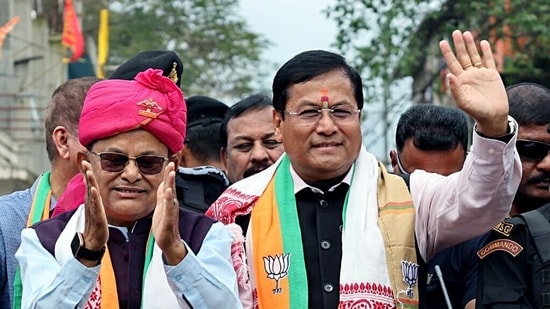
BJP’s Prasanta Phukan eyes fifth consecutive win from Dibrugarh in 2026 Assembly Polls
# BJP’s Phukan Eyes 5th Dibrugarh Win
**By Political Desk, The National Standard, May 4, 2026**
Veteran Bharatiya Janata Party (BJP) leader Prasanta Phukan has officially set his sights on the 2026 Assam Legislative Assembly elections, confirming his intention to contest once again from the prestigious Dibrugarh constituency. Seeking a rare fifth consecutive term, Phukan aims to extend a political dominance that began in 2006. As Upper Assam prepares for a high-stakes electoral battle, the continuation of Phukan’s candidacy highlights the BJP’s strategy of banking on deeply entrenched local stalwarts to maintain its fortress in the state’s economic capital, simultaneously navigating the inevitable challenges of long-term incumbency [Source: Hindustan Times | Additional: Assam State Election Commission Archives].
## The Legacy of an Upper Assam Stalwart
Prasanta Phukan’s political trajectory is deeply intertwined with the rise of the BJP in Assam. When he first won the Dibrugarh seat in **2006**, the Congress party, led by the late Tarun Gogoi, was at the height of its power in the state. Phukan was one of the few BJP candidates to breach the Congress bastion in Upper Assam, winning by a narrow but symbolically massive margin.
Over the next two decades, Phukan transformed Dibrugarh into an impenetrable fortress for the saffron party. He successfully retained his seat during the Congress wave of 2011, rode the massive “Modi wave” in 2016 which saw the BJP form its first government in Assam, and consolidated his position further during the 2021 elections under the leadership of Chief Minister Himanta Biswa Sarma.
Phukan’s enduring appeal lies in his deep local roots and highly visible presence in the constituency. Unlike politicians who migrate to state capitals, Phukan is known for his localized approach, frequently seen mediating community disputes, attending local cultural events, and spearheading municipal initiatives.
### Historical Electoral Performance of Prasanta Phukan
To understand the magnitude of Phukan’s grip on Dibrugarh, one must look at his consistent electoral growth over the past four election cycles:
* **2006 Assembly Election:** Defeated Kalyan Kumar Gogoi (INC). Marked the BJP’s critical entry into the constituency.
* **2011 Assembly Election:** Defeated Kalyan Kumar Gogoi (INC) again, surviving a state-wide pro-Congress wave.
* **2016 Assembly Election:** Secured a massive victory over Chandra Kanta Baruah (INC), aligning with the BJP’s state-wide landslide.
* **2021 Assembly Election:** Defeated Rajkumar Nilanetra Neog (INC) by a commanding margin of over 38,000 votes, securing over 60% of the total vote share.
[Source: Hindustan Times | Additional: Election Commission of India Historical Data].
## Electoral Dynamics and Demographics of Dibrugarh
Dibrugarh is not merely a legislative seat; it is the economic nucleus of Upper Assam. Often dubbed the “Tea City of India,” its demographic makeup is complex and highly influential in determining the region’s political climate. The constituency features a vibrant mix of native Assamese communities, a significant population of tea tribe workers, Bengali Hindus, and a large Marwari business community that drives the local economy.
For the BJP, retaining the support of this diverse electorate has required a delicate balancing act. The urban business communities have historically aligned with the BJP’s economic policies and nationalistic rhetoric. Meanwhile, the crucial tea garden vote—once a monolithic vote bank for the Indian National Congress—has decisively shifted toward the BJP over the last ten years. This shift was engineered through aggressive direct-benefit transfer (DBT) schemes, free rice distribution, and infrastructure development within the tea estates.
However, the recent 2023 delimitation exercise in Assam has subtly altered the boundaries of several constituencies. While Dibrugarh retained its core urban and peri-urban character, the inclusion of new suburban blocks means Phukan will have to introduce his micro-level campaigning to a freshly integrated subset of voters.
## Development Initiatives vs. The Anti-Incumbency Factor
A politician seeking a fifth term inevitably faces the shadow of anti-incumbency. Twenty years is a long time in public office, and voter fatigue is a documented phenomenon in Indian electoral politics. To counter this, Phukan’s 2026 campaign is heavily anchored to the tangible infrastructure transformations witnessed in Dibrugarh over the last decade.
**Key developmental highlights under his tenure include:**
* **Urban Infrastructure Upgrade:** The elevation of the Dibrugarh Municipal Board to a Municipal Corporation, unlocking greater central and state funding for urban development.
* **Healthcare Expansion:** Massive infrastructural upgrades to the Assam Medical College and Hospital (AMCH), the oldest medical college in the Northeast, establishing it as a premier super-specialty hub.
* **Flood Management:** Ongoing investments into the Dibrugarh Town Protection (DTP) drain project, addressing the city’s chronic urban flooding issues—a persistent demand of local residents.
* **Connectivity:** Leveraging the completion of the Bogibeel Bridge (inaugurated in 2018), which transformed Dibrugarh into a massive logistics hub connecting the northern and southern banks of the Brahmaputra.
Despite these achievements, the opposition is likely to target persistent local grievances. Issues such as urban waterlogging during the monsoons, the demand for higher daily wages for tea garden workers, and youth unemployment remain fertile ground for political challengers.
## The Opposition’s Strategy for 2026
The political landscape in Assam has evolved significantly since the 2021 elections. The United Opposition Forum Assam (UOFA), a coalition of opposition parties including the Congress, Assam Jatiya Parishad (AJP), and Raijor Dal, is attempting to pool its resources to prevent the fragmentation of anti-BJP votes.
In Dibrugarh, the Congress faces an uphill battle. To unseat a four-term incumbent, the opposition requires a charismatic local candidate capable of bridging the gap between the urban middle class and the rural tea workers. Analysts expect the opposition to focus heavily on the economic anxieties of the youth and promise reforms in the tea sector.
“Prasanta Phukan’s greatest strength is his accessibility,” notes Dr. Jyotirmoy Saikia, a political science researcher based in Upper Assam. “However, after 20 years, an MLA transitions from being a representative to becoming an institution. The opposition’s only viable strategy is to run an aggressively future-focused campaign, convincing voters that while Phukan stabilized Dibrugarh, a new vision is required for its next phase of modernization.” [Source: Independent Political Analysis].
## Strategic Importance for the State BJP Leadership
For Chief Minister Himanta Biswa Sarma and the BJP’s central high command, Dibrugarh is a prestige battle. Upper Assam is the cultural and political heartland of the state. Sweeping this region is an absolute necessity for the BJP to secure a third consecutive term in Dispur (the seat of the Assam government).
Phukan’s renomination is a clear indicator that the BJP is not taking unnecessary risks in its core strongholds. While the party has ruthlessly replaced sitting MLAs in other states to combat anti-incumbency—a strategy often termed the “Gujarat model”—Phukan’s unbroken winning streak and immense personal capital have seemingly shielded him from such internal purges.
His campaign will likely be bolstered by the state government’s flagship welfare initiatives, notably the *Orunodoi* scheme, which provides direct monthly financial assistance to women from economically weaker households. The BJP relies heavily on this “labharthivarg” (beneficiary class) to secure electoral mandates.
## Implications and Future Outlook
As the countdown to the 2026 Assembly polls begins, Prasanta Phukan’s bid for a fifth term sets the stage for a fascinating electoral contest in Dibrugarh.
**Key Takeaways to Watch:**
1. **Voter Turnout Dynamics:** Whether Phukan can maintain the enthusiastic turnout of his urban base despite the fatigue of a two-decade tenure.
2. **Opposition Unity:** Whether the Congress and regional parties can effectively field a joint candidate to consolidate the anti-incumbent vote share.
3. **Tea Tribe Sentiment:** How the tea garden communities, a decisive factor in Upper Assam, respond to the state government’s ongoing economic interventions versus the opposition’s wage-hike promises.
If Phukan secures victory in 2026, he will cement his legacy as one of the longest-serving and most successful legislators in Assam’s modern political history. For now, the veteran leader remains heavily entrenched, utilizing his vast organizational machinery to ensure that the lotus continues to bloom in the tea capital of the world.





