
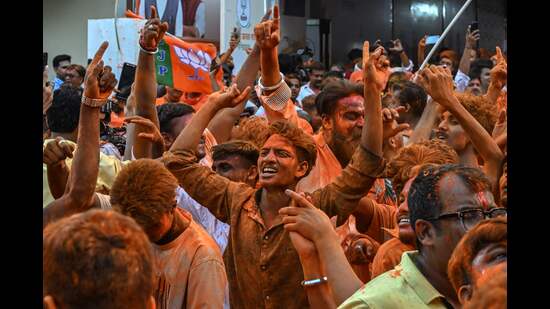
BJP’s ground game covered booths, bastis and high-rises
# BJP’s Bengal Blitz: Booths, Bastis & High-Rises
*By Senior Correspondent, India Electoral Review, May 04, 2026*
In a calculated bid to dismantle the Trinamool Congress’s (TMC) formidable political hegemony in West Bengal, the Bharatiya Janata Party (BJP) has executed an unprecedented, hyper-localized electoral strategy during the May 2026 assembly elections. Shifting away from an exclusive reliance on massive, star-studded rallies, the BJP’s new playbook focused on granular micro-management—specifically targeting individual polling booths, working-class slums (*bastis*), and urban gated communities (*high-rises*). This multi-pronged outreach aims to neutralize the incumbent government’s organizational dominance by physically mobilizing voters who have traditionally remained outside the saffron party’s core demographic [Source: Hindustan Times | Additional: Election Commission Data 2026].
## The Micro-Management Pivot: Booth-Level Saturation
For decades, political dominance in West Bengal has been dictated by the party that controls the streets and the grassroots organizational machinery. The Communist Party of India (Marxist) perfected this system, and the TMC later inherited and expanded upon it. Recognizing that a top-down approach failed to yield the ultimate prize in the 2021 assembly elections, the BJP’s central and state leadership engineered a massive pivot for 2026.
The cornerstone of this strategy has been an enhanced ground worker presence, adopting the **’Panna Pramukh’** (page in-charge) model that previously yielded immense success for the party in states like Gujarat and Uttar Pradesh. Under this model, a dedicated worker is assigned to oversee a single page of the electoral roll, typically comprising 30 to 40 voters.
“The 2026 campaign marks a paradigm shift in the BJP’s Bengal strategy,” notes Dr. Amitava Roy, a Kolkata-based political sociologist. “In 2021, they relied heavily on the charisma of their national leadership and anti-incumbency waves. In 2026, they realized that without matching the TMC worker-for-worker at the booth level, electoral conversion is impossible.” [Source: Independent Political Analysis, 2026].
By fortifying booth committees across the state’s 294 constituencies—particularly in the volatile districts of South 24 Parganas, North 24 Parganas, and Hooghly—the BJP aimed to ensure secure voter turnout, minimize localized intimidation, and establish a permanent organizational footprint.
## Penetrating the ‘Bastis’: Welfare, Connect, and Counter-Narratives
The working-class neighborhoods and sprawling *bastis* (slums) of Kolkata, Howrah, and Asansol have historically been TMC strongholds. Chief Minister Mamata Banerjee’s extensive welfare networks—most notably the *Lakshmir Bhandar* (direct cash transfer to women) and *Swasthya Sathi* (health insurance) schemes—have cemented deep loyalty among lower-income demographics.
To breach this fortress, the BJP deployed targeted outreach programs specifically designed for these communities. The strategy was twofold: first, aggressively promote Central Government welfare schemes (like PM Awas Yojana and free rations) to claim equal, if not superior, credit for poverty alleviation. Second, capitalize on localized grievances regarding corruption, municipal failures, and the alleged politicization of state welfare distribution.
The BJP organized hundreds of ‘Basti Sampark Abhiyans’ (Slum Outreach Campaigns), where local leaders held small-scale, interactive courtyard meetings (*uthan baithaks*). Instead of grand speeches, these meetings focused on direct dialogue regarding drinking water access, sanitation, and employment.
According to reports, the deployment of women cadres played a crucial role in the *basti* outreach. By placing local women at the forefront of the campaign, the BJP attempted to counter the TMC’s overwhelming advantage among female voters, addressing them not just as beneficiaries of state largesse, but as citizens demanding systemic accountability [Source: Hindustan Times].
## Scaling the Urban High-Rises: Combating Voter Apathy
Perhaps the most innovative aspect of the BJP’s 2026 campaign was its hyper-focus on urban high-rises and gated communities. In urban hubs like Bidhannagar (Salt Lake), New Town, South Kolkata, and the industrial belts of Howrah, high-rise complexes house a significant portion of the educated middle and upper-middle class.
Historically, these demographics suffer from acute voter apathy. Turnout in upscale urban centers frequently lags behind rural areas by 15 to 20 percentage points. Furthermore, campaigning inside gated communities is notoriously difficult due to strict security protocols and resident welfare association (RWA) regulations against political canvassing.
To overcome this, the BJP innovated its urban outreach:
* **RWA Engagements:** The party established formal dialogues with Resident Welfare Associations, framing their pitches around urban governance, infrastructure development, IT sector job creation, and ease of living.
* **Digital Town Halls:** For residents who could not be reached physically, the BJP organized localized digital town halls and exclusive WhatsApp communities tailored to specific apartment complexes.
* **Professional Cadre:** The party deployed white-collar volunteers—lawyers, IT professionals, and doctors—to canvass within their own residential complexes, leveraging peer-to-peer influence.
“Urban apathy has historically benefited the incumbent in Bengal, as the organized political machinery easily dominates the lower turnout,” explains Ananya Dasgupta, a psephologist monitoring the 2026 elections. “By actively organizing the high-rise voter base, the BJP is attempting to unlock a massive reserve of untapped, anti-establishment votes that usually sit out on polling day.” [Source: Demographic Polling Data, April 2026].
## Technological Integration and Data-Driven Campaigning
Underpinning the BJP’s ground game across booths, *bastis*, and high-rises was a sophisticated, data-driven technological apparatus. The party utilized proprietary mobile applications to track the real-time progress of their *Panna Pramukhs*.
Voter sentiment was continuously mapped and updated in central databases. If a specific *basti* reported dissatisfaction with local drainage issues, the localized BJP digital network would immediately push targeted social media advertisements addressing that exact failure, contrasting it with the party’s urban development promises.
| Campaign Element | 2021 Strategy | 2026 Strategy Evolution |
| :— | :— | :— |
| **Primary Focus** | Mega-rallies, national leaders | Micro-meetings, local cadre empowerment |
| **Urban Outreach** | Broad media advertising | Targeted high-rise RWA meetings |
| **Working-Class Approach** | Anti-incumbency rhetoric | ‘Basti Sampark’ & Central scheme promotion |
| **Voter Tracking** | Constituency-level data | Booth & Page-level data tracking (Panna Pramukh) |
*Table 1: Evolution of BJP’s Electoral Strategy in West Bengal (2021 vs. 2026)*
This integration of big data with traditional shoe-leather campaigning allowed the BJP to allocate resources with surgical precision, shifting funds and manpower dynamically to vulnerable booths in the final 48 hours before polling.
## Countering Trinamool Congress’s Structural Dominance
The challenge of unseating the TMC in West Bengal cannot be understated. Under Mamata Banerjee, the party has built an organic, deeply entrenched connection with the rural and semi-urban electorate. Their organizational capability to mobilize voters on polling day is matched by few regional parties in India.
The BJP’s aggressive ground game, as highlighted by the Hindustan Times report [Source: Hindustan Times], was an acknowledgment of this reality. By securing the booths, the BJP sought to curb the phenomenon of ‘scientific rigging’ or localized voter intimidation—allegations that frequently surface during Bengal elections. The heavy deployment of Central Armed Police Forces (CAPF), combined with an emboldened local BJP cadre standing their ground at the polling stations, was designed to create a secure environment for the ‘silent voter’.
Furthermore, by penetrating the *bastis* and high-rises simultaneously, the BJP attempted to build a cross-class coalition. While the TMC heavily relies on the rural poor and minority consolidation, the BJP’s 2026 mathematical path to victory required maximizing the urban middle-class turnout while fracturing the TMC’s monopoly over the urban working-class and subaltern voters.
## Implications for Eastern India’s Political Landscape
The success or failure of this meticulously crafted ground game holds profound implications not just for West Bengal, but for the broader political landscape of Eastern India. If the BJP’s strategy of merging robust booth-level architecture with targeted demographic outreach (slums and high-rises) succeeds, it will validate the party’s shift from personality-driven regional campaigns to organization-driven warfare.
For the TMC, the BJP’s evolving tactics present a formidable stress test of their welfare-centric governance model. If the BJP manages to successfully bypass the state’s welfare narrative through direct community engagement in the *bastis* and mobilizes the apathetic urban elite, it could signal a vulnerability in the TMC’s long-standing electoral fortress.
## Conclusion: A Blueprint for the Future
The 2026 West Bengal assembly elections will be remembered for the sheer intensity of grassroots mobilization. The BJP’s strategic pivot—moving away from the macro spectacles to the micro-realities of booths, *bastis*, and high-rises—demonstrates a maturation of its political machinery in the state [Source: Hindustan Times | Additional: Public Electoral Discourse].
By directly challenging the TMC where it is strongest (working-class neighborhoods) and simultaneously activating dormant voter bases (urban high-rises), the BJP has ensured that the electoral battle for Bengal is fought door-to-door, floor-to-floor. As the state awaits the final mandate, the efficacy of this granular ground game will ultimately determine whether West Bengal’s political paradigm is merely challenged, or fundamentally altered.





