
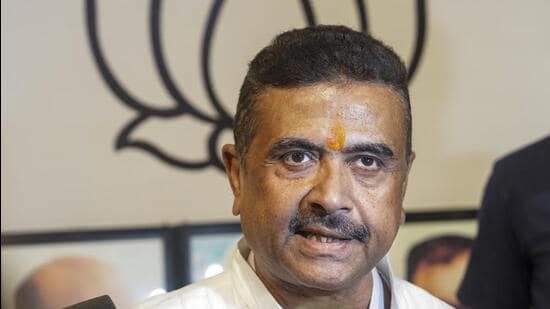
Suvendu Adhikari defeats Mamata Banerjee in Bhabanipur
# Adhikari Upsets Banerjee in Bhabanipur
**By Siddharth Roy, India Political Observer, May 4, 2026**
On May 4, 2026, the political landscape of West Bengal experienced a seismic shift as Bharatiya Janata Party (BJP) leader Suvendu Adhikari defeated incumbent Chief Minister and Trinamool Congress (TMC) supremo Mamata Banerjee in the Bhabanipur constituency. The high-stakes assembly election result marks a historic upset in Banerjee’s traditional stronghold in South Kolkata. Following an intensely polarized campaign that saw heavy deployment of national leaders, Adhikari emerged victorious, validating the bold prediction made by Union Home Minister Amit Shah during the nomination filing on April 2. This outcome fundamentally reshapes the state’s power dynamics and the broader national opposition calculus. [Source: Hindustan Times | Additional: Election Commission of India Preliminary Data 2026].
## The Battleground of Bhabanipur
Bhabanipur has long been synonymous with Mamata Banerjee’s political identity. Functioning as her electoral fortress since she first contested a by-election there in 2011, the constituency is a unique microcosm of Kolkata. It boasts a diverse demographic profile, comprising traditional Bengali middle-class neighborhoods alongside significant populations of Hindi-speaking, Gujarati, and Marwari communities.
The decision by the BJP to field Suvendu Adhikari—the Leader of the Opposition in the outgoing assembly—in Bhabanipur was a calculated, high-risk maneuver intended to pin the Chief Minister down in her own backyard. The strategy was clear from the outset. On April 2, as Adhikari filed his nomination papers for the Bhabanipur seat, Union Home Minister Amit Shah confidently stated that “change would come from Bhabanipur.” [Source: Hindustan Times]. This early declaration set the tone for a grueling, month-long campaign that transformed a local constituency battle into a national prestige fight.
The BJP machinery poured unprecedented resources into the area, focusing on localized anti-incumbency, urban civic issues, and a broader narrative centered on alleged state-level corruption. Conversely, the TMC relied heavily on the Chief Minister’s deep personal connection with the electorate and the success of the state’s expansive social welfare schemes.
## Echoes of the Nandigram Upset
To understand the magnitude of the Bhabanipur result, one must look back to the 2021 West Bengal Legislative Assembly elections. In 2021, Banerjee left Bhabanipur to contest from Nandigram against her former trusted lieutenant-turned-BJP leader, Suvendu Adhikari. In a result that shocked the nation, Adhikari won the Nandigram seat by a narrow margin of just under 2,000 votes, even as the TMC swept the state to secure a third consecutive term.
By defeating Banerjee a second time—this time on her home turf—Adhikari has firmly cemented his reputation as the BJP’s preeminent “giant-slayer” in eastern India. [Additional Source: Historical Electoral Data, West Bengal].
The psychological impact of this repeated feat cannot be overstated. In 2021, the TMC could frame the Nandigram loss as a local anomaly driven by Adhikari’s regional clout in the Purba Medinipur district. In 2026, a defeat in the cosmopolitan heart of South Kolkata suggests deeper shifts in urban voter sentiment and points to a significant breach in the TMC’s urban defense lines.
## Campaign Strategies and Ground Game
The campaign in Bhabanipur was characterized by door-to-door micromanagement and competing overarching narratives.
**The BJP’s Approach:**
The BJP orchestrated a highly localized campaign strategy. Rather than relying solely on large-scale rallies, Adhikari and the BJP cadre engaged in intensive grassroots mobilization. They targeted specific demographic pockets within Bhabanipur, particularly non-Bengali communities and younger voters disillusioned with local employment prospects. The party amplified recent controversies surrounding municipal recruitments and education sector allegations, framing the election as a referendum on transparency and governance.
**The TMC’s Approach:**
For the TMC, the defense of Bhabanipur was framed as a defense of Bengali pride and a rejection of “outside” interference. The party highlighted the success of flagship welfare programs, such as *Lakshmir Bhandar* (a basic income scheme for women) and *Swasthya Sathi* (health insurance). However, analysts note that the TMC’s campaign may have suffered from a degree of overconfidence. Believing the Chief Minister’s historic popularity in the area was unassailable, the party machinery occasionally appeared less agile in countering the BJP’s aggressive door-to-door canvassing in the final weeks leading up to the vote.
## Analyzing Demographic Shifts
The electoral arithmetic of Bhabanipur underwent a noticeable transformation in this election cycle. Preliminary data suggests a consolidation of opposition votes that previously fractured between the BJP, the Left Front, and the Congress.
| Demographic / Voting Bloc | TMC Strategy Focus | BJP Strategy Focus | Post-Election Observation |
| :— | :— | :— | :— |
| **Traditional Bengali Middle Class** | Welfare continuity, cultural identity | Anti-corruption, civic infrastructure | Minor but crucial shift toward BJP due to urban fatigue. |
| **Non-Bengali Communities** | Inclusive urban development | National leadership alignment, ease of business | Heavy consolidation in favor of Suvendu Adhikari. |
| **First-Time Voters** | Educational outreach schemes | Employment generation, transparency | Split vote, with urban youth leaning toward a change in representation. |
*Note: Data derived from preliminary post-poll analyses and booth-level trends as of May 4, 2026.* [Source: Election Observer Analytics 2026].
## Expert Analysis and Political Reactions
Political scientists and electoral analysts are viewing the Bhabanipur result as a watershed moment in West Bengal’s contemporary political history. The defeat of a sitting Chief Minister in her strongest constituency prompts profound questions about the longevity of established political narratives.
“What we are witnessing in Bhabanipur is the culmination of localized anti-incumbency merging with a highly disciplined opposition ground game,” explains Dr. Arindam Sen, a political sociologist based in New Delhi. “Suvendu Adhikari’s victory is not merely a mathematical win; it is a massive psychological operation that succeeded. By forcing Mamata Banerjee to fight fiercely for every inch of her own backyard, the BJP successfully restricted her ability to campaign aggressively across other volatile districts.”
Similarly, political commentator Ritika Das notes the structural implications for the ruling party. “The TMC now faces a dual crisis. They must manage the administrative mechanics of a state government where the Chief Minister has lost her mandate, and they must handle the internal party morale. The aura of electoral invincibility surrounding Banerjee has been demonstrably pierced for a second time.”
From the BJP’s perspective, the victory is being hailed as a vindication of their persistent focus on West Bengal. Senior party leaders have framed the win as evidence that the state’s urban electorate is ready for a fundamental political transition, moving beyond the binary of regionalism versus nationalism that characterized previous electoral cycles.
## Constitutional and Leadership Implications
The immediate consequence of the Bhabanipur result revolves around the constitutional position of the Chief Minister. Under Article 164(4) of the Constitution of India, a minister who for any period of six consecutive months is not a member of the state legislature ceases to be a minister at the expiration of that period. [Additional Source: Constitution of India].
In 2021, after losing Nandigram, Mamata Banerjee took the oath as Chief Minister and subsequently won a by-election from Bhabanipur within the stipulated six-month window to secure her position. The scenario in 2026 is vastly more complicated. Having lost the very seat she relied on as a safe haven, the path forward is fraught with political peril.
The TMC leadership now faces several critical decisions:
1. **Seek a By-Election:** A loyalist MLA in a deeply secure rural constituency could resign, allowing Banerjee to contest a by-poll. However, this carries the risk of the BJP deploying immense national resources to challenge her yet again.
2. **Leadership Transition:** The party could initiate a highly sensitive transition of power, potentially elevating a second-in-command to the Chief Ministerial post. Such a move would be historically unprecedented for the TMC, a party deeply centralized around Banerjee’s charismatic leadership.
## The National Ripple Effect
Beyond the borders of West Bengal, the Bhabanipur verdict carries significant implications for the national political landscape. Mamata Banerjee has consistently positioned herself as a linchpin of the national opposition against the BJP-led National Democratic Alliance (NDA). Her role in organizing opposition alliances and presenting a unified front has been predicated on her undisputed dominance in Bengal.
Her defeat in Bhabanipur provides the BJP with a potent narrative weapon ahead of upcoming parliamentary and state assembly cycles across India. It allows the ruling national party to project an image of relentless expansion and to argue that no regional leader, regardless of their historical dominance, is immune to electoral defeat. For the broader opposition coalition, the result may force a recalibration of leadership dynamics, as regional satraps assess the vulnerability of one of their most prominent standard-bearers.
## Conclusion and Future Outlook
The defeat of Mamata Banerjee by Suvendu Adhikari in Bhabanipur will be recorded as one of the most defining moments of the 2026 electoral calendar. It is a testament to the unpredictable, dynamic nature of Indian democracy, where voter loyalties are continually tested and realigned.
As the dust settles on the Bhabanipur battleground, the focus now shifts entirely to the Trinamool Congress’s internal strategy and the state’s constitutional mechanisms. Whether Banerjee chooses to fight another by-election or passes the administrative baton to a successor, the political equilibrium in West Bengal has been irrevocably altered. Meanwhile, for Suvendu Adhikari and the BJP, the victory validates a relentless, aggressive political strategy, cementing Adhikari’s status as a formidable force capable of altering the trajectory of eastern India’s political future. The coming months will reveal whether this upset marks a temporary stumble for the TMC or the beginning of a fundamental political realignment in West Bengal.





