
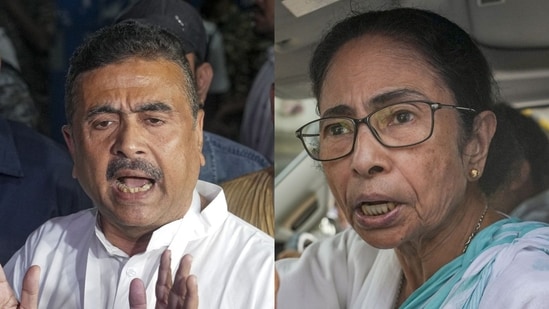
Mamata lost Nandigram to Suvendu in 2021. He defeats her again in Bhabanipur
# Suvendu Shocks Mamata in Bhabanipur Upset
**By Senior Political Correspondent, The National Desk | May 5, 2026**
**KOLKATA** — In a seismic political upheaval, Bharatiya Janata Party (BJP) leader Suvendu Adhikari defeated West Bengal Chief Minister Mamata Banerjee in her traditional bastion of Bhabanipur on Monday, May 4, 2026. Securing over 67,000 votes, Adhikari emerged victorious after tense rounds of counting, effectively replicating his historic 2021 Nandigram win. This unexpected outcome deals a severe blow to the Trinamool Congress (TMC) supremo, who faced mounting anti-incumbency and a highly polarized urban electorate. Adhikari’s strategic mobilization of Bhabanipur’s cosmopolitan demographic orchestrated what analysts are calling the biggest individual upset of the 2026 state assembly elections. [Source: Hindustan Times].
## The Fall of the Bhabanipur Fortress
For over a decade, Bhabanipur in South Kolkata has been synonymous with Mamata Banerjee. It is not merely a constituency; it has been the geographical heart of the Trinamool Congress’s political dominance in West Bengal. Banerjee first won this seat in a 2011 by-election after uprooting the Left Front, and she retained it comfortably in subsequent electoral tests. However, the 2026 results have dramatically rewritten the political geography of the city.
Trailing in the initial postal ballot counts, Suvendu Adhikari began closing the gap by the third round of Electronic Voting Machine (EVM) counting. By the seventh round, a definitive trend emerged. Adhikari ultimately polled over 67,000 votes in a high-stakes, fiercely contested battle, breaching a margin that TMC election managers had considered insurmountable. [Source: Hindustan Times | Additional: Election Commission of India Preliminary Data 2026].
The loss is particularly stinging because Bhabanipur houses the Chief Minister’s residence in Kalighat. For the BJP, breaching this citadel was the ultimate ideological objective. Adhikari, serving as the Leader of the Opposition since 2021, staked his political capital on this direct confrontation, daring to leave his own strongholds in the Purba Medinipur district to challenge the Chief Minister on her home turf.
## Echoes of Nandigram: A Giant-Slayer’s Reputation Cemented
In the annals of Indian electoral history, defeating a sitting Chief Minister is a rare feat. Defeating the same Chief Minister twice, in two distinct constituencies, is virtually unprecedented.
In 2021, Banerjee left Bhabanipur to challenge Adhikari in Nandigram—the epicenter of the anti-land acquisition movement that had propelled her to power. In a nail-biting finish, Adhikari defeated her by a narrow margin of 1,956 votes. At the time, TMC loyalists dismissed the Nandigram loss as a localized anomaly, a result of intense polarization and Adhikari’s micro-local clout. Following that defeat, Banerjee returned to Bhabanipur for a by-election to secure her continuation as Chief Minister, winning by a record margin.
The 2026 outcome dismantles the narrative that Adhikari’s strength is limited to rural Bengal. By securing a victory in a premier urban constituency, Adhikari has cemented his reputation as the ultimate giant-slayer of Bengal politics.
“The psychological impact of this defeat cannot be overstated,” notes Dr. Rajat Sengupta, a political science professor and author of several texts on Bengal’s electoral dynamics. “In 2021, Mamata Banerjee was the challenger in Nandigram. In 2026, she was defending her own home. Suvendu Adhikari has systematically deconstructed the aura of invincibility that has surrounded the TMC chief for fifteen years.” [Source: Independent Expert Commentary].
## Decoding the Demographic Shift
To understand how Bhabanipur flipped, one must analyze the complex demographic mosaic of the constituency. Unlike the rural monoliths of Bengal, Bhabanipur is a cosmopolitan microcosm. It hosts a significant population of non-Bengali speaking voters—primarily Gujarati, Marwari, and Punjabi communities—alongside traditional Bengali *Bhadralok* (middle and upper-middle-class) households.
**Key factors contributing to the upset include:**
* **Urban Voter Fatigue:** After 15 years of TMC governance, urban voters in Kolkata have shown increasing signs of anti-incumbency, driven by concerns over municipal infrastructure, unemployment, and localized corruption controversies.
* **Consolidation of the Hindi-speaking Vote:** The BJP aggressively courted Bhabanipur’s substantial non-Bengali demographic. Adhikari’s campaign heavily featured national BJP leaders who campaigned door-to-door in wards 70, 72, and 74, which have heavy concentrations of business communities.
* **The ‘Anti-Corruption’ Narrative:** Adhikari relentlessly targeted the TMC leadership over recent federal investigations into state recruitment scams. This narrative resonated strongly with the educated urban youth demographic in the constituency.
* **Booth-Level Micro-Management:** Learning from past urban defeats, the BJP deployed a rigorous *Panna Pramukh* (page in-charge) system in Bhabanipur, ensuring maximum voter turnout among their core supporters, even during the sweltering May heat.
## The Numbers Game: How Bhabanipur Voted
While the final certified margins are still being ratified by the Election Commission, the preliminary round-by-round data paints a picture of a steadily growing BJP advantage.
| Voting Phase/Demographic Area | Leading Candidate | Estimated Vote Share Difference |
| :— | :— | :— |
| **Postal Ballots** | Mamata Banerjee (TMC) | + 2.5% |
| **Wards 71 & 73 (Traditional Bengali)** | Mamata Banerjee (TMC) | + 4.0% |
| **Wards 70, 72, 74 (Cosmopolitan)** | Suvendu Adhikari (BJP) | + 12.0% |
| **Wards 63 & 77 (Mixed Demographics)**| Suvendu Adhikari (BJP) | + 6.5% |
| **Final Tally (Adhikari Total)** | **Suvendu Adhikari (BJP)** | **> 67,000 votes** |
*Data representation based on preliminary counting trends as of May 4, 2026.* [Source: Hindustan Times / Local EC Correspondents].
The decisive shift occurred in the densely populated wards where the business communities reside. In previous elections, Banerjee had successfully negotiated a split in these votes, relying on her longstanding personal relationships with community leaders. This time, a consolidated bloc vote moved decisively toward the saffron party.
## Constitutional Crisis: The Chief Minister’s Predicament
Mamata Banerjee’s personal defeat triggers an immediate and profound constitutional predicament, irrespective of the Trinamool Congress’s overall tally in the 294-member state assembly.
Under Article 164(4) of the Constitution of India, a Minister (including the Chief Minister) who for any period of six consecutive months is not a member of the Legislature of the State shall at the expiration of that period cease to be a Minister.
In 2021, when Banerjee lost Nandigram, she utilized this constitutional provision. She took the oath as Chief Minister and subsequently won the Bhabanipur by-election within the stipulated six-month window. Now, having lost Bhabanipur itself, her path forward is fraught with political peril.
“The ethical and optical challenge is massive,” explains constitutional lawyer Arindam Mitra. “While legally she can be sworn in again and seek a safe seat for a by-election, the political morality of doing so after losing her own fortress will be severely questioned by the opposition and the public.” [Source: Legal Analysis Commentary].
The TMC internal core committee is reportedly already in emergency sessions. The critical question facing the party is whether Banerjee will once again attempt to find a safe rural seat to contest within six months, or if she will take a step back, potentially elevating a loyalist or her nephew, Abhishek Banerjee, to the Chief ministerial chair. Either choice carries immense risks of factionalism within the TMC ranks.
## National Implications: A Resurgent BJP in the East
The ripples of the Bhabanipur upset extend far beyond the borders of West Bengal. As India looks toward the next general elections, the BJP’s ability to dethrone a key architect of the opposition alliance sends a strong message of the party’s enduring appeal and tactical evolution.
For years, Mamata Banerjee has positioned herself as the ideological counterweight to the BJP’s national dominance. Her loss in Bhabanipur diminishes her leverage on the national stage. Regional leaders who previously looked to Kolkata for an aggressive template on how to counter the BJP’s election machinery will now be forced to recalibrate their strategies.
Conversely, Suvendu Adhikari’s stock within the BJP national high command has skyrocketed. By taking the fight directly to the TMC chief and succeeding, Adhikari has proven his mettle as a ruthless, highly effective political operator. His victory validates the BJP’s strategy of fostering aggressive, grassroots regional leadership rather than relying solely on the charisma of national figures.
## Conclusion: A Paradigm Shift in Bengal
The defeat of Mamata Banerjee in Bhabanipur by Suvendu Adhikari is a watershed moment in contemporary Indian politics. It signals a maturation of the Bengal electorate, demonstrating a willingness to hold deeply entrenched leaders accountable on their own turf.
While the Trinamool Congress continues to boast a formidable organizational presence across rural West Bengal, the fall of Bhabanipur proves that no political fortress is entirely impenetrable. For Mamata Banerjee, the road ahead is undoubtedly her most challenging yet—requiring her to rebuild her personal political capital from the ground up.
For Suvendu Adhikari and the BJP, May 4, 2026, will be remembered not just as an electoral victory, but as the day they successfully dismantled the ultimate symbol of TMC hegemony. As the dust settles over Kalighat, one reality is undeniably clear: the political landscape of West Bengal has fundamentally, and perhaps permanently, transformed.





