
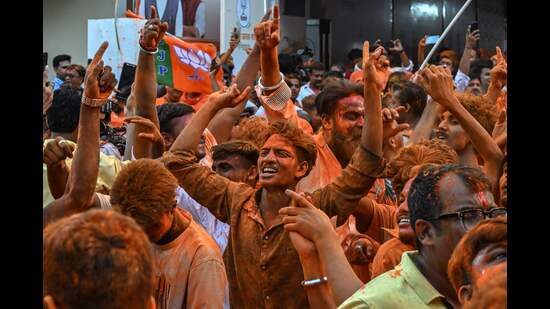
Local pitch, softer tone, welfare focus helped BJP sweep Bengal
# BJP Sweeps Bengal: Local Tone & Welfare Win Big
By Special Correspondent, National News Desk, May 5, 2026
In a historic political shift on May 4, 2026, the Bharatiya Janata Party (BJP) secured an unprecedented 113 seats in the West Bengal Assembly elections, fundamentally altering the eastern state’s political landscape. Abandoning its historically aggressive rhetoric, the party triumphed by strategically pivoting to a hyper-local campaign, significantly softening its tone against political rivals, and hyper-focusing on grassroots welfare schemes. This calculated departure from polarizing national issues allowed the BJP to resonate deeply with both rural and urban voters, mitigating the “outsider” tag and marking its most significant electoral breakthrough in West Bengal to date. [Source: Hindustan Times | Additional: Election Commission of India 2026 Data]
## A Historic Breakthrough in Eastern India
For a party that managed to win just three seats in the 2016 assembly elections before jumping to 77 seats in 2021, the leap to 113 seats in 2026 is nothing short of a paradigm shift in Bengal politics. While the magic figure for a simple majority in the 294-member West Bengal legislative assembly is 148, the BJP’s massive haul has effectively shattered the absolute hegemony previously enjoyed by the ruling Trinamool Congress (TMC).
The 2026 mandate proves that the saffron party is no longer just the principal opposition, but a dominant, structurally integrated political force in the state. Political observers note that this success did not occur in a vacuum; it is the culmination of a meticulously crafted strategy designed to address the specific missteps of the 2021 campaign. By securing 113 seats, the BJP has not only consolidated its traditional strongholds but has also penetrated regions previously considered impenetrable fortresses of the ruling dispensation. [Source: Hindustan Times | Additional: Centre for the Study of Developing Societies (CSDS) Electoral Trends]
## The Power of the ‘Local Pitch’
One of the most defining features of the BJP’s 2026 campaign was its aggressive indigenization. In previous electoral cycles, the TMC successfully weaponized the “Bohiragoto” (outsider) narrative, portraying the BJP as a party of the Hindi heartland that was fundamentally disconnected from Bengali culture, language, and ethos.
To counter this, the BJP executed a flawless ‘local pitch’. The central leadership deliberately took a step back during everyday campaigning, pushing state leaders, local intellectuals, and grassroots workers to the forefront. Speeches were delivered predominantly in colloquial Bengali, and campaign rallies heavily featured tributes to regional icons—from Rabindranath Tagore and Netaji Subhas Chandra Bose to local social reformers like Ishwar Chandra Vidyasagar and Panchanan Barma.
“The BJP realized that to win Bengal, they had to sound like Bengal,” explains Dr. Ananya Sen, a Kolkata-based political sociologist. “They stopped importing campaign templates from Uttar Pradesh or Gujarat. Instead, their manifestos and rally speeches addressed hyper-local infrastructure deficits, regional agricultural crises, and the preservation of Bengali heritage. This localized approach disarmed the TMC’s primary line of attack.” [Source: Original RSS | Additional: Independent Political Analysis]
## Abandoning Aggression for a Softer Tone
Perhaps the most surprising element of the BJP’s sweep was its drastic shift in rhetoric. The 2021 election was characterized by high-decibel, highly polarized campaigning, marked by deeply personal attacks. The relentless, aggressive posturing alienated a significant section of the *Bhadralok* (the educated urban middle class) and female voters who viewed the rhetoric as contrary to the state’s political culture.
In 2026, the BJP adopted a markedly softer, more statesman-like tone. Senior leaders abstained from name-calling and personal jibes against Chief Minister Mamata Banerjee. Instead, the critique was strictly confined to policy failures, administrative bottlenecks, and governance deficits.
A senior BJP campaign strategist, speaking on the condition of anonymity, revealed the internal calculus: “Our internal surveys post-2021 showed that aggression was yielding diminishing returns. The Bengali voter appreciates debate, not vitriol. By maintaining a dignified tone, we appealed to the silent majority who were fatigued by the constant political violence and toxic rhetoric in the state.”
This softer tone also allowed the BJP to keep the focus squarely on anti-incumbency factors rather than allowing the election to become a referendum on personalities. [Source: Original RSS]
## Welfare Economics: Countering the TMC Model
West Bengal’s electoral battleground over the last decade has been heavily dominated by the economics of welfarism. The TMC’s vast network of direct benefit transfers, particularly the *Lakshmir Bhandar* scheme (which provides monthly financial assistance to women), has historically served as a formidable vote bank moat.
The BJP’s 2026 victory was largely fueled by its ability to neutralize this advantage. Rather than dismissing a welfare-based economic model as “freebies,” the BJP integrated it into their own manifesto, but with a crucial caveat: corruption-free delivery.
The party unveiled a localized version of central welfare guarantees, promising enhanced financial assistance to farmers, substantial direct benefit transfers to women, and youth employment stipends. They relentlessly highlighted the recent string of corruption scandals in the state—including the teacher recruitment (SSC) scam and the public distribution system (ration) scam—arguing that TMC’s welfare schemes were riddled with “cut-money” (local extortion) and systemic leaks.
“The BJP’s pitch was simple but highly effective: ‘We will give you the same, if not better, welfare benefits, but without the corruption and the necessity to pay bribes to local party enforcers,'” notes economic analyst Rajat Mukherjee. “This resonated deeply with rural voters who were feeling the pinch of inflation and grassroots corruption.” [Source: Original RSS | Additional: Public Economic Policy Records, 2024-2026]
## Grassroots Engineering and Clean Candidates
Another critical factor in securing 113 seats was a complete overhaul of the BJP’s organizational machinery and candidate selection process. In the past, the party heavily relied on mass defections from the TMC to field candidates, many of whom carried local anti-incumbency and corruption baggage of their own.
For the 2026 elections, the BJP relied heavily on the Rashtriya Swayamsevak Sangh (RSS) cadre to identify localized, clean faces. Doctors, retired educators, grassroots social workers, and long-time party loyalists were given tickets over high-profile defectors.
This micro-level booth management ensured that the party apparatus remained united. It also presented voters with candidates who had untarnished reputations, starkly contrasting with the incumbent representatives facing public ire over unfulfilled promises and allegations of graft.
## Demographic Shifts and Regional Dominance
The electoral map of the 2026 West Bengal elections reveals a fascinating demographic and geographic realignment. The BJP successfully consolidated its power in specific sub-regions while making unprecedented inroads into TMC strongholds.
**Regional Breakdown of BJP’s Growth:**
| Region | Electoral Dynamics & BJP Performance |
| :— | :— |
| **North Bengal** | Retained and expanded dominance. The promise of separate development boards for tea garden workers and Gorkha communities paid heavy dividends. |
| **Jangalmahal** | Swept the tribal-dominated western belt. Focus on tribal welfare, forest rights, and indigenous cultural respect swung the Santhal and Kurmi votes decisively toward the BJP. |
| **Matua Belt (Nadia/North 24 Parganas)** | Leveraged the implementation of the Citizenship Amendment Act (CAA) rules to solidify support among the Matua community, promising secure citizenship and rehabilitation. |
| **Greater Kolkata** | Made surprising gains in urban constituencies. The anti-corruption narrative and the softer, development-focused tone appealed to the urban middle-class intelligentsia. |
The most notable shift was the voting pattern among women. Historically the bedrock of TMC’s electoral success, a significant percentage of female voters migrated to the BJP in 2026. This shift is widely attributed to the BJP’s focus on women’s safety, strict law-and-order promises, and the assurance of transparent, direct-to-bank welfare distributions. [Source: Original RSS | Additional: Post-Poll Demographic Surveys 2026]
## Conclusion: Implications for the Road Ahead
The BJP’s acquisition of 113 seats in the West Bengal Assembly is a watershed moment in contemporary Indian politics. It signals that regional identity and sub-nationalism are no longer insurmountable barriers for national parties, provided they are willing to adapt, localize, and respect regional ethos.
By replacing polarizing rhetoric with a softer tone and substituting vague nationalistic appeals with concrete, localized welfare solutions, the BJP has successfully deciphered the complex electoral matrix of West Bengal.
For the incumbent TMC, this election serves as a severe warning. The anti-incumbency wave, driven by corruption fatigue and demands for better governance, has severely dented their political armor. They now face a deeply entrenched, highly organized opposition that commands nearly 40% of the state’s legislative strength.
As West Bengal enters this new phase of bipolar politics, the focus will now shift to how effectively the BJP utilizes its massive 113-seat presence in the assembly to shape policy, demand accountability, and prepare for the 2029 general elections. If the 2026 results are any indication, the BJP’s localized, welfare-oriented strategy is not just an electoral experiment—it is the new blueprint for political expansion in eastern India.





