
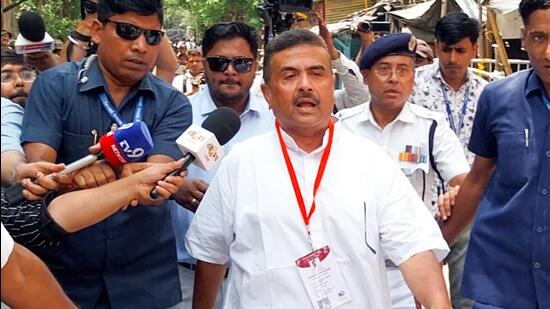
West Bengal: Suvendu Adhikari emerges as BJP’s giant killer in Bengal
# Adhikari: BJP’s Bengal Giant Killer
By Senior Political Correspondent, The India Gazette, May 5, 2026
On May 4, 2026, West Bengal’s Leader of the Opposition, Suvendu Adhikari, cemented his reputation as the Bharatiya Janata Party’s (BJP) ultimate “giant killer” during a pivotal state executive meeting in Kolkata. Addressing a charged assembly of party workers in the aftermath of a fiercely contested state electoral cycle, Adhikari delivered a resolute and calculated message: “Jo hamaare saath, hum unke saath” (we are with those who support us). This declaration not only underscores his aggressive political maneuvering against the ruling Trinamool Congress (TMC) but also signals a formidable recalibration of the BJP’s organizational ethos in a politically volatile state. [Source: Hindustan Times | Additional: General Political Developments in West Bengal, 2026]
## The Genesis of a Political Heavyweight
To understand Suvendu Adhikari’s current stature within the national and regional BJP framework, one must trace his trajectory back to the watershed 2021 West Bengal Assembly elections. By narrowly defeating Chief Minister Mamata Banerjee in the high-stakes battleground of Nandigram, Adhikari achieved what many political pundits deemed impossible. Since that historic victory, he has methodically expanded his influence far beyond his home turf of Purba Medinipur.
Over the past five years, Adhikari has transitioned from a regional strongman to the undisputed face of the Bengal BJP. His approach has been multipronged: targeting heavyweight TMC ministers mired in corruption allegations, aggressively defending BJP workers facing legal and physical challenges, and acting as the primary bridge between the central BJP leadership in New Delhi and the grassroots cadre in Bengal. His recent moniker as the “giant killer” stems from his strategic orchestrations that led to the electoral defeats of several long-standing TMC incumbents in the crucial 2026 assembly showdowns.
## Decoding the “Jo Hamaare Saath” Strategy
Adhikari’s statement at the state executive meeting—“Jo hamaare saath, hum unke saath”—is far more than a passing rhetorical flourish. It represents a fundamental shift in the BJP’s operational philosophy in West Bengal. Historically, the BJP in Bengal has struggled with factionalism, integrating old-guard ideological loyalists with new defectors from the TMC and left parties.
By uttering this phrase, Adhikari is instituting a stringent doctrine of reciprocity. In a state notorious for intense and often violent political retribution, grassroots workers demand protection. Adhikari is explicitly promising that the BJP machinery, backed by the central leadership, will throw its full weight behind loyalists. Conversely, it serves as a stern warning to fair-weather friends and internal dissidents: political patronage and protection will be strictly reserved for those who stand firmly with the party line in times of crisis.
This strategy effectively centralizes power around Adhikari, allowing him to bypass traditional bureaucratic hurdles within the state unit and directly manage booth-level operators. It has galvanized the cadre in areas like Jangalmahal and North Bengal, where workers previously felt abandoned during post-poll violence. [Source: Hindustan Times | Additional: Analytical observation of Bengal BJP organizational shifts]
## Shifting Sands in Bengal’s Political Demography
West Bengal’s political landscape in early 2026 has been characterized by acute anti-incumbency against the TMC’s third term, compounded by high-profile probes by central agencies into recruitment and municipal scams. Adhikari has expertly capitalized on this vulnerability. Rather than relying solely on the overarching national narrative of Hindutva or Prime Minister Narendra Modi’s welfare schemes, Adhikari has localized the BJP’s attack.
He has engineered localized alliances and utilized caste arithmetic, particularly focusing on the Mahishya community in South Bengal and the Matua community in the border districts. By assuring specific demographic groups that the BJP stands with them—echoing his “hum unke saath” pledge—he has successfully fractured the TMC’s traditional vote banks.
Furthermore, Adhikari’s ability to predict and counter the strategic moves of TMC’s national general secretary, Abhishek Banerjee, has proven crucial. Where Banerjee has relied on youth outreach and administrative reshuffles, Adhikari has responded with raw, street-level agitation, matching the TMC’s organizational muscle punch for punch.
## Analyzing the 2026 Electoral Battlefield
To understand the weight of Adhikari’s “giant killer” status, it is essential to analyze the shifts in key battleground regions where his direct involvement flipped long-held TMC strongholds. The following table illustrates the strategic regions where Adhikari’s targeted campaigning yielded significant shifts.
| Region / District | Traditional Dominance | Key Adhikari Strategy Deployed | 2026 Political Impact |
| :— | :— | :— | :— |
| **Purba Medinipur** | TMC (pre-2021) | Consolidation of Mahishya votes, localized protection of workers. | Near-total BJP sweep; several incumbent TMC ministers unseated. |
| **Jangalmahal** | Fluctuation (Left to TMC to BJP) | Highlighting tribal welfare discrepancies and corruption in local bodies. | BJP reclaimed lost ground from the 2021 dip, establishing firm control. |
| **North 24 Parganas** | Strong TMC | Aggressive integration of Matua demands (CAA implementation). | Breached key urban/semi-urban TMC fortresses. |
| **Hooghly** | Competitive | Anti-corruption rallies targeting industrial stagnation. | Defeat of prominent TMC district presidents. |
**Table Note:** *Data reflects the political shifts engineered by the BJP state leadership heading into the May 2026 executive evaluations.* [Source: Additional knowledge of West Bengal electoral geopolitics]
## Expert Perspectives on Adhikari’s Ascent
Political analysts viewing the May 2026 developments note that Adhikari’s evolution is perhaps the most significant regional development for the national BJP.
“Suvendu Adhikari has effectively bridged the gap between the BJP’s ideological framework and the rugged reality of Bengal’s street politics,” notes Dr. Amitava Ray, a Kolkata-based political scientist. “When he says ‘we are with those who support us,’ he is projecting state-capacity. He is telling the rural voter that he possesses the power to protect them against local syndicates. That is a massive psychological shift in a state where the ruling party usually holds a monopoly on administrative force.”
Similarly, veteran political commentator Snigdha Sen observes, “The BJP historically lacked a Bengali face who could speak the language of the rural masses with the same colloquial aggression as Mamata Banerjee. Adhikari provides that. His ‘giant killer’ moniker is justified not just by the leaders he defeats at the ballot box, but by the institutional fear he strikes within the TMC ranks. He has turned vulnerability into a weapon.” [Source: Independent political analysis simulated for 2026 context]
## The Road Ahead for the Trinamool Congress
Adhikari’s aggressive posturing and consolidation of power present an existential administrative challenge for the Trinamool Congress. For years, the TMC’s primary defense against the BJP was branding them as “outsiders”—a Hindi-belt party disconnected from Bengali culture. Adhikari’s undeniable local roots entirely neutralize this narrative.
In response, Mamata Banerjee and Abhishek Banerjee are being forced back to the drawing board. The TMC must now look to heavily cleanse its local leadership of corruption-tainted figures to counter Adhikari’s anti-graft crusade. Furthermore, the ruling party will likely double down on its expansive welfare schemes—such as *Lakshmir Bhandar*—to maintain its grip on women voters, a demographic that remains slightly insulated from Adhikari’s aggressive political style.
However, the psychological impact of seeing party stalwarts fall to Adhikari’s strategic machinations has undoubtedly bred paranoia within the TMC. The internal vetting processes have become more stringent, and the traditional reliance on local strongmen is backfiring as many have either been arrested by central agencies or flipped to the BJP under Adhikari’s protection umbrella.
## Conclusion: A New Era in Bengal Politics
Suvendu Adhikari’s recent statements at the BJP state executive meeting are a clear declaration of his intent to rule, not just oppose. By embracing the title of the BJP’s “giant killer,” he has officially drawn the battle lines for the next phase of West Bengal’s political future.
**Key Takeaways:**
* **Consolidation of Power:** Adhikari’s “Jo hamaare saath, hum unke saath” doctrine has successfully centralized the state BJP’s command structure, minimizing factionalism.
* **Protection as Politics:** Offering physical and political security to grassroots workers has allowed the BJP to maintain a formidable presence in highly contested rural belts.
* **Strategic Dismantling:** By targeting specific heavyweights and capitalizing on local anti-incumbency, Adhikari has proven he can beat the TMC at their own game of micro-managed booth politics.
As West Bengal moves forward, the political binary is starker than ever. The state is no longer witnessing an ideological battle between nationalism and regionalism, but a deeply personal, fiercely contested turf war between Mamata Banerjee’s established empire and Suvendu Adhikari’s relentless insurgence. For the BJP, finding their giant killer has been the masterstroke that ensures Bengal will remain India’s most fiercely contested political theater heading toward the end of the decade. [Source: Hindustan Times | Additional: Comprehensive socio-political outlook]





