
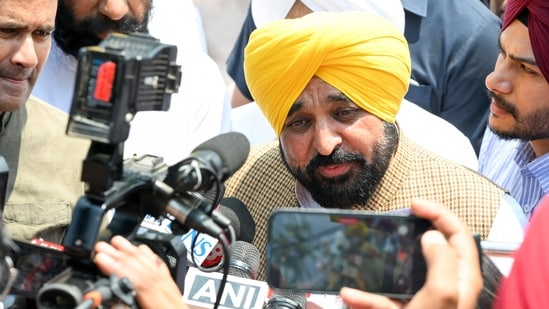
'Can't do as they please': Punjab CM Bhagwant Mann hits out at Raghav Chadha, ex-AAP MPs for BJP switch
# Mann Seeks Sack of AAP MPs After BJP Switch
**By Senior Political Correspondent, The National Desk | May 05, 2026**
Punjab Chief Minister Bhagwant Mann met President Droupadi Murmu in New Delhi on Tuesday, demanding the immediate termination of six Rajya Sabha Members of Parliament from Punjab who recently defected to the Bharatiya Janata Party (BJP). Submitting a formal memorandum at Rashtrapati Bhavan, Mann launched a scathing attack on the defectors, prominently including former top Aam Aadmi Party (AAP) strategist Raghav Chadha. Mann argued that the unprecedented switch violates the anti-defection provisions of the Constitution, stating the defectors “cannot do as they please” with the mandate entrusted to them by the people of Punjab.
[Source: Hindustan Times | Additional: Rashtrapati Bhavan Press Communiqué]
## The Presidential Intervention and Mann’s Ultimatum
The political landscape of Punjab was jolted earlier this month when a commanding majority of the state’s Upper House representatives abandoned the ruling Aam Aadmi Party to don saffron colors. Chief Minister Bhagwant Mann’s high-profile visit to the President marks an aggressive escalation in AAP’s response to what it terms an illegal subversion of democracy.
During his address to the media outside Rashtrapati Bhavan, Mann minced no words. “These individuals were sent to the Rajya Sabha on the strength of the Aam Aadmi Party’s historic 2022 assembly victory in Punjab. The mandate belongs to the voters, not to individual ambitions. They cannot do as they please, betray the electorate, and expect to retain their constitutional privileges,” Mann declared.
The Chief Minister’s memorandum to President Murmu explicitly invokes the **Tenth Schedule of the Indian Constitution**, requesting her to advise the Chairman of the Rajya Sabha to expedite the disqualification proceedings. While the formal power of disqualification in the Upper House rests with its Chairman—Vice President Jagdeep Dhankhar—Mann’s appeal to the President is a strategic move designed to amplify the constitutional and moral magnitude of the defections.
## The Raghav Chadha Factor: A Stunning Realignment
The focal point of this mass exodus is undeniably Raghav Chadha. Once considered the blue-eyed boy of AAP’s national convener Arvind Kejriwal and the chief architect of the party’s 2022 Punjab campaign, Chadha’s transition to the BJP has sent shockwaves through Indian political corridors.
Chadha, who previously co-piloted AAP’s expansion initiatives and handled crucial financial and strategic portfolios, had notably distanced himself from frontline party activities throughout late 2024 and 2025. His sudden emergence at the BJP headquarters, flanked by five other AAP Rajya Sabha MPs from Punjab, represents a critical loss of intellectual and administrative capital for AAP.
“Raghav Chadha’s exit is not just a numerical loss; it is a psychological blow to the Aam Aadmi Party,” notes Dr. Meenakshi Sundaram, a New Delhi-based political scientist. “Chadha was instrumental in bridging the gap between Delhi and Punjab leaderships. His defection, alongside five others, signals severe internal ruptures within the party’s core structure that have been festering behind closed doors.”
[Source: Hindustan Times | Additional: Independent Political Analysis, May 2026]
## Constitutional Crisis: Navigating the Tenth Schedule
The defection of six out of AAP’s seven Rajya Sabha MPs from Punjab brings the intricacies of India’s anti-defection law into sharp focus. The Tenth Schedule, inserted into the Constitution in 1985, was designed to prevent the proverbial “Aaya Ram Gaya Ram” politics by punishing legislators who switch sides post-election.
However, the law contains specific exemptions. Paragraph 4 of the Tenth Schedule protects legislators from disqualification if their original political party “merges” with another party, and if at least two-thirds of the members of the legislature party agree to such a merger.
**The Legal Dispute:**
* **The Defectors’ Argument:** The defecting MPs argue that since six out of seven MPs constitute well over the two-thirds majority required (approx. 85%), they represent a legitimate split/merger of the parliamentary party and should be shielded from disqualification.
* **AAP’s Counter-Argument:** AAP’s legal cell, backing CM Mann’s memorandum, insists that the Tenth Schedule requires the *original political party* to merge. AAP, as a national party, has not merged with the BJP. Therefore, a mere separation of a parliamentary faction, regardless of its size, does not meet the legal threshold for exemption.
### Anti-Defection Law Criteria at a Glance
| Legal Concept | Requirement under 10th Schedule | Application in AAP Crisis |
| :— | :— | :— |
| **Disqualification** | Voluntarily giving up party membership. | Defecting MPs formally joined the BJP. |
| **Merger Exemption** | 2/3rd members must agree to a merger of the *original party*. | 6 of 7 MPs agreed (>2/3rd), but AAP as a party has not merged. |
| **Deciding Authority** | Chairman/Speaker of the respective House. | Rajya Sabha Chairman Jagdeep Dhankhar must rule. |
“The jurisprudence around the Tenth Schedule has evolved significantly, particularly after the Maharashtra political crisis of 2022-2023,” explains Adv. Harish Salve, a constitutional law expert. “The Supreme Court has clarified that a legislative majority cannot be conflated with the original political party. If the Election Commission still recognizes AAP as an independent entity, the breakaway faction of MPs is highly vulnerable to disqualification, irrespective of their two-thirds strength.”
## Aam Aadmi Party’s Internal Turmoil
For the Aam Aadmi Party, the defections arrive at a precarious time. Since its resounding victory in Punjab in 2022, the party has grappled with the dual pressures of fulfilling expansive pre-poll guarantees and managing intense scrutiny from central investigative agencies over various administrative policies.
Chief Minister Bhagwant Mann has found himself increasingly isolated as the central leadership in Delhi battles its own legal and political storms. The departure of six Rajya Sabha MPs—individuals who were handpicked by the high command to represent Punjab’s interests in the national capital—reflects growing dissent against the party’s centralized decision-making process.
Insiders suggest that the defecting MPs cited “stifling bureaucracy within the party” and a “lack of vision for Punjab’s long-term agricultural and industrial revival” as primary reasons for their exit. By framing their defection as a principled stand for the state’s development, they aim to dilute the stigma traditionally associated with party-hopping.
However, Mann’s aggressive pushback is an attempt to reclaim the narrative. By demanding their immediate termination, he is signaling to his remaining MLAs in the Punjab Legislative Assembly that the party leadership will employ every legal mechanism available to punish disloyalty.
## BJP’s Calculated Expansion in Punjab
While AAP fights fires, the Bharatiya Janata Party is celebrating a monumental strategic victory. Historically, the BJP has struggled to establish an independent, formidable footprint in Punjab, having played junior partner to the Shiromani Akali Dal (SAD) for decades. Following the dissolution of their alliance over the controversial farm laws, the BJP has been aggressively trying to court Sikh leaders and prominent local faces.
Bringing six sitting Rajya Sabha MPs into the fold—especially a high-profile, urban-savvy leader like Raghav Chadha—is a masterstroke in the BJP’s “Look North” strategy. It bolsters the BJP’s numbers in the Upper House, moving them closer to an absolute, unassailable majority, which is critical for passing contentious legislative reforms slated for late 2026.
“The BJP is executing a classic decapitation strike on AAP’s national aspirations,” states Smita Rao, a political commentator specializing in North Indian electoral dynamics. “By absorbing AAP’s intellectual core in the Rajya Sabha, the BJP achieves three things: they weaken their most vocal opponent in Parliament, they acquire ready-made organizational leaders for Punjab ahead of the 2027 state elections, and they create a perception of AAP as a sinking ship.”
[Source: Hindustan Times | Additional: BJP Strategy Reports 2026]
## The Procedural Road Ahead
The ball now lies firmly in the court of Rajya Sabha Chairman Jagdeep Dhankhar. When a petition for disqualification is filed, the Chairman is required to issue notices to the accused members, seeking their response. The process can involve hearings and the examination of legal precedents.
While the anti-defection law does not prescribe a strict time limit for the presiding officer to decide on disqualification petitions, the Supreme Court of India ruled in the *Keisham Meghachandra Singh vs. The Hon’ble Speaker* (2020) case that such petitions should ideally be decided within a reasonable period, typically three months.
If the MPs are disqualified, it will trigger by-elections for these six Rajya Sabha seats. Given that the Aam Aadmi Party still commands a brute majority of 92 seats in the 117-member Punjab Legislative Assembly, AAP would easily win back all six seats. This mathematical reality begs the question: why would the MPs risk defection knowing they could lose their parliamentary status?
Political analysts believe the defectors are banking on a prolonged legal battle. By dragging the disqualification proceedings through the Chairman’s office and subsequently through the Supreme Court, the MPs hope to retain their seats and privileges long enough to transition into direct electoral roles ahead of the 2027 Punjab Assembly elections.
## Implications for Punjab and National Politics
Chief Minister Bhagwant Mann’s intervention at Rashtrapati Bhavan elevates this conflict from a regional skirmish to a national constitutional debate. The defection saga carries several profound implications:
1. **Litmus Test for the Tenth Schedule:** The Chairman’s ruling on whether a two-thirds majority of a parliamentary faction constitutes a legal merger will set a monumental precedent for future party splits in the Rajya Sabha.
2. **AAP’s Survival Tactics:** The AAP will need to rapidly restructure its Punjab unit. Mann’s leadership is now under the microscope; he must prove he can hold his remaining legislative flock together amidst perceived aggressive poaching by the BJP.
3. **Redrawn Electoral Map for 2027:** The BJP, armed with new, prominent faces, will likely contest the upcoming Punjab assembly elections with unprecedented aggression, turning the state into a fiercely contested multi-cornered fight involving AAP, Congress, SAD, and the BJP.
## Conclusion: A High-Stakes Waiting Game
As Bhagwant Mann returns to Chandigarh, the political tremors of his Delhi visit will continue to resonate. His firm stance—”They can’t do as they please”—reflects the outrage of a party that feels its massive democratic mandate is being subverted through backroom maneuvering.
However, moral outrage must now translate into legal victory. The fate of Raghav Chadha and the five other defecting MPs rests entirely on the interpretation of the Tenth Schedule by the Rajya Sabha Chairman and, inevitably, the Supreme Court of India. Until a verdict is delivered, Punjab remains trapped in a high-stakes waiting game, watching as the very fabric of its political representation is tested on the anvil of constitutional law.
*Disclaimer: The above political analysis is based on unfolding events and constitutional precedents up to May 2026. The final legal standing of the Members of Parliament is subject to the rulings of the Rajya Sabha Chairman and the judiciary.*





