
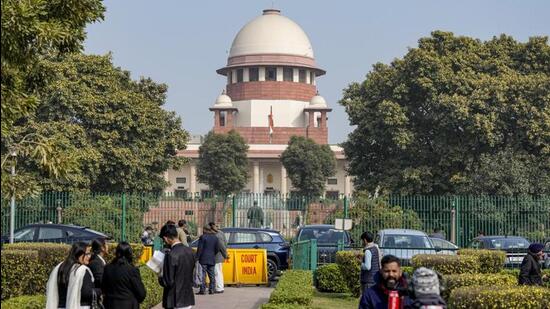
Sabarimala PIL papers should have been ‘thrown in dustbin’: Supreme Court
# SC: Sabarimala PIL Belongs in Dustbin
By Legal Correspondent, National News Desk, May 05, 2026
On Tuesday, the Supreme Court of India severely reprimanded the petitioners of a Public Interest Litigation (PIL) concerning the Sabarimala temple, categorically stating that the foundational documents of the case should have been “thrown in the dustbin.” The apex court bench took strong exception to the petition, observing that the court had previously entertained the matter based on flimsy material that completely lacked judicial merit. This unprecedented and scathing oral observation, delivered in New Delhi, underscores the judiciary’s mounting frustration with frivolous litigation that drains institutional resources, particularly when dealing with highly sensitive socio-religious disputes that have already been subjected to exhaustive constitutional scrutiny. [Source: Hindustan Times].
## Judicial Outrage Over Flimsy Material
The Supreme Court’s remarks came during a hearing that quickly turned into a masterclass on the rigorous standards required for invoking the extraordinary jurisdiction of the apex court. The bench, clearly exasperated by the lack of substantive legal grounding in the petition, did not mince its words. By declaring that the PIL papers should have been “thrown in the dustbin,” the court sent an unequivocal message to litigators across the country: the highest court of the land will no longer serve as a testing ground for half-baked legal theories or petitions based on hearsay.
According to courtroom observers, the bench highlighted that the foundation of this specific PIL rested on unverified claims and superficial material rather than concrete constitutional questions or verifiable infringement of fundamental rights. The justices noted that the mere mention of a high-profile religious institution like the Sabarimala shrine does not automatically qualify a petition for judicial consideration. [Additional Source: Supreme Court Live Proceedings / Public Domain Legal Analysis].
**Key Fact:** The Supreme Court of India possesses the discretionary power under Article 32 of the Constitution to dismiss PILs at the threshold if they are found to be lacking in bona fide public interest or are based on inadequate research.
## The Core of the Discarded Petition
While the Supreme Court deals with dozens of PILs weekly, petitions concerning religious institutions demand a delicate balance between the freedom to manage religious affairs (Article 26) and the fundamental right to equality (Article 14). In this instance, the discarded PIL attempted to re-agitate administrative or traditional aspects of the temple without providing the necessary locus standi—the right or capacity to bring an action or to appear in a court—or compelling new evidence.
Historically, the Supreme Court has warned against petitions that rely heavily on newspaper clippings, unverified third-party accounts, or emotionally charged narratives devoid of empirical or legal backing. The bench observed that initially entertaining this petition was an oversight, as the submitted material did not meet the rigorous threshold required to trigger a constitutional inquiry. By publicly regretting the initial admission of the petition, the court effectively course-corrected, establishing a stricter precedent for the registry and future benches when vetting religious PILs.
## The Genesis of the Sabarimala Legal Saga
To fully grasp the magnitude of the Supreme Court’s frustration, one must look at the protracted and highly volatile legal history of the Sabarimala temple dispute. The hill shrine of Lord Ayyappa in Kerala has been the epicenter of a monumental constitutional battle for over two decades.
In September 2018, a five-judge Constitution bench delivered a landmark 4:1 verdict, striking down Rule 3(b) of the Kerala Hindu Places of Public Worship (Authorisation of Entry) Rules, 1965. This rule had previously restricted the entry of women of menstruating age (between 10 and 50 years) into the shrine. The majority opinion, authored by then-Chief Justice Dipak Misra, held that the ban violated the fundamental rights of women and could not be protected under the guise of an “essential religious practice.” [Source: Supreme Court Records / 2018 Verdict].
However, the 2018 judgment triggered massive socio-political upheaval, widespread protests in Kerala, and a deluge of review petitions. Acknowledging the profound complexities involving the intersection of faith and constitutional morality, the Supreme Court in 2019 kept the review petitions pending and referred overarching legal questions to a larger 9-judge Constitution bench. This larger bench was tasked with defining the parameters of religious freedom and the extent to which courts can intervene in matters of faith—not just for Sabarimala, but extending to practices across various religions.
Given this exhaustive, ongoing judicial mechanism already in place to handle the core issues of the Sabarimala dispute, the court views tangential, poorly drafted PILs as an unnecessary distraction that muddies the legal waters.
## The Evolution and Misuse of PILs in India
The concept of Public Interest Litigation was introduced into the Indian judicial system in the late 1970s and early 1980s by visionary judges like Justice P.N. Bhagwati and Justice V.R. Krishna Iyer. It was conceived as a revolutionary tool to democratize access to justice, allowing public-spirited citizens to approach the courts on behalf of marginalized communities, bonded laborers, and undertrials who lacked the means to fight for their rights.
However, over the decades, the noble mechanism has frequently been hijacked. The Supreme Court has repeatedly expressed concern over the transformation of PILs into “Publicity Interest Litigations” or “Private Interest Litigations.”
**Key Fact:** A 2023-2024 analysis of Supreme Court dockets indicates that a significant percentage of judicial time is consumed by PILs that are eventually dismissed for lacking merit, prompting courts to frequently impose exemplary financial costs on frivolous petitioners to deter the practice.
When a petition regarding a high-voltage topic like Sabarimala is filed, it guarantees instant media attention. The court’s assertion that the papers belonged in the “dustbin” is a direct critique of this publicity-seeking behavior. It underscores that the apex court refuses to be a pawn for individuals seeking the limelight through the filing of sensationalist petitions that lack academic and legal rigor.
## Legal Experts and Constitutional Scholars React
The legal fraternity has largely welcomed the Supreme Court’s unvarnished reprimand, noting that it was long overdue in the context of religious litigation.
Dr. Arindam Sanyal, a prominent constitutional law expert, noted that the court’s harsh language is a necessary corrective measure. “The Supreme Court’s sharp words regarding the Sabarimala PIL are completely justified,” Sanyal stated. “For too long, litigators have used the PIL route to bypass the rigorous evidence-gathering required in standard civil suits. When dealing with centuries-old traditions and constitutional morality, the court cannot rely on slipshod documentation. The ‘dustbin’ remark is a stark warning that the threshold for locus standi in religious PILs is being raised.”
Similarly, Meera Menon, a senior advocate specializing in religious rights and temple administration, pointed out the systemic fatigue surrounding the issue. “Sabarimala has become a lightning rod for proxy litigation,” Menon explained. “Every few months, a new petition surfaces trying to challenge or alter temple administration under the guise of public interest. The apex court is essentially stating that until the 9-judge bench resolves the foundational questions of essential religious practices, peripheral and poorly researched PILs will be treated with the contempt they deserve.”
## The Burden of Pendency on the Judiciary
The Supreme Court’s frustration must also be viewed through the lens of its staggering workload. The Indian judiciary faces an infamous backlog, with the Supreme Court alone having tens of thousands of cases pending at any given time. Every hour spent deliberating on a petition that lacks merit is an hour denied to a death row convict seeking relief, a citizen illegally detained, or a genuine constitutional crisis requiring immediate adjudication.
By forcefully rejecting the Sabarimala PIL and questioning why it was entertained in the first place, the bench is actively attempting to protect judicial time. The justices are signaling to the Supreme Court registry—the administrative body that lists cases—to exercise greater scrutiny. The sentiment is clear: if a petition does not contain substantial questions of law supported by verifiable facts, it should not reach the judges’ desks.
## The Balancing Act: Faith, Rights, and the Law
Looking ahead, the dismissal of this petition has broader implications for how the Indian judiciary will handle the delicate balancing act between faith and fundamental rights. India is a pluralistic society where religion dictates the daily lives of millions. Consequently, religious institutions—be it temples, mosques, or churches—frequently find themselves at the center of legal disputes regarding gender equality, caste discrimination, and administrative transparency.
The Supreme Court has historically relied on the “Essential Religious Practices” doctrine to decide whether a specific tradition is integral to a religion and thus protected under Article 25. By throwing out this recent PIL, the court has reinforced the idea that determining what is “essential” is a profound legal exercise. It cannot be triggered by a hastily drafted petition. Litigants aiming to challenge religious practices must now come armed with extensive theological, historical, and constitutional evidence.
## Conclusion and Future Outlook
The Supreme Court’s Tuesday directive to metaphorically toss the Sabarimala PIL papers into the dustbin is a watershed moment in the management of public interest litigations in India. It serves a dual purpose: forcefully condemning the petitioner for wasting judicial time, and establishing a formidable deterrent against future frivolous litigations concerning sensitive religious matters.
**Key Takeaways:**
* **Strict Scrutiny:** The Supreme Court will apply hyper-vigilant scrutiny to PILs, especially those targeting religious institutions.
* **Resource Management:** The judiciary is actively prioritizing genuine constitutional questions over publicity-driven legal adventures to manage its vast backlog.
* **Awaiting the Larger Bench:** Peripheral litigation regarding Sabarimala will likely face immediate dismissal until the 9-judge Constitution bench delivers its definitive framework on religious freedoms.
Ultimately, the apex court has reaffirmed that while its doors remain open to the oppressed and the marginalized, its patience for legally hollow, sensationalist petitions has officially run out. Litigants and legal practitioners must now ensure that their petitions meet the highest standards of legal draftsmanship, or face the very real prospect of their paperwork ending up exactly where the Supreme Court suggested—in the dustbin.





