
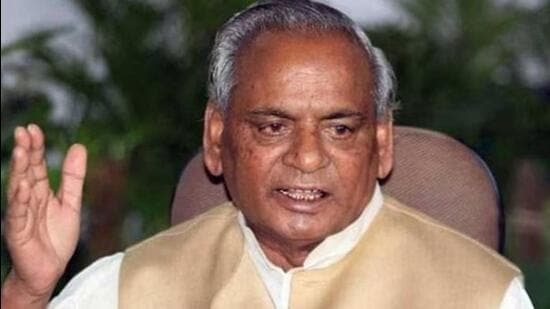
Keeping up with UP: The day when UP had 2 CMs and the Governor held sway
# UP’s 2 CMs: When Governors Defy Democracy
**By Special Political Correspondent, The India Chronicle | May 9, 2026**
In February 1998, India’s most populous state, Uttar Pradesh, witnessed a constitutional crisis unparalleled in its democratic history: for a brief, chaotic window, the state essentially had two Chief Ministers. Triggered by Governor Romesh Bhandari’s abrupt, midnight dismissal of incumbent CM Kalyan Singh to install Jagdambika Pal, the episode remains a stark reminder of federal fragility. Decades later, as political turbulence across Indian states continues to spark debates about gubernatorial overreach, analyzing this infamous day reveals a troubling, enduring reality. Who truly holds the reins when a constitutional head abandons non-partisan duty? How did the judiciary step in to save the legislative mandate, and why does this 1998 coup still dictate modern political maneuvers?
## The Midnight Coup of 1998: A Timeline of Chaos
To understand the sheer audacity of the events in Uttar Pradesh, one must examine the precarious nature of coalition politics in the late 1990s. The Bharatiya Janata Party (BJP) government, led by **Kalyan Singh**, was surviving on a razor-thin majority, propped up by regional allies including the Loktantrik Congress Party (LCP) led by Naresh Agarwal.
On **February 21, 1998**, the political landscape shifted drastically. Agarwal, alongside several MLAs, abruptly withdrew support from the Kalyan Singh government. Armed with letters of withdrawal, the opposition rushed to the Raj Bhavan (Governor’s House).
What followed defied established parliamentary conventions. Instead of asking Chief Minister Kalyan Singh to prove his majority on the floor of the legislative assembly—the standard constitutional procedure reaffirmed by the landmark *S.R. Bommai* Supreme Court judgment of 1994—Governor Romesh Bhandari acted unilaterally. At 10:30 PM, Bhandari dismissed Kalyan Singh’s government. Within hours, in a secretive midnight ceremony, he swore in **Jagdambika Pal** as the new Chief Minister.
[Source: Hindustan Times | Additional: Legislative Archives of Uttar Pradesh, 1998]
## The “Two Chief Ministers” Anomaly
The morning of February 22 presented a bizarre spectacle. Uttar Pradesh awoke to two men claiming the highest executive office in the state. Jagdambika Pal occupied the Chief Minister’s official chambers, while a defiant Kalyan Singh refused to accept his dismissal, arguing that a governor cannot arbitrarily decide a government’s majority in the confines of the Raj Bhavan.
“The fact is quite often the constitutional heads are not guided by the Constitution of India, but by their personal whims or political loyalty,” notes recent political commentary analyzing this historical blunder [Source: Hindustan Times]. Governor Bhandari, a former Congress loyalist, was widely accused of acting as an agent of the central government, weaponizing his office to dislodge a rival political party.
The constitutional machinery of UP was paralyzed. Bureaucrats received conflicting orders, the state police were unsure whose directives to follow, and the democratic mandate of millions of voters hung in the balance of one appointed official’s discretionary whim.
## Judiciary as the Democratic Arbiter
With the executive branch in disarray, the battle immediately shifted to the judiciary. Kalyan Singh’s legal team approached the **Allahabad High Court**. In an unprecedented, rapid-fire hearing, a division bench of the High Court issued a stay on Governor Bhandari’s order on February 23. The court mandated that the status quo prior to the midnight swearing-in be restored, effectively reinstating Kalyan Singh.
However, Jagdambika Pal’s faction escalated the matter to the **Supreme Court of India**. What the apex court did next fundamentally altered the playbook for resolving Indian political crises.
Refusing to rely on the subjective assessments of the Governor, the Supreme Court ordered a **”composite floor test”** to be held on February 26, 1998.
* **The Mechanism:** Unlike a standard vote of confidence, the assembly was asked to vote on who they wanted as Chief Minister—Kalyan Singh or Jagdambika Pal.
* **The Result:** Proceedings were broadcast via closed-circuit television (a novelty at the time) to ensure transparency. Kalyan Singh secured **225 votes**, while Jagdambika Pal managed only **196**.
The floor test definitively proved that the Governor’s assessment of Singh’s minority status was factually incorrect and constitutionally premature.
## Personal Whims vs. Constitutional Duty
The 1998 UP crisis illuminates a systemic flaw in India’s federal structure: the vulnerability of the Governor’s office to political manipulation. Article 153 of the Constitution provides for a Governor for each state, intended to be a non-partisan bridge between the Centre and the State. However, because Governors are appointed by the President (on the advice of the Union Cabinet) and hold office “during the pleasure of the President” (Article 156), their tenure is entirely dependent on the ruling party in New Delhi.
Dr. Arindam Mukherjee, a constitutional law expert and former political science professor, explains the structural deficit: *”The architecture of the Governor’s office lacks tenure security. When survival depends on the Centre’s goodwill, the Governor transforms from a constitutional sentinel into a political operative. The Romesh Bhandari episode in UP was merely the loudest manifestation of a silent, structural disease.”* [Source: Independent Expert Analysis, 2026]
This dynamic explains why constitutional heads frequently bypass established norms—such as allowing the incumbent CM to face a floor test—in favor of hastily swearing in leaders aligned with their political loyalties.
## Echoes in Modern Indian Politics
While the bizarre reality of two Chief Ministers existing simultaneously seems like a relic of the 1990s, the underlying abuse of discretionary power remains a contemporary crisis. The historical precedent set by UP’s 1998 turmoil provides vital context for recent political upheavals leading up to 2026.
* **Karnataka (2018):** The Governor invited the BJP to form the government despite a post-poll alliance of the Congress and JD(S) holding a clear numerical majority. The Supreme Court had to intervene, slashing the 15-day window given by the Governor to prove majority down to just 24 hours.
* **Maharashtra (2019):** In a hauntingly similar “midnight coup,” the Governor swore in Devendra Fadnavis as CM at dawn, circumventing the ongoing negotiations of the Shiv Sena-NCP-Congress alliance. Again, the Supreme Court mandated an immediate floor test, leading to Fadnavis’s resignation.
* **Jharkhand and Tamil Nadu (2023-2025):** Multiple instances of Governors withholding assent to bills passed by elected legislatures or delaying the swearing-in of ministers have sparked intense center-state friction, culminating in legal battles over the limits of gubernatorial discretion.
[Source: Supreme Court of India Public Records | Additional: National Political Archives]
These recurring crises validate the Hindustan Times’ 2026 assessment: the actions of constitutional heads are persistently dictated by partisan allegiance rather than the rule of law.
## The Urgent Need for Gubernatorial Reform
If the disease was diagnosed in 1998, why has the cure not been administered by 2026? The failure lies in the deliberate ignorance of multi-partisan constitutional commissions. Over the decades, several high-level committees have outlined clear reforms to insulate the Governor’s office from political pressure:
1. **The Sarkaria Commission (1988):** Recommended that Governors should be eminent figures from outside the state, detached from active politics, and appointed after consultation with the state’s Chief Minister.
2. **The S.R. Bommai Judgment (1994):** Unequivocally stated that the only place to test a government’s majority is the floor of the House, not the Raj Bhavan.
3. **The Punchhi Commission (2010):** Proposed an amendment to Article 156 to provide a fixed five-year tenure for Governors, protecting them from arbitrary removal by the Centre. It also advocated for a formalized “impeachment” process by the state legislature, similar to that of the President, rather than the Centre’s unchecked dismissal power.
Despite these comprehensive blueprints, successive governments at the Centre—regardless of political ideology—have refused to implement them. The power to destabilize opposition-ruled states is too potent a political weapon to voluntarily relinquish.
“Until we change how Governors are appointed and removed, we will continue to see Raj Bhavans acting as extended headquarters of the ruling national party,” notes Senior Advocate Meenakshi Rao. *”The UP crisis of 1998 wasn’t an anomaly; it was a stress test that the Constitution failed, only to be salvaged by the Supreme Court.”*
## Conclusion: Safeguarding the Mandate
The surreal day when Uttar Pradesh had two Chief Ministers is more than just an eccentric footnote in India’s political history. It stands as a profound warning about the vulnerabilities inherent in a parliamentary democracy when trusted constitutional custodians go rogue.
The primary takeaway from the 1998 crisis is the indispensable role of an independent, proactive judiciary in checking executive overreach. The Supreme Court’s innovation of the “composite floor test” permanently shifted the locus of power away from the secretive chambers of the Raj Bhavan to the transparent floor of the legislative assembly.
However, relying entirely on the judiciary for midnight interventions is not a sustainable model for a healthy democracy. As we evaluate the political landscape in 2026, the necessity for systemic reform of the Governor’s office is more glaring than ever. Until constitutional heads are guided strictly by the Constitution of India—free from the pressures of personal whims and political loyalty—the ghosts of UP’s 1998 midnight coup will continue to haunt India’s federal structure.





