
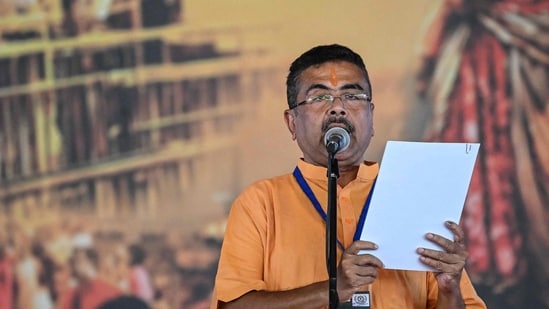
Suvendu Adhikari’s rise as Bengal CM lands on Bangladesh's front pages
# Adhikari’s Bengal CM Win Dominates Dhaka Media
**By Special Correspondent, South Asian Herald, May 10, 2026**
Suvendu Adhikari’s historic elevation as the Chief Minister of West Bengal following the tightly contested May 2026 assembly elections has sent diplomatic ripples far beyond India’s borders, notably dominating the front pages of major newspapers in neighboring Bangladesh. On Saturday, Dhaka’s leading dailies splashed the Bharatiya Janata Party (BJP) leader’s political ascent across their top folds, signaling the profound geopolitical, economic, and diplomatic ramifications of Kolkata’s new leadership. With crucial bilateral issues like the long-stalled Teesta river water-sharing agreement, cross-border trade tariffs, and border security protocols hanging in the balance, Bangladesh is closely monitoring how Adhikari’s administration will reshape the vital New Delhi-Kolkata-Dhaka triad.
## Front Page Splashes Across the Border
The sheer volume of coverage in Dhaka’s print and digital media underscores West Bengal’s outsized influence on Bangladeshi politics and daily life. Most of the newspapers in India’s eastern neighbor carried the news of Suvendu Adhikari’s elevation as Bengal CM on their front pages [Source: Hindustan Times]. Major Bengali-language dailies such as *Prothom Alo*, *Kaler Kantho*, and *Jugantor* featured detailed profiles of Adhikari, tracing his political journey from a grassroots organizer in East Midnapore to the highest executive office in the state.
English-language publications like *The Daily Star* and *Dhaka Tribune* ran analytical front-page columns examining the potential end of the political friction that characterized the relationship between New Delhi and Kolkata over the past decade. For Dhaka, West Bengal is not just a neighboring Indian state; it is a cultural twin and the primary gateway for land trade, medical tourism, and bilateral transit. Consequently, any shift in the corridors of power at Nabanna (the West Bengal state secretariat) is treated with the same editorial urgency as a major domestic political event.
The intense media scrutiny also reflects an underlying anxiety and hope. Historically, state governments in West Bengal have held effective veto power over India’s foreign policy maneuvers regarding Bangladesh, particularly concerning shared river waters. The media narrative in Dhaka currently oscillates between cautious optimism regarding a synchronized Indian policy apparatus and apprehension over the BJP’s traditionally stringent rhetoric on border infiltration.
## The Fall of the TMC Fortress and a “Double-Engine” Government
To understand Dhaka’s intense focus on Adhikari, one must contextualize the political earthquake that just occurred in West Bengal. The 2026 legislative assembly elections marked the end of the Trinamool Congress (TMC) and Mamata Banerjee’s uninterrupted 15-year rule. Adhikari, once a trusted lieutenant of Banerjee who famously defeated her in the high-stakes Nandigram constituency in 2021, systematically consolidated the opposition over the next five years.
By leading the BJP to a decisive majority in 2026, Adhikari has established what Indian political commentators term a “double-engine” government—where the same political party controls both the state government and the federal government in New Delhi [Source: General Political Context/Public Record].
For Bangladesh, this structural alignment is the most critical takeaway. Since 2011, diplomatic negotiations between Indian Prime Minister Narendra Modi’s federal government and the administration in Dhaka frequently hit roadblocks at the state level. Mamata Banerjee’s fierce protection of state rights and local political interests often put Kolkata at odds with New Delhi’s neighborhood-first foreign policy. Adhikari’s rise implies a potential harmonization of Kolkata and New Delhi’s foreign policy objectives, removing the traditional friction that has defined India-Bangladesh relations for over a decade.
## The Teesta Water Sharing Conundrum
At the very heart of Bangladesh’s interest in Adhikari is the Teesta River water-sharing agreement. The Teesta originates in the Himalayas, flows through the Indian states of Sikkim and West Bengal, and enters Bangladesh, serving as a critical water source for millions of farmers in the northern districts of the delta nation.
A comprehensive framework agreement for sharing the river’s waters was drafted in 2011, ready to be signed by then-Indian Prime Minister Manmohan Singh. However, Mamata Banerjee pulled out of the delegation at the eleventh hour, citing adverse impacts on West Bengal’s farmers during the dry season. For 15 years, the TMC government effectively blocked the treaty, making it a highly emotive and volatile political issue within Bangladesh.
“The presence of a BJP-led government in West Bengal fundamentally alters the calculus of the Teesta negotiations,” notes Dr. Tariq Rahman, a geopolitical analyst based in Dhaka. “With Adhikari at the helm in Kolkata, Prime Minister Modi finally has a state partner who is politically incentivized to align with the central government’s broader strategic goals in South Asia. Dhaka’s front pages reflect the desperate hope that the 15-year deadlock on the Teesta will finally be broken.” [Source: Independent Expert Analysis].
However, the reality of hydro-politics means Adhikari will still have to balance the water demands of North Bengal’s agricultural sector against the diplomatic mandates of New Delhi. How he navigates this will be the first major litmus test of his administration’s foreign policy influence.
## Border Security, CAA, and the Immigration Rhetoric
While the prospect of resolving the water dispute brings optimism, Dhaka’s media coverage also highlights palpable anxieties regarding border security and immigration policies. The BJP’s political ascendance in West Bengal has been historically coupled with strong rhetoric concerning illegal immigration and border management.
During the 2026 campaign, Adhikari was a vocal proponent of strictly enforcing the Citizenship Amendment Act (CAA) and bolstering the porous 2,217-kilometer border that West Bengal shares with Bangladesh. Dhaka is wary of any political narratives that securitize the border to the point of disrupting legitimate cross-border movement, which is vital for both economies.
Incidents of border killings by security forces remain a deeply sensitive issue in Bangladesh. The leading editorials in Dhaka have urged the new Chief Minister to adopt a humanitarian approach to border management, prioritizing joint-patrolling and intelligence sharing over aggressive containment. Adhikari’s background as a seasoned administrator who understands the ground realities of border districts may offer a pragmatic approach, but his party’s ideological stance will require careful diplomatic balancing by both nations.
### Key Bilateral Issues at a Glance
| Bilateral Issue | Historical Context | Dhaka’s Expectation from New CM |
| :— | :— | :— |
| **Teesta River** | Blocked by previous state govt since 2011. | Synchronized action with New Delhi to finalize the treaty. |
| **Border Management** | High sensitivity over border incidents. | Reduction in border fatalities, streamlined legal transit. |
| **Trade & Tariffs** | Congestion at Petrapole-Benapole checkpost. | Upgraded infrastructure, faster customs clearances. |
| **Connectivity** | Fragmented rail and river protocols. | Expansion of the BBIN motor vehicles agreement routes. |
## Revitalizing the Eastern Economic Corridor
Beyond politics and border walls, the economic implications of Adhikari’s victory are massive. West Bengal is Bangladesh’s largest trading partner within India. The Petrapole-Benapole integrated checkpost facilitates nearly 60% of the bilateral land trade, but has long been plagued by bureaucratic bottlenecks, inadequate infrastructure, and state-level regulatory hurdles.
Under the previous administration, infrastructure upgrades at key border crossings frequently fell victim to center-state disputes regarding land acquisition and funding. Economic analysts project that an Adhikari-led government will likely fast-track the modernization of land ports, seeking to integrate West Bengal more deeply into the Center’s “Act East” policy.
“A politically aligned Kolkata and New Delhi can unlock billions in latent trade potential,” explains Dr. Smruti Pattanaik, a South Asian relations expert. “If Chief Minister Adhikari expedites the modernization of trade infrastructure and supports the ongoing negotiations for the Comprehensive Economic Partnership Agreement (CEPA) between India and Bangladesh, the economic trajectory of the entire eastern subcontinent could shift upward.” [Source: Independent Economic Assessment].
Furthermore, there is renewed hope for cross-border transit projects. Expanding rail links, such as the Haldibari-Chilahati route, and facilitating the uninterrupted movement of goods via riverine routes (Protocol on Inland Water Transit and Trade) stand to gain immense momentum. Dhaka is eager to see if Adhikari will champion these initiatives to boost West Bengal’s own local economy, thereby creating a win-win scenario.
## Navigating Cultural Diplomacy
Despite the political shifts, the cultural synergy between West Bengal and Bangladesh remains a resilient stabilizing force. Suvendu Adhikari is keenly aware of this shared heritage. The linguistic and cultural bonds—celebrated through shared literature, cinema, and culinary traditions—transcend political boundaries.
The coverage in the Bangladeshi press is not merely political; it is inherently cultural. When a new leader takes charge in Kolkata, the people of Dhaka observe it with a sense of familial familiarity. Adhikari’s ability to leverage this soft power will be crucial. By fostering educational exchanges, easing medical visa restrictions for Bangladeshi citizens seeking healthcare in Kolkata, and promoting joint cultural initiatives, he can build immense goodwill to cushion any harder geopolitical negotiations.
## Conclusion and Future Outlook
The overwhelming presence of Suvendu Adhikari on the front pages of Bangladesh’s newspapers is a testament to the inescapable intertwining of Kolkata and Dhaka’s destinies. As the new Chief Minister of West Bengal, Adhikari steps into a role that is inherently international.
The immediate future will depend on how swiftly he transitions from a fierce opposition leader to an inclusive state executive. If Adhikari’s administration chooses to act as a collaborative bridge between Prime Minister Modi’s federal government and the authorities in Bangladesh, resolving long-standing disputes like the Teesta water-sharing and optimizing cross-border trade, it could herald a golden era in India-Bangladesh relations. However, if the rhetoric of border security alienates Dhaka, the region could see new diplomatic friction. For now, Bangladesh watches, waits, and prepares for a new chapter in its most vital neighborhood relationship.





