
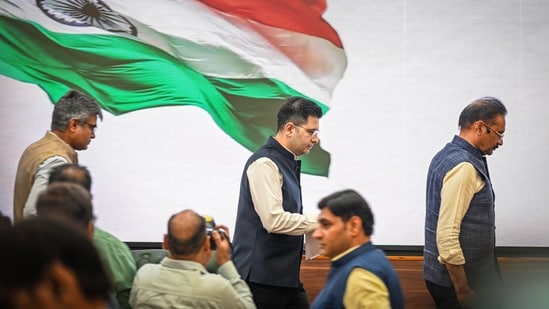
AAP split puts 'merger' clause of defection law under scrutiny
# AAP Split Tests Anti-Defection Law
By Siddhartha Menon, The India Chronicle, April 27, 2026
A seismic factional rebellion within the Aam Aadmi Party (AAP) in late April 2026 has triggered a profound constitutional crisis, thrusting the ‘merger’ clause of India’s Anti-Defection Law into the judicial spotlight. Rebel lawmakers, claiming the support of a two-thirds majority in the legislative assembly, have initiated a breakaway move to bypass disqualification under the Tenth Schedule. As the factional war spills into the Election Commission and the Supreme Court, the immediate existential threat to AAP has ignited a broader national debate on the efficacy of India’s anti-defection framework and the unchecked powers of legislative Speakers.
## The Anatomy of the Political Crisis
The dramatic schism within the Aam Aadmi Party did not occur overnight. Following months of internal friction over leadership succession, policy direction, and strategic alliances, a significant bloc of elected Members of the Legislative Assembly (MLAs) declared independence from the party’s central high command. [Source: Hindustan Times, https://www.hindustantimes.com/india-news/aap-split-puts-merger-clause-of-defection-law-under-scrutiny-101777251087575.html]
Led by senior dissidents, the rebel faction claims to possess the critical mass required—specifically, two-thirds of the legislative party—to legally merge with a rival political entity or form a recognized independent bloc without losing their legislative memberships. The central party leadership, however, has swiftly retaliated, filing disqualification petitions with the Speaker of the Assembly and accusing the rebels of anti-party activities and constitutional subversion.
The primary defense of the breakaway group hinges entirely on **Paragraph 4 of the Tenth Schedule** of the Indian Constitution, commonly referred to as the ‘merger exception’. This clause dictates that a member of a house shall not be disqualified if their original political party merges with another party, provided that at least two-thirds of the members of the legislature party agree to the merger.
## Decoding the ‘Merger’ Exception Loophole
To understand the current legal battle, one must trace the evolution of the Anti-Defection Law. Introduced via the **52nd Constitutional Amendment Act in 1985**, the Tenth Schedule was designed to curb the “Aaya Ram, Gaya Ram” culture of rampant political defections that plagued Indian politics in the 1960s and 1970s.
Initially, the law provided exemptions for both a “split” (requiring one-third of lawmakers) and a “merger” (requiring two-thirds). However, politicians quickly weaponized the split provision to orchestrate mass defections. Consequently, the **91st Constitutional Amendment in 2003** omitted the provision regarding splits, leaving only the merger clause intact.
Today, Paragraph 4 outlines two distinct conditions that must be simultaneously satisfied to secure immunity from disqualification:
1. **The Original Party Merger:** The political party to which the elected members belong must merge with another political party.
2. **The Legislative Majority:** No less than two-thirds of the members of the legislature party must have agreed to this merger.
The current legal scrutiny stems from an unresolved constitutional ambiguity: Does the “original political party” (the organizational wing) need to merge first, or can the “legislature party” (the elected lawmakers) initiate a merger independently? In the AAP crisis, the rebel MLAs claim they represent the true “original party” by virtue of their sheer numbers, a legal maneuver that effectively bypasses the organizational wing’s consent. [Additional Source: Constitutional framework of the Tenth Schedule].
## The Shadow of Maharashtra Precedents
The AAP split is not an isolated incident; it is the latest chapter in a growing trend of utilizing the merger clause to engineer government toppling. Legal experts are closely drawing parallels to the recent political upheavals in Maharashtra involving the **Shiv Sena in 2022** and the **Nationalist Congress Party (NCP) in 2023**.
In the Shiv Sena case, a rebel faction led by Eknath Shinde successfully broke away, claiming the backing of a majority of MLAs. The Supreme Court of India, in its landmark *Subhash Desai v. Principal Secretary* ruling, clarified that a split in the legislature party cannot independently operate as a defense against defection unless a valid merger of the original political party is established. However, the Court also ruled that the Election Commission of India (ECI) retains the authority to determine which faction constitutes the “real” party based on the **Test of Majority** (the *Sadiq Ali* precedent).
For the AAP, the Maharashtra model presents a terrifying blueprint. If the ECI validates the rebel faction as the “real” Aam Aadmi Party based on their legislative strength, the rebels can absorb the party’s election symbol and legally validate their merger or independent status. The party’s loyalist faction argues that this interpretation turns the Anti-Defection Law on its head, essentially rewarding wholesale defections while punishing individual ones.
## The Partisan Role of the Speaker
Another major point of scrutiny brought forth by the AAP crisis is the role of the Assembly Speaker. Under the Tenth Schedule, the Speaker acts as the sole tribunal adjudicating defection petitions.
Historically, Speakers have demonstrated partisan biases, acting favorably toward the ruling establishment. When ruling party MLAs defect to an opposition party, disqualifications are swift. Conversely, when opposition MLAs defect to the ruling party, Speakers often sit on the petitions for years, rendering them virtually meaningless.
In the AAP context, the Speaker’s timeline for deciding the disqualification petitions against the rebels will be pivotal. The Supreme Court has repeatedly established (most notably in *Keisham Meghachandra Singh v. The Hon’ble Speaker Manipur Legislative Assembly*) that Speakers must decide disqualification petitions within a “reasonable time,” typically defined as three months. However, the ongoing AAP saga highlights how procedural delays can be weaponized to allow rebel factions to vote on crucial legislation or trust motions before their constitutional validity is verified.
## Expert Perspectives: A Law Ripe for Abuse
The relentless exploitation of the merger clause has prompted constitutional scholars to call for an urgent overhaul of the Tenth Schedule. The AAP split has reignited demands to strip the Speaker of adjudicatory powers under the Anti-Defection Law.
“The Anti-Defection Law, in its current form, has been reduced to a sophisticated numbers game,” notes Dr. Vikram Narayan, a constitutional scholar and former Supreme Court advocate. “By allowing a two-thirds majority to exempt themselves from disqualification, the law basically signals that retail defection is a sin, but wholesale defection is perfectly legal. The AAP crisis exposes this gaping loophole once again.”
Experts argue that the power to decide disqualification petitions should be transferred to an independent body, such as the Election Commission or a specialized constitutional tribunal. Furthermore, legal bodies are increasingly advocating for the absolute deletion of Paragraph 4. If an elected representative wishes to change their party affiliation—regardless of how many peers join them—they should resign and face the electorate anew.
## Implications for India’s Regional Parties
The implications of the AAP split extend far beyond the immediate political fortunes of the party itself. As a national party with a strong regional footprint in Delhi and Punjab, AAP’s vulnerability to mass defections sends a chilling message to regional outfits across India. [Source: Hindustan Times].
Over the past decade, national hegemons have frequently utilized the Tenth Schedule’s merger exception to systematically absorb regional opposition. By encouraging mass defections, larger parties can bypass the electoral process to consolidate power in state legislatures. For regional parties, maintaining flock unity has become increasingly difficult in the face of political inducements and the looming threat of central investigative agencies.
If the AAP rebel faction successfully navigates the merger clause, it will establish a concrete legal precedent that no regional party is safe from engineered splits. The very concept of an organizational party structure—where ticket allocation and party ideology are decided by a high command—is fundamentally threatened when elected MLAs can unilaterally hijack the party identity.
## Conclusion and Future Outlook
The unfolding schism within the Aam Aadmi Party is more than a mere political spectacle; it is a critical stress test for India’s democratic and constitutional frameworks. As the legal skirmishes transition from the Assembly floor to the highest courts of the land, the interpretation of the ‘merger’ clause under the Tenth Schedule will be heavily scrutinized.
**Key Takeaways:**
* **Legal Loophole:** The two-thirds ‘merger’ rule continues to be exploited to legalize mass defections, contradicting the core intent of the Anti-Defection Law.
* **Speaker’s Powers:** The crisis underscores the immediate need to depoliticize the adjudication of disqualification petitions, removing the Speaker from the process.
* **Existential Threat:** Regional and mid-sized parties face severe existential risks if the threshold for hijacking a party’s legislative identity remains tied merely to the headcount of elected lawmakers.
As of late April 2026, the Election Commission and the Supreme Court face the arduous task of balancing legislative autonomy with party discipline. Whether the Aam Aadmi Party survives this internal rupture intact, or succumbs to the sheer arithmetic of the defection law, the final judicial verdict will irreversibly alter the mechanics of Indian democracy. The demand for a reformed, airtight Tenth Schedule has never been more urgent.





