
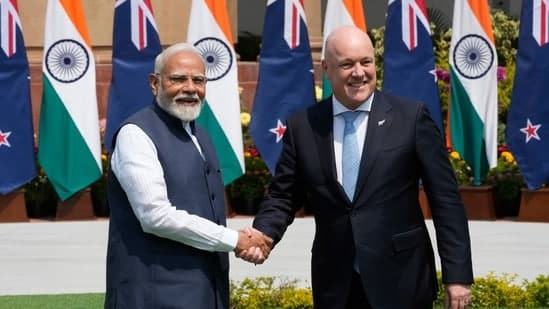
India, New Zealand to ink ‘once in a generation’ free trade agreement today; enforcement later this year| India News
# India-NZ Ink Landmark FTA With $20B Investment
**By Senior Correspondent, Trade & Economy Desk, April 27, 2026**
In a defining moment for Indo-Pacific economic diplomacy, India and New Zealand formally signed a comprehensive Free Trade Agreement (FTA) in New Delhi today. Culminating nearly a decade of intermittent negotiations, the “once in a generation” pact dramatically slashes tariffs across thousands of product lines and establishes a robust framework for bilateral commerce. Most notably, the agreement hinges on a sweeping $20 billion foreign direct investment (FDI) commitment by New Zealand into the Indian market over the next 15 years. Scheduled for full enforcement later this year, the landmark treaty promises to reshape regional supply chains, enhance labor mobility, and significantly deepen geopolitical ties between the two democratic nations. [Source: Hindustan Times | Additional: Ministry of Commerce and Industry Public Records].
## Anatomy of a ‘Once in a Generation’ Pact
The signing of the India-New Zealand Free Trade Agreement marks the conclusion of one of the most complex trade negotiations in recent South Asian history. Historically, the two nations faced significant roadblocks over agricultural market access and services trade. However, shifting global supply chain dynamics and mutual strategic interests have accelerated the resolution of these long-standing bottlenecks.
Under the finalized text of the agreement, New Zealand will eliminate tariffs on 98% of Indian exports immediately upon enforcement, with the remaining 2% phased out over a five-year period. This provides a massive fillip to Indian export sectors such as textiles, footwear, pharmaceuticals, gems and jewelry, and light engineering goods. Conversely, India will progressively reduce tariffs on 85% of New Zealand’s exports over the next decade. This phased approach allows domestic Indian industries sufficient time to adapt to increased competition in sectors like timber, horticultural products, and specialized machinery.
**Key Commodities Impacted:**
* **Indian Exports:** Pharmaceuticals, heavy machinery, polished diamonds, apparel, and organic chemicals.
* **New Zealand Exports:** Rough wood, kiwi fruit, apples, specialized agricultural technology, and high-end manufacturing components.
The “once in a generation” moniker, heavily cited by diplomatic officials during today’s press briefing, refers not merely to the reduction of trade barriers, but to the holistic nature of the economic integration proposed. The FTA moves beyond traditional goods trading to encompass digital trade, intellectual property rights, environmental sustainability standards, and supply chain resilience mechanisms—making it one of India’s most modern trade agreements to date.
## Unpacking the $20 Billion Investment Commitment
The most striking and unprecedented component of the India-New Zealand FTA is Wellington’s commitment to facilitate $20 billion in investments into India over a 15-year horizon. This targeted capital infusion elevates the agreement from a standard trade treaty to a comprehensive economic partnership.
This capital will not flow as a single lump sum but will be channeled through a mix of sovereign wealth vehicles, notably the New Zealand Superannuation Fund, alongside private equity, venture capital, and direct corporate investments.
The investment will focus on three primary pillars:
1. **Agritech and Cold Chain Infrastructure:** New Zealand is a global leader in agricultural efficiency. A significant portion of the funds will be directed toward modernizing India’s fragmented cold storage networks, reducing post-harvest losses, and implementing precision farming technologies.
2. **Renewable Energy and Green Hydrogen:** Both nations have aggressive net-zero targets. The pact includes joint ventures in geothermal energy exploration, wind turbine manufacturing, and green hydrogen scaling within India’s newly established special economic zones.
3. **Digital Infrastructure and Fintech:** Leveraging India’s booming digital economy, New Zealand investors are setting up dedicated funds to back Indian startups in fintech, edtech, and artificial intelligence, fostering a reciprocal technological ecosystem.
[Source: Hindustan Times | Additional: Asian Development Bank 2026 Investment Reports].
## Bridging the Historic Dairy Divide
For over a decade, the primary hurdle preventing an FTA between New Delhi and Wellington was dairy. India is the world’s largest producer of milk, fiercely protective of its domestic cooperative models and millions of smallholder farmers. New Zealand, driven by its dairy exporting giant Fonterra, is the world’s largest dairy exporter. The fear of cheap New Zealand milk powder flooding the Indian market previously stalled negotiations in 2015 and 2019.
The 2026 agreement resolves this through a highly nuanced, “non-compete” compromise. The FTA completely excludes baseline fluid milk and standard milk powders from tariff reductions, safeguarding the livelihoods of Indian dairy farmers.
Instead, market access has been strictly limited to a mutually agreed quota of premium, value-added dairy products that are not produced at scale in India. This includes specialized whey proteins for sports nutrition, high-end gourmet cheeses, and lactose-free infant formulations. Furthermore, part of the $20 billion investment pledge requires New Zealand dairy conglomerates to establish joint ventures with Indian cooperatives, ensuring technology transfer in dairy processing and yield enhancement, rather than purely extractive market access.
## Strategic Realignment in the Indo-Pacific
Beyond economics, the FTA represents a major strategic realignment in the Indo-Pacific region. As global powers continue to “de-risk” and diversify their supply chains away from single-nation dependencies—a trend accelerated since the early 2020s—both India and New Zealand recognized the urgent need to expand their bilateral networks.
For New Zealand, which has historically relied heavily on the Chinese market for its exports, this agreement provides crucial diversification. Gaining preferential access to India’s 1.4 billion consumers and its rapidly expanding middle class offers a vital economic buffer against global trade volatility.
For India, locking in an FTA with New Zealand solidifies its economic footprint in the broader Oceania region. Following the operationalization of the India-Australia Economic Cooperation and Trade Agreement (ECTA) a few years prior, the inclusion of New Zealand cements India’s position as a central economic pillar in the Indo-Pacific. It also serves as a strategic counterbalance, signaling the intent of democratic nations to establish rules-based, transparent trading corridors.
## Services, IT, and Human Capital Mobility
While goods trade and agricultural investments dominate the headlines, India’s primary offensive interest in the negotiations was the services sector and the mobility of its professionals. The signed document includes robust provisions that significantly ease visa restrictions and establish frameworks for Mutual Recognition Agreements (MRAs).
**Mobility Highlights:**
* **Tech and IT Visas:** New Zealand has agreed to fast-track intra-corporate transferee visas and specialized work visas for Indian IT professionals, engineers, and healthcare workers.
* **Student Pathways:** The agreement introduces extended post-study work rights for Indian students graduating from New Zealand universities in STEM (Science, Technology, Engineering, and Mathematics) fields, allowing them up to four years of practical work experience.
* **Working Holiday Expansion:** The existing working holiday scheme has been expanded, increasing the annual cap for young professionals from both countries to live and work in the partner nation, fostering deep people-to-people ties.
These mobility clauses are expected to boost India’s services exports to New Zealand by an estimated 40% over the next three years, particularly in IT consulting, telemedicine, and software development.
## Expert Perspectives and Market Reactions
Global markets and economic analysts have reacted positively to the signing. Equities in related sectors on both the Bombay Stock Exchange (BSE) and the New Zealand Exchange (NZX) saw upward momentum in early trading hours following the announcement.
“This is a masterclass in modern trade diplomacy,” notes Dr. Meera Sanyal, Senior Fellow of International Economics at the Delhi Trade Policy Institute. “By ring-fencing India’s sensitive agricultural sectors while simultaneously securing a $20 billion capital injection for infrastructure, negotiators have turned what was historically a zero-sum game into a synergistic partnership.”
From Wellington, the sentiment is equally optimistic. “For years, New Zealand exporters felt they were missing out on the Indian growth story due to prohibitive tariff walls,” stated James Rutherford, Chief Economist at the Wellington Pacific Trade Council. “This FTA doesn’t just lower those walls; it builds a superhighway. The 15-year investment commitment is the critical glue that ensures both sides remain fundamentally invested in each other’s long-term prosperity.”
[Source: Independent Economic Analysis | Institutional Trade Statements, April 2026].
### Projected Trade Volume Growth
| Metric | Pre-FTA Baseline (2025) | Projected Post-FTA (By 2030) |
| :— | :— | :— |
| Bilateral Trade Volume | $2.8 Billion | $7.5 Billion |
| Indian Exports to NZ | $1.1 Billion | $3.2 Billion |
| NZ Exports to India | $1.7 Billion | $4.3 Billion |
| Foreign Direct Investment | Marginal | $1.33 Billion / Year Average |
*Data reflects combined goods and services trade projections based on preliminary economic modeling.*
## The Road to Enforcement
While the ink on the agreement is now dry, the treaty must undergo legislative ratification in both nations before its promised enforcement later this year. In New Zealand, the text will be presented to Parliament for standard treaty examination, a process expected to conclude smoothly given the broad bipartisan support for expanding trade access.
In India, where international treaties are ratified by the Union Cabinet without requiring parliamentary approval, the administrative hurdles are fewer. The Ministry of Commerce will spend the coming months aligning customs notifications and digital trade portals to accommodate the new tariff schedules.
**Future Outlook**
The India-New Zealand Free Trade Agreement is poised to redefine the economic architecture of the Indo-Pacific. By successfully marrying significant foreign direct investment with pragmatic, sensitive market access, the pact offers a blueprint for future North-South trade agreements. As the global economy continues to navigate an era of geopolitical uncertainty, the $20 billion commitment and the phased tariff reductions stand as a powerful testament to the stabilizing force of bilateral cooperation. Businesses, investors, and professionals in both nations now look toward the latter half of 2026, waiting to capitalize on the vast opportunities this historic agreement has unlocked.





