
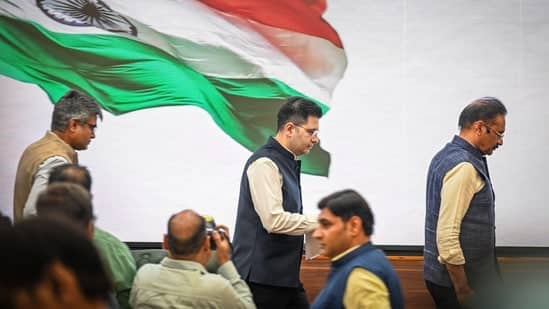
AAP split puts 'merger' clause of defection law under scrutiny
# AAP Split Tests Anti-Defection Merger Clause
By Vikram Aditya, National Political Editor, April 27, 2026
The unprecedented internal schism within the Aam Aadmi Party (AAP) this April has ignited a fierce constitutional debate over India’s Anti-Defection Law. As a substantial faction of AAP lawmakers attempts to bypass disqualification by invoking the contentious ‘merger’ exception under the Tenth Schedule, legal experts warn the implications extend far beyond the party’s immediate crisis. This maneuver tests whether legislative majorities can unilaterally declare party mergers without the backing of the core organizational wing. The unfolding drama is forcing the judiciary, the Election Commission, and constitutional scholars to re-evaluate systemic loopholes that continue to destabilize Indian electoral mandates in 2026. [Source: Hindustan Times | Additional: Constitutional Law Archives]
## The Anatomy of the AAP Rebellion
The political landscape in the national capital and surrounding strongholds was irrevocably altered when a critical mass of Aam Aadmi Party legislators announced their intention to form a separate bloc, signaling an imminent merger with a rival political formation. Unlike isolated resignations or cross-voting, this rebellion was meticulously engineered to trigger the protections of the Anti-Defection Law’s merger clause.
The breakaway faction asserts that they possess the requisite two-thirds majority of the legislature party, effectively immunizing them from disqualification under the Tenth Schedule of the Constitution. However, the AAP high command has vehemently challenged this narrative, arguing that a legislative breakaway does not constitute a legitimate merger of the “original political party.”
This standoff has transcended a mere intra-party dispute, morphing into a high-stakes constitutional stress test. The core issue—whether elected representatives can hijack the mandate of the organizational party apparatus—threatens to set a precedent that could either fortify or fundamentally break India’s framework for parliamentary stability.
## Decoding the Anti-Defection Law
To understand the gravity of the AAP split, one must examine the genesis of the Anti-Defection Law. Inserted into the Constitution via the **52nd Amendment Act in 1985**, the Tenth Schedule was designed to curb the infamous “Aaya Ram, Gaya Ram” culture of the 1960s and 1970s, where legislators switched allegiances for ministerial berths or financial gain.
Initially, the law allowed a “split” if one-third of the party’s legislators defected. However, this merely institutionalized mass defections. Recognizing the flaw, Parliament enacted the **91st Constitutional Amendment Act in 2003**, which omitted the provision for a split. Today, the only constitutional shield against disqualification for defecting lawmakers is a “merger.”
Under Paragraph 4 of the Tenth Schedule, disqualification does not apply if:
1. The original political party merges with another political party.
2. The merger is agreed upon by no less than **two-thirds of the members of the legislature party**.
The current AAP crisis hinges entirely on the interpretation of these two intertwined conditions. [Source: Hindustan Times | Additional: Ministry of Law and Justice, India]
## The ‘Merger’ Exemption: A Constitutional Gray Area
The fundamental dispute lies in the reading of Paragraph 4. Does the political party need to merge at the organizational level first, or does the legislative wing’s decision legally enforce a merger?
“The Tenth Schedule is clear that a merger requires the consent of the original political party,” explains Dr. Meenakshi Sundaram, a prominent constitutional scholar and former Supreme Court advocate. “However, practical politics has inverted this. Rebel factions consistently use the two-thirds legislative majority as a carte blanche to claim the identity of the original party. The AAP split is the latest, and perhaps most brazen, exploitation of this loophole.”
The breakaway AAP legislators argue that their physical numbers in the assembly grant them the legal authority to execute a merger. Conversely, the AAP leadership contends that the organizational wing—comprising party workers, the national executive, and foundational members—has not authorized any such merger, thereby rendering the rebel action an illegal defection.
## Original Political Party vs. Legislature Party
The dichotomy between the “Original Political Party” (the organization that issues tickets and campaigns) and the “Legislature Party” (the elected lawmakers) is the most heavily scrutinized element of the defection law today.
During the landmark *Subhash Desai v. Principal Secretary, Governor of Maharashtra (2023)* case concerning the Shiv Sena split, the Supreme Court of India observed that the legislature party cannot be entirely disconnected from the original political party. The Court emphasized that allowing the legislative wing to operate independently of the party organization subverts the democratic process, as voters cast their ballots based on the party’s symbol and manifesto, not just the individual candidate.
The AAP leadership is heavily relying on this Supreme Court precedent, arguing that the rebels cannot use their assembly numbers to legally extinguish the existence or mandate of the AAP organization. If the Speaker or the courts rule in favor of the rebels, it essentially dictates that the organizational structure of a political party holds no legal weight compared to its elected members.
### Historical Context of Major Party Splits (Post-2003)
| Year | Political Party | Nature of Split | Legal Outcome under Tenth Schedule |
| :— | :— | :— | :— |
| **2022** | Shiv Sena (Maharashtra) | Eknath Shinde faction claimed 2/3rd majority. | Recognized as the real party by Election Commission; Speaker upheld numbers. |
| **2023** | Nationalist Congress Party (NCP) | Ajit Pawar faction broke away. | Similar to Shiv Sena; EC granted symbol based on legislative majority. |
| **2026** | Aam Aadmi Party (AAP) | Faction claims merger under Paragraph 4. | **Currently under intense legal and constitutional scrutiny.** |
## The Speaker’s Tribunal: A Contentious Role
Compounding the crisis is the role of the Speaker of the Assembly. The Tenth Schedule designates the Speaker as the sole tribunal for deciding disqualification petitions. However, this mechanism has drawn severe criticism for its inherent conflict of interest.
Because the Speaker remains a member of the ruling dispensation, their decisions—or strategic delays in making decisions—often align with the political interests of the government in power. In the AAP scenario, if the faction is merging with a rival party that holds sway over the Speaker’s office, the rebel legislators are likely to receive expedited protections, while disqualification petitions filed by the loyalist AAP camp may languish.
“The framers of the Tenth Schedule assumed the Speaker would act as an impartial constitutional authority,” notes legal analyst R.K. Raghavan. “The reality of 2026 is that the Speaker’s office is highly partisan. The AAP crisis highlights the urgent need for an independent tribunal—perhaps led by retired judges or the Election Commission—to adjudicate defection cases.” [Source: Hindustan Times | Additional: PRS Legislative Research]
## Democracy, Mandates, and the “Wholesalization” of Defection
The broader implications of the AAP split paint a grim picture for electoral integrity. Critics argue that while the 91st Amendment successfully stopped “retail defections” (individual MLAs jumping ship), it inadvertently institutionalized “wholesale defections.”
If gathering a two-thirds majority guarantees immunity, deeply resourced political actors are incentivized to engineer massive, covert operations to topple governments or hollow out rival parties entirely. This dynamic effectively disenfranchises the voter. When a citizen votes for an AAP candidate based on the party’s specific governance model or ideological stance, an overnight merger with a party holding diametrically opposed views constitutes a direct betrayal of the electoral mandate.
This erosion of voter trust is the hidden cost of the Tenth Schedule’s merger loophole. It transforms elections from a binding five-year mandate into a mere preliminary round, where the real battle is fought post-election through backroom negotiations and constitutional technicalities.
## Calls for Constitutional Reform
In light of the AAP fracture, civic watchdogs and political reformers are renewing calls for sweeping changes to the Anti-Defection Law. Several proposals are currently gaining traction in policy circles:
* **Total Ban on Defections:** Deleting Paragraph 4 entirely. Any legislator wishing to change party affiliation must resign and face a by-election, allowing the voters to ratify their decision.
* **Independent Adjudication:** Stripping the Speaker of disqualification powers and transferring them to the Election Commission of India (ECI), acting on the binding advice of the President or Governor, similar to the process under Article 103 for holding an office of profit.
* **Strict Timelines:** Mandating that any disqualification petition must be decided within a strict 60-day window, preventing the strategic delays that currently plague the system.
## Conclusion: The Judiciary’s Impending Acid Test
The Aam Aadmi Party split of April 2026 is far more than a localized political earthquake; it is a critical litmus test for India’s constitutional machinery. As the breakaway faction seeks refuge under the ‘merger’ clause of the Tenth Schedule, they bring to the forefront the glaring inconsistencies of a law meant to protect democracy, which is now being used to subvert it.
The immediate political fallout for AAP is undeniably severe, potentially threatening its status as a national party and altering the balance of power in key legislative assemblies. However, the long-term ramifications depend entirely on how the judiciary interprets Paragraph 4 in this new context.
If the courts and the Election Commission allow legislative numbers to steamroll organizational mandates, no political party in India will be safe from hostile takeovers. The AAP crisis serves as a stark warning: without urgent and definitive reform to the Anti-Defection Law, the sanctity of the Indian voter’s ballot will remain perpetually at the mercy of parliamentary arithmetic and political opportunism.





