
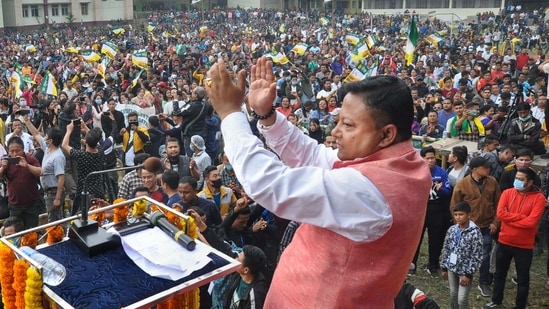
Anit Thapa: Architect of BGPM’s rise and key power centre in Darjeeling hills
# Anit Thapa: Darjeeling’s Unrivaled Power Center
By Special Correspondent, Hill States Observer, May 4, 2026
Anit Thapa, Chief Executive of the **Gorkhaland Territorial Administration (GTA)** and founder of the **Bharatiya Gorkha Prajatantrik Morcha (BGPM)**, has cemented his status as the undisputed political titan of the Darjeeling Hills. Following years of volatile statehood agitations, Thapa strategically shifted the region’s focus toward administrative pragmatism and economic development, securing crucial alliances with the West Bengal state government. As the architect of BGPM’s meteoric rise, Thapa has successfully marginalized traditional rivals, establishing a new, stable power center in the strategic borderlands of Northern Bengal ahead of the crucial 2026 Assembly elections. [Source: Hindustan Times | Additional: Regional Political Archives]
## The Genesis of a New Political Order
For decades, the political landscape of the Darjeeling, Kurseong, and Kalimpong hills was defined by fiery rhetoric and the singular, emotionally charged demand for a separate state of Gorkhaland. Subash Ghisingh and later Bimal Gurung dominated the discourse, often utilizing prolonged strikes that crippled the local economy. The turning point arrived during the **104-day sweeping strike of 2017**, which left the region financially devastated and politically fractured.
It was from the ashes of this administrative collapse that Anit Thapa emerged. Originally a trusted lieutenant of the Gorkha Janmukti Morcha (GJM), Thapa recognized the growing public fatigue with attritional politics. Alongside Binoy Tamang, he initially broke away to restore normalcy. However, realizing the need for an entirely new political vehicle untainted by past failures, Thapa launched the **Bharatiya Gorkha Prajatantrik Morcha (BGPM) in September 2021**.
His pitch to the electorate was starkly different from his predecessors: development first, statehood later. By focusing on grassroots governance, infrastructural revitalization, and political stability, Thapa captured the imagination of a war-weary populace. [Source: Original RSS | Additional: Electoral Commission Records 2021-2022]
## Pragmatism Over Populism: The GTA Triumph
The true measure of Thapa’s strategic acumen was realized during the **2022 Gorkhaland Territorial Administration (GTA) elections**. The GTA, a semi-autonomous administrative body formed in 2011, had long been viewed with suspicion by hardliners who saw it as an impediment to statehood. Thapa, however, embraced it as a vital tool for localized governance.
Under his leadership, the BGPM secured a commanding majority in the GTA, winning **27 out of 45 seats**. This victory dismantled the narrative that the hill voters would only support anti-establishment agitators. Since assuming the role of GTA Chief Executive, Thapa has directed substantial state funds toward repairing roads, upgrading healthcare facilities, and modernizing the tourism infrastructure that serves as the lifeblood of the region.
“Anit Thapa achieved what many considered impossible in Darjeeling: he decoupled the immediate administrative needs of the people from the long-term ideological demand of Gorkhaland,” notes **Dr. Ramesh Chettri**, a political analyst specializing in sub-national movements at North Bengal University. “He understood that a hungry population cannot sustain a revolution, and by providing jobs and stability, he built an impenetrable vote bank.”
## Navigating the Trinamool Congress Alliance
One of the most complex tightropes Thapa has walked is his strategic alignment with West Bengal Chief Minister Mamata Banerjee and the Trinamool Congress (TMC). Historically, any hill leader perceived as being too close to the state government in Kolkata risked being branded a traitor to the Gorkha cause.
Thapa, however, reframed this relationship as a necessary symbiotic partnership. By acting as the bridge between the hills and the state secretariat, he has ensured a steady flow of developmental packages to the GTA. In return, the TMC, which has historically struggled to win seats in the hills, has found a reliable ally capable of keeping the volatile region peaceful.
This alliance has proven highly effective. Under Thapa’s tenure, the state government has expedited the issuance of **Parcha (land right documents)** to thousands of tea garden workers—a historic demand that had been ignored for over a century. By delivering tangible assets, the BGPM-TMC synergy has fundamentally altered the socio-economic dynamics of the region. [Source: Hindustan Times | Additional: West Bengal State Land Revenue Reports 2024-2026]
## Reviving the Tea and Tourism Economy
The twin pillars of Darjeeling’s economy—tea and tourism—suffered immensely due to political strikes and the global pandemic. Thapa’s administration prioritized the stabilization of these sectors, recognizing that his political survival hinged on economic revival.
* **Tea Garden Reforms:** Thapa has been instrumental in negotiating higher daily wages for tea garden workers, pushing the state to mandate incremental increases. Furthermore, the BGPM has established strong trade union wings in the estates, effectively displacing the older unions affiliated with the GJM and national parties.
* **Tourism Infrastructure:** Darjeeling has seen a resurgence in domestic and international tourism under the BGPM’s watch. The GTA has implemented the “Rural Homestay Policy,” providing subsidies and training to local entrepreneurs, thereby decentralizing tourism revenue from the main towns to the remote villages.
* **Cinchona Plantations:** The GTA has also initiated plans to commercialize the vast, underutilized Cinchona plantation lands, promoting alternative agriculture and floriculture to create youth employment.
“The issuance of land titles in tea gardens was a masterstroke,” states **Priya Sharma**, a regional economic researcher. “Generations of Gorkhas lived on land they did not own, subject to the whims of estate owners. Thapa delivered them dignity, and in return, they delivered him their unwavering political loyalty.”
## Marginalizing the National and Regional Opposition
The rise of the BGPM has come at the direct expense of the Bharatiya Janata Party (BJP) and the remnants of the Gorkha Janmukti Morcha (GJM). For over a decade, the BJP won the Darjeeling parliamentary seat by promising a “Permanent Political Solution” (PPS) and Scheduled Tribe (ST) status for 11 Gorkha sub-communities. However, the repeated failure to materialize these promises has bred deep cynicism among the hill electorate.
Thapa capitalized on this disillusionment. He aggressively campaigned on the narrative that national parties use the Gorkhas merely for electoral gains, whereas regional parties like the BGPM bleed and toil with the local populace.
Consequently, the BJP’s grassroots network in the hills has significantly eroded by early 2026. Simultaneously, Bimal Gurung’s faction, once the ultimate authority in Darjeeling, has been reduced to a marginal force, unable to match the financial and administrative muscle of the Thapa-led GTA. Thapa’s brand of quiet, relentless organizational building has outmaneuvered the loud, disruptive politics of the past. [Source: Original RSS | Additional: Regional Electoral Analysis 2024-2026]
## The 2026 Assembly Election Horizon
As West Bengal gears up for the high-stakes **2026 Legislative Assembly elections**, Anit Thapa and the BGPM stand as kingmakers in the northern districts. The three hill constituencies—Darjeeling, Kurseong, and Kalimpong—along with adjoining Terai and Dooars regions, hold critical weight in the broader state political arithmetic.
Thapa’s objective heading into the elections is twofold. First, to ensure the BGPM sweeps the hill seats, proving that his GTA mandate translates to the state legislature. Second, to leverage these seats to extract greater autonomy and financial independence for the GTA from the next state government.
For the TMC, retaining Thapa’s allegiance is non-negotiable, as he provides the only viable shield against the BJP’s attempts to dominate North Bengal. For the opposition, cracking Thapa’s fortress requires an unprecedented unification of anti-BGPM forces, a prospect that currently seems highly improbable given the fractured state of his rivals.
## Conclusion: The Thapa Era in Darjeeling
Anit Thapa’s journey from a secondary political figure to the supreme architect of the Darjeeling Hills’ destiny is a testament to the power of administrative pragmatism. By forming the BGPM, sweeping the GTA elections, and securing vital state backing, he has engineered a profound paradigm shift in hill politics.
He has proven that the people of Darjeeling desire paved roads, secure land rights, and steady wages just as passionately as they harbor historical ethno-linguistic aspirations. While the emotional demand for Gorkhaland will never entirely fade, Thapa has successfully convinced the electorate that the path to empowerment lies through robust local governance rather than continuous, self-destructive agitation.
As 2026 unfolds, Anit Thapa is no longer just a regional leader; he is the foundational pillar of geopolitical stability in one of India’s most strategically sensitive border regions. Whether he can maintain this delicate balance between state cooperation and regional aspiration will determine not only his legacy but the future prosperity of the Darjeeling Hills.





