
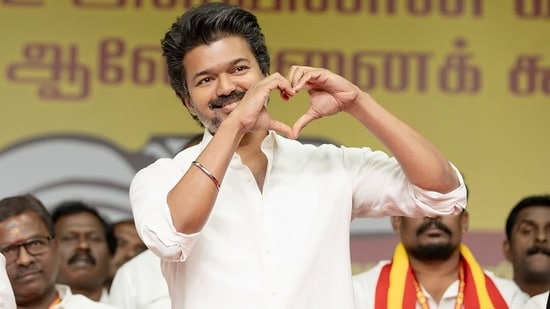
Will Vijay's TVK join hands with DMK or AIADMK to form government in Tamil Nadu? What we know
# TVK Alliance: Will Vijay Join DMK or AIADMK?
**By Special Political Correspondent, India Election Desk** | **May 4, 2026**
On May 4, 2026, as the dust settles on one of the most fiercely contested Assembly elections in Tamil Nadu’s history, actor-turned-politician Thalapathy Vijay’s Tamilaga Vettri Kazhagam (TVK) finds itself at a historic crossroads. With early projections and exit polls hinting at a heavily fractured mandate in the 234-member assembly, the central question dominating political corridors is whether TVK will align with the ruling Dravida Munnetra Kazhagam (DMK) or the opposition All India Anna Dravida Munnetra Kazhagam (AIADMK) to form the state government. By successfully disrupting the traditional bipolar dynamic of the state, Vijay’s nascent party has positioned itself either as the ultimate kingmaker or a potential king requiring coalition support, triggering intense backchannel negotiations across Chennai. [Source: Hindustan Times | Additional: State Electoral Projections 2026].
## Disrupting the Dravidian Fortress
For over half a century, Tamil Nadu’s political landscape has been an impenetrable fortress guarded by two Dravidian behemoths: the DMK and the AIADMK. Numerous third-front alternatives—ranging from Sivaji Ganesan and Vijayakanth to Kamal Haasan—have attempted to break this duopoly, often with limited long-term success. However, the entry of Joseph Vijay and his Tamilaga Vettri Kazhagam has proven to be a watershed moment in the state’s contemporary history.
Launched formally in early 2024, TVK utilized the intervening two years to build a formidable grassroots infrastructure. Capitalizing on Vijay’s massive fan base, transitioning them seamlessly into dedicated political cadres, the party fought the 2026 assembly elections on a plank of “Secular Social Justice.” Vijay’s campaign strategically targeted the ideological right while simultaneously mounting a ferocious attack on what he termed the “corrupt, dynastic politics” of the ruling establishment.
As the May 2026 electoral arithmetic unfolds, it is becoming increasingly evident that neither the DMK-led alliance nor the AIADMK-led front may secure the magic number of 118 seats required for an absolute majority. Consequently, TVK’s substantial vote share and projected seat tally have transformed the party into the most sought-after political entity in Tamil Nadu.
## The DMK Conundrum: Ideological Overlap vs. Anti-Incumbency
The prospect of TVK joining hands with Chief Minister M.K. Stalin’s DMK is fraught with both ideological synergies and severe political contradictions.
**The Synergies:** On paper, TVK and DMK share several ideological touchstones. During TVK’s inaugural state conference in Vikravandi, Vijay explicitly named Dravidian icon Periyar, former Chief Minister K. Kamaraj, and Dr. B.R. Ambedkar as his party’s ideological guiding lights. Both parties are fiercely protective of state autonomy, linguistic pride, and social justice. If TVK were to support a DMK government, it could be pitched to the public as a grand coalition to protect Tamil Nadu’s secular fabric from national, right-wing influences.
**The Contradictions:** Despite the ideological overlap, a post-poll alliance with the DMK carries massive reputational risks for Vijay. Throughout the 2026 campaign, Vijay positioned himself as the definitive anti-establishment candidate. He vehemently criticized the DMK’s governance, focusing on allegations of corruption, the centralization of power within one family, and unfulfilled electoral promises from 2021.
“If Vijay aligns with the DMK to form a government, he risks entirely alienating his core voter base, which voted for him explicitly to oust the incumbent government,” notes Dr. K. Srinivasan, a senior Chennai-based political analyst. “It would mirror the compromises made by traditional politicians, stripping TVK of its ‘alternative’ aura.” [Source: Independent Political Analysis].
## The AIADMK Equation: A Marriage of Convenience?
Conversely, an alliance with Edappadi K. Palaniswami’s (EPS) AIADMK presents a different set of strategic advantages and pitfalls for the TVK leadership.
**The Advantages:** An AIADMK-TVK coalition would represent a formidable anti-DMK consolidation. For the AIADMK, which has struggled to project cinematic charisma since the demise of J. Jayalalithaa, Vijay brings unprecedented mass appeal. For TVK, the AIADMK offers a robust, established organizational machinery across all 38 districts of the state. If TVK emerges with a higher seat count than the AIADMK, EPS might be persuaded to support a TVK-led government, or vice versa, based on a power-sharing formula—potentially a rotational Chief Ministership.
**The Pitfalls:** The primary obstacle to an AIADMK alliance is the baggage of their past association with the Bharatiya Janata Party (BJP). Although the AIADMK formally severed ties with the BJP-led National Democratic Alliance (NDA) prior to the 2024 Lok Sabha elections, TVK has heavily relied on minority voters who remain highly skeptical of the AIADMK’s secular credentials. Furthermore, aligning with a traditional Dravidian party still contradicts Vijay’s promise of ushering in an entirely new political culture.
## Learning from History: The DMDK Precedent
As TVK strategists weigh their options, the ghost of the Desiya Murpokku Dravida Kazhagam (DMDK) looms large over their deliberations. Founded by another beloved actor, ‘Captain’ Vijayakanth, the DMDK broke into the political scene in 2006 with an impressive vote share. In the 2011 Assembly elections, Vijayakanth allied with Jayalalithaa’s AIADMK, successfully routing the DMK. The DMDK won 29 seats, and Vijayakanth became the Leader of the Opposition.
However, the alliance quickly soured. The dominant AIADMK systematically marginalized the DMDK, leading to defections and a gradual erosion of Vijayakanth’s political capital. By the subsequent elections, the DMDK had been reduced to a marginal player.
Vijay is acutely aware of this history. Sources close to the TVK high command suggest that the actor is extremely hesitant to play second fiddle in any alliance. “Vijay did not enter politics to become a cabinet minister in a Dravidian government. His eyes are set firmly on the Chief Minister’s chair,” reports a TVK insider on condition of anonymity. If TVK falls short of a majority but holds the balance of power, Vijay might prefer to offer “issue-based outside support” rather than entering a formal coalition cabinet. [Source: Electoral Context & Public Domain Projections].
## Post-Poll Alliance Scenarios: What the Numbers Dictate
The ultimate decision will be heavily dictated by the exact seat matrix once the final results are declared. Here are the three most likely scenarios political observers are tracking:
| Electoral Scenario | Seat Matrix Implication | TVK’s Likely Strategic Move |
| :— | :— | :— |
| **Scenario A: TVK as King** | TVK emerges as the single largest party but falls short of 118. | TVK will likely seek unconditional outside support from either AIADMK or smaller regional parties to form a minority government, refusing to share the CM post. |
| **Scenario B: TVK as Kingmaker** | DMK or AIADMK is the largest party, TVK is in second/third place. | TVK may demand a rotational Chief Ministership or a massive share of key portfolios (Home, Finance) in exchange for coalition support. |
| **Scenario C: The Opposition Bench** | A Dravidian major secures a razor-thin majority independently. | TVK sits as the principal opposition, using the legislative assembly to aggressively build momentum for the 2029 elections. |
## The “Third Way”: Outside Support and Minority Governments
If negotiations with both the DMK and AIADMK stall due to leadership demands, Tamil Nadu could witness a rare political phenomenon: a minority government relying on outside support.
If the DMK emerges as the single largest party but requires 15-20 seats to prove its majority, TVK could offer outside support with strict conditions. This strategy would allow Vijay to claim that he kept the “communal forces” out of power, without taking ownership of the DMK government’s administrative failures. Conversely, if the AIADMK requires support, TVK could back them from the outside to ensure the “corrupt dynasty” is unseated, honoring his anti-incumbency campaign promises.
This tightrope walk requires immense political acumen. Providing outside support keeps a party’s independent identity intact but denies its cadres the fruits of administrative power, which is often crucial for sustaining a nascent political organization.
## Implications for National Politics
The ongoing suspense over TVK’s alliance choices in Tamil Nadu has vast implications beyond the state’s borders. As India looks ahead to the 2029 General Elections, the political alignment of Tamil Nadu—a state that sends 39 Members of Parliament to the Lok Sabha—is of critical importance to both the Congress-led INDIA bloc and the BJP-led NDA.
If Vijay chooses to ally with the DMK, it strengthens the INDIA bloc’s southern fortress. However, if TVK forces the DMK into the opposition or strikes a deal with the AIADMK, it completely shatters the existing national opposition matrix, forcing national parties to radically rethink their southern strategies.
## Conclusion: A Defining Moment for Thalapathy
As Tamil Nadu waits with bated breath for the final tallies to crystallize, the decision made by Vijay and his inner circle in the coming days will permanently alter the state’s political DNA. The question of whether TVK will join hands with the DMK or the AIADMK is not merely about forming a government; it is a profound test of Vijay’s political philosophy.
Will he succumb to the pragmatic compromises that have defined coalition politics in India, or will he chart an uncompromising, solitary path, risking short-term power for long-term credibility? As backroom negotiations intensify this May, one fact remains irrefutable: Thalapathy Vijay is no longer just a cinematic icon; he is the new pivot around which the political destiny of Tamil Nadu revolves.





