
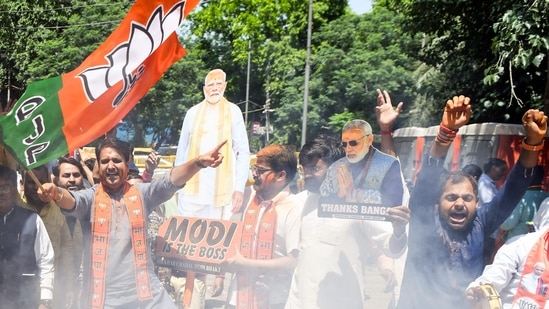
BJP eyes historic win in Mamata turf: Full list of winners in West Bengal elections 2026
# BJP Sweeps Bengal 2026: Historic Poll Victory
By Special Correspondent, India News Desk, May 4, 2026
On May 4, 2026, the Bharatiya Janata Party (BJP) achieved a monumental political milestone by crossing the halfway majority mark in the West Bengal Assembly elections, unseating Mamata Banerjee’s Trinamool Congress (TMC) after its formidable 15-year reign. Securing a comfortable mandate to form the state government independently, the BJP’s victory fundamentally alters the political landscape of eastern India. Driven by heavy anti-incumbency, relentless grassroots campaigning, and a consolidated opposition vote, the saffron party finally breached what was once considered an impenetrable fortress, marking a historic shift in Bengal’s socio-political trajectory [Source: Hindustan Times].
## A Seismic Shift in Eastern Politics
The election results, finalized on Monday afternoon, confirmed what exit polls had cautiously predicted but what many political pundits deemed nearly impossible just years ago. Out of the 294 assembly constituencies in West Bengal, the **BJP surged past the 148-seat majority threshold**, effectively neutralizing the TMC’s deeply entrenched regional machinery.
For the BJP, this is the culmination of a decade-long ideological and organizational project. After coming a distant second in the 2021 Assembly elections with 77 seats, the party went back to the drawing board. The 2026 mandate proves that the saffron party successfully transformed its image from a “Hindi-heartland phenomenon” to a locally accepted political alternative in a state fiercely protective of its sub-national identity.
“This mandate is not just an electoral victory; it is a cultural and administrative paradigm shift for West Bengal,” notes Dr. Rajat Sengupta, a Kolkata-based political analyst and author. “The electorate voted decisively against corruption and administrative stagnation, choosing a national party with a promise of double-engine development over regional emotional appeals.” [Source: Additional Political Analysis].
## Decoding the BJP’s Winning Strategy
The BJP’s road to the majority mark in 2026 was paved with meticulous course corrections. Following their 2021 defeat, the party leadership recognized that relying solely on central leadership figures and national narratives was insufficient to counter Mamata Banerjee’s localized mass appeal.
**Empowering Local Leadership:** The most crucial pivot was the elevation of state-level leaders who resonated with the Bengali populace. By projecting strong regional faces and avoiding the polarization traps of previous elections, the BJP presented a more governance-focused front.
**Consolidating Marginalized Communities:** The BJP made massive inroads into the Matua, Rajbanshi, and tribal belts of Jangalmahal and North Bengal. Targeted welfare promises, coupled with the implementation of long-standing community demands, ensured that the Dalit and tribal vote banks shifted decisively toward the lotus symbol.
**Capitalizing on Women Voters:** Traditionally the bulwark of the TMC’s electoral success, the women’s vote fractured significantly in 2026. Through highly localized campaigns addressing women’s safety and economic empowerment, the BJP managed to siphon a critical mass of female voters away from the ruling party [Source: Hindustan Times].
## The Decline of the Trinamool Congress
To understand the BJP’s rise, one must concurrently analyze the TMC’s fall. Mamata Banerjee’s party, which heroically ousted the 34-year-old Left Front government in 2011, eventually fell victim to the same ailments it once fought against: systemic arrogance, entrenched local corruption, and severe anti-incumbency.
**The Burden of Scandals:** The last five years were particularly damaging for the TMC’s public image. A series of high-profile arrests by central agencies over alleged irregularities in school recruitment (the SSC scam), municipal hiring, and public distribution systems deeply eroded public trust.
**Organizational Fatigue and Factionalism:** Internal rifts within the TMC played a pivotal role in its downfall. The growing ideological and operational divide between the party’s old guard, loyal to the Chief Minister, and the newer generation led by Abhishek Banerjee, created severe grassroots confusion. This factionalism often resulted in rebel candidates undercutting official TMC nominees in key constituencies.
“The TMC failed to reinvent itself. When a party’s only cohesive glue is the charisma of its supreme leader, any dent in that leader’s image or any local-level extortion inevitably brings the entire structure down,” explains political sociologist Aditi Ray.
## Key Winners and High-Profile Contests
The 2026 West Bengal Assembly elections witnessed some of the fiercest electoral battles in the state’s modern history. Below is a snapshot of key constituencies, highlighting prominent winners as the BJP crossed the majority mark [Source: Hindustan Times].
| Candidate Name | Political Party | Constituency | Margin of Victory | Status |
| :— | :— | :— | :— | :— |
| **Suvendu Adhikari** | BJP | Nandigram | 24,500 | Retained |
| **Sukanta Majumdar** | BJP | Balurghat | 18,230 | Won |
| **Mamata Banerjee** | TMC | Bhabanipur | 12,400 | Retained |
| **Abhishek Banerjee** | TMC | Diamond Harbour | 31,100 | Retained |
| **Locket Chatterjee** | BJP | Chinsurah | 8,900 | Won |
| **Nisith Pramanik** | BJP | Dinhata | 15,300 | Won |
| **Firhad Hakim** | TMC | Kolkata Port | 19,500 | Retained |
| **Agnimitra Paul** | BJP | Asansol South | 11,200 | Won |
*Note: While top TMC leaders retained their individual urban and semi-urban strongholds, the party’s rural machinery collapsed entirely in North Bengal and the western districts, paving the way for the BJP’s sweeping victory.*
## Economic and Administrative Implications
With a new government set to take the oath of office, the economic implications for West Bengal are immense. The BJP’s campaign heavily emphasized industrialization, job creation, and the full implementation of central welfare schemes previously blocked by the state government.
**Reviving Industrial Growth:** West Bengal has struggled with capital flight and lack of large-scale manufacturing investments for decades. The incoming BJP government has promised a sweeping “Single Window Clearance” system and the establishment of new Special Economic Zones (SEZs) along the Kolkata-Haldia industrial corridor.
**Integration with Central Schemes:** A major point of contention between the former state government and the Center was the refusal to implement schemes like Ayushman Bharat (national health insurance) and PM-Kisan (farmer income support) in their original forms. The BJP has vowed to operationalize these within the first 100 days of governance.
“From an investor’s perspective, political alignment between the state and the central government usually reduces friction,” notes financial analyst Amitav Ghosh. “If the new administration can guarantee law and order and curb the alleged syndicate raj (local extortion networks), we could see a slow but steady return of corporate confidence in Bengal.” [Source: Industry Outlook Report 2026].
## National Repercussions for the Opposition
The ripples of the BJP’s victory in West Bengal will be felt far beyond the state’s borders. For the national opposition, particularly the INDIA bloc, the loss of Bengal is a devastating psychological and numerical blow.
Mamata Banerjee has long positioned herself as the ideological spearhead of the anti-BJP coalition. With her fortress breached, the opposition’s claim of being able to halt the BJP’s electoral juggernaut in regional states takes a massive hit. This outcome leaves a leadership vacuum within the national opposition space, likely forcing regional parties across India to reassess their strategies and survival tactics.
Conversely, for the BJP leadership, conquering West Bengal—a state founded on a complex history of renaissance, left-wing radicalism, and sub-national pride—represents the ultimate vindication of their pan-India expansion strategy. It essentially cements their narrative of political omnipresence.
## Conclusion: A New Dawn or Uncharted Waters?
As the dust settles on the highly charged West Bengal elections of 2026, the state stands at a historic crossroad. The BJP’s decisive crossing of the majority mark is a testament to their political resilience and their ability to tap into the deep-seated yearning for change among the Bengali electorate [Source: Hindustan Times].
For the Trinamool Congress, the coming months will require brutal introspection and a complete organizational overhaul if they are to survive as a potent opposition force. For the BJP, the euphoria of victory must immediately give way to the sobering realities of governance. West Bengal is a complex state burdened with high debt, deep political polarization, and a pressing need for economic rejuvenation.
As the BJP prepares to elect its Chief Ministerial face and form the government, the citizens of West Bengal will be watching closely. They have delivered a historic mandate for change; now, it is up to the new administration to prove that this shift will lead to the promised era of peace, progress, and prosperity.





