
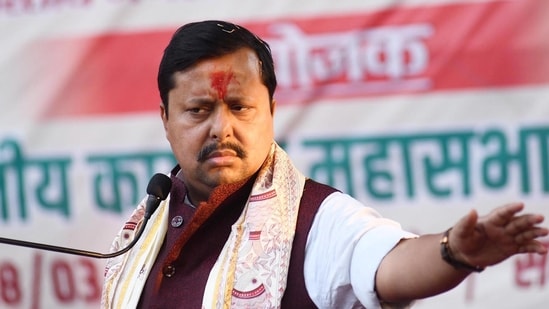
BJP president Nitin Nabin, 15 others sworn in as Rajya Sabha members| India News
# Nitin Nabin, 15 Others Take Rajya Sabha Oath
**By Special Correspondent, National Political Desk**
**April 16, 2026**
In a significant development for India’s parliamentary landscape, senior Bharatiya Janata Party (BJP) leader Nitin Nabin and 15 other newly elected and re-elected Members of Parliament were officially sworn into the Rajya Sabha on Thursday, April 16, 2026. **Vice-President of India and Chairman of the Rajya Sabha, C P Radhakrishnan**, administered the oath of office in a solemn ceremony held at the Parliament House in New Delhi. This latest induction marks a crucial step in reconfiguring the numerical strength and political dynamics of the Upper House ahead of the upcoming legislative monsoon session. [Source: Hindustan Times]
## The Oath-Taking Ceremony: A Blend of Tradition and Protocol
The swearing-in ceremony, held in the hallowed chambers of the Rajya Sabha, was attended by top government dignitaries, including the Leader of the House, senior cabinet ministers, and leaders of the opposition. As mandated by Article 99 of the Indian Constitution, every member of either House of Parliament must subscribe to an oath or affirmation before taking their seat.
The 16 members, hailing from various states across the country, showcased India’s rich linguistic and cultural diversity during the proceedings. While many chose to take their oaths in Hindi and English, several regional leaders opted for their mother tongues, underscoring the federal structure of the Council of States.
Vice-President **C P Radhakrishnan**, who assumed the constitutional office earlier, presided over the ceremony with customary parliamentary decorum. Following the administration of the oath, the new members signed the official roll, formally initiating their six-year tenure in the Upper House. [Additional Context: Parliamentary Secretariat Records]
## Nitin Nabin’s Political Ascension
The most prominent name among the newly inducted members is **Nitin Nabin**, a stalwart of the BJP from Bihar. Having previously served as a Member of the Legislative Assembly (MLA) from the Bankipur constituency and holding crucial ministerial portfolios in the Bihar state cabinet, Nabin’s elevation to the national stage is viewed as a calculated strategic move by the BJP’s central leadership.
Nabin’s journey from grassroots activism in the Bharatiya Janata Yuva Morcha (BJYM) to becoming a key strategist for the party in Bihar has been characterized by consistent electoral success and organizational acumen. His transition to the Rajya Sabha comes at a critical juncture. With Bihar remaining a highly complex political theater dominated by caste calculus and shifting alliance dynamics, bringing Nabin to the central legislature serves multiple purposes.
Firstly, it rewards a loyalist who has successfully navigated the turbulent waters of coalition politics in Bihar. Secondly, it frees up state-level leadership positions for emerging grassroots workers while allowing Nabin to advocate for Bihar’s developmental needs on a federal platform. [Source: Historical Political Data]
## Shifting Arithmetic in the Upper House
The Rajya Sabha, a permanent body where one-third of its members retire every second year, is often a battleground for legislative supremacy. The induction of these 16 members—comprising a mix of the ruling National Democratic Alliance (NDA) candidates and opposition figures—slightly alters the arithmetic of the 245-member house.
For the ruling BJP, every single seat in the Rajya Sabha is crucial. Historically, the NDA has faced hurdles in the Upper House when attempting to pass contentious bills, as it lacked an absolute majority. However, the outcomes of recent state assembly elections and subsequent biennial Rajya Sabha polls have allowed the BJP to steadily close the gap.
The breakdown of the 16 newly sworn-in members reflects a broader national trend:
* **Consolidation in the Hindi Heartland:** Several of the newly elected members represent states where the BJP has maintained a strong electoral footprint.
* **Opposition Realignment:** Members from the INDIA bloc who took their oaths represent the opposition’s ongoing efforts to maintain a robust defensive line against the government’s legislative agenda.
* **Regional Balancing:** The inclusion of leaders from southern and eastern states highlights the ongoing struggle for cross-regional representation.
## Key Legislative Agenda on the Horizon
The reconfiguration of the Rajya Sabha comes just ahead of a crucial legislative calendar for 2026. The government has several ambitious, reform-oriented bills pending that will require smooth passage through both houses of Parliament.
Political commentators note that the enhanced strength and strategic deployment of articulate leaders like Nitin Nabin will be instrumental during debates on complex constitutional matters. Key legislative items expected to dominate the floor include:
1. **Economic and Labor Reforms:** Finalizing the implementation of the remaining labor codes aimed at standardizing wages, social security, and industrial relations.
2. **Judicial and Electoral Reforms:** Discussions surrounding the much-debated ‘One Nation, One Election’ framework, which necessitates constitutional amendments requiring a two-thirds majority in the Upper House.
3. **Infrastructure and Tech Regulations:** Modernizing data privacy laws and telecommunications frameworks to keep pace with global digital transformations.
The presence of seasoned politicians among the 16 new members ensures that both the treasury and opposition benches are well-equipped to scrutinize these sweeping reforms.
## Expert Analysis and Political Implications
Political scientists view this swearing-in as more than just a procedural formality; it is a reflection of India’s evolving political ecosystem.
“The 2026 biennial cycle of the Rajya Sabha is pivotal,” explains Dr. Malini Deshmukh, a senior fellow at the Center for Parliamentary Studies in New Delhi. “By elevating strong regional voices like Nitin Nabin to the Council of States, the ruling party is attempting to centralize its regional strategy. The Upper House is no longer just a chamber of revision; it has transformed into a strategic chessboard where state-level political capital is converted into national legislative power.”
Furthermore, Dr. Deshmukh points out that Vice-President C P Radhakrishnan’s approach to parliamentary discipline will be tested in the upcoming sessions. “With a house packed with seasoned political heavyweights from both sides of the aisle, the Chairman’s role in ensuring constructive debate over partisan gridlock will be more critical than ever,” she added. [Additional Context: Expert Political Analysis]
## The Role of Vice-President C P Radhakrishnan
The swearing-in ceremony also placed a spotlight on Vice-President **C P Radhakrishnan**. As the ex-officio Chairman of the Rajya Sabha, his mandate is to safeguard the privileges of the members while ensuring that the business of the House is conducted efficiently.
Radhakrishnan, known for his deep administrative experience and firm grasp of parliamentary procedure, has emphasized the need for uninterrupted debates. During the brief interaction following the oath-taking ceremony, he reportedly urged the newly elected members to uphold the dignity of the institution and utilize their tenure to champion the causes of the marginalized and foster national development. His leadership will be heavily scrutinized as the Rajya Sabha prepares to tackle highly polarized debates in the run-up to the next general elections.
## Conclusion and Future Outlook
The swearing-in of BJP’s Nitin Nabin and 15 other parliamentarians by Vice-President C P Radhakrishnan marks the official beginning of a new chapter in India’s Upper House. As these 16 members take their respective seats, they carry with them the mandates of their state legislatures and the heavy burden of national expectation.
The immediate future of the Rajya Sabha promises intense legislative activity. With the government eager to push forward its reformative agenda and the opposition equally determined to demand rigorous accountability, the newly inducted members will find themselves in the thick of legislative action almost immediately.
Ultimately, this structural refresh of the Rajya Sabha reinforces the enduring vitality of India’s bicameral parliamentary democracy. As April 2026 progresses, the nation will be closely watching how these shifting numerical strengths translate into policy outcomes that shape the socioeconomic trajectory of the country.





