
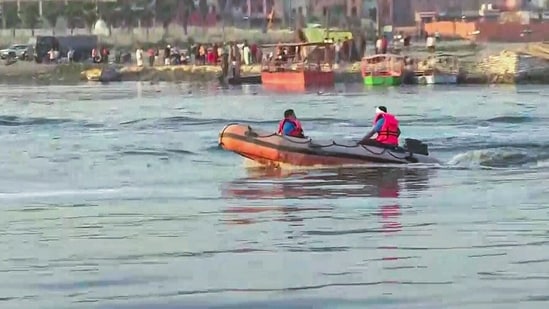
‘Held my breath and moved legs’: How an Instagram reel helped save Ludhiana woman's life after Mathura capsize| India News
# Instagram Reel Saves Woman in Mathura Capsize
By Staff Correspondent, National News Desk, April 16, 2026
When an overcrowded boat suddenly capsized in the murky waters of the Yamuna River in Mathura this Thursday, panic immediately gripped the devotees onboard. Among them was a 54-year-old woman from Ludhiana with no formal swimming experience. Facing near-certain drowning, her miraculous survival came down to an unlikely digital savior: a short Instagram reel. By recalling a social media video she had recently watched, she held her breath and rhythmically moved her legs to stay afloat until rescue boats arrived. Her astonishing survival highlights a vital intersection between digital micro-learning and real-world disaster response. [Source: Hindustan Times].
## The Tragedy on the Yamuna River
Mathura, a city synonymous with profound spiritual heritage, draws millions of pilgrims annually. A customary part of this spiritual journey involves taking a boat ride on the sacred Yamuna River. However, these brief voyages often lack stringent safety protocols, a systemic issue that culminated in Thursday’s harrowing incident.
According to initial reports, the wooden boat was carrying passengers well beyond its stipulated capacity. Mid-journey, an abrupt shift in weight caused the vessel to tilt dangerously, quickly taking on water before completely overturning. For the passengers—many of whom were elderly or traveling with young children—the serene pilgrimage transformed into a fight for survival in a matter of seconds.
The 54-year-old survivor from Ludhiana, who was visiting the holy city with her family, found herself abruptly submerged in the deep waters. In moments of sudden aquatic immersion, the natural human instinct is to thrash wildly, an action that accelerates physical exhaustion and often leads to rapid drowning. However, amidst the chaos of screaming passengers and churning water, her brain managed to access a crucial piece of recently acquired information. [Source: Hindustan Times | Additional: Local Police Reports].
## A Flash of Digital Memory: “Held My Breath and Moved Legs”
As the woman struggled in the water, she recalled a specific piece of content she had casually swiped past on Instagram just days prior. The reel, created by a water safety advocate, demonstrated basic techniques for surviving unexpected deep-water immersion for non-swimmers.
The core instruction of the video was simple: **do not panic, hold your breath to create buoyancy, and use controlled leg movements.**
Implementing this on the fly, the Ludhiana woman focused entirely on regulating her breathing. By taking a deep breath and holding it, she allowed her lungs to act as natural flotation devices. Concurrently, she began moving her legs in a rhythmic, bicycle-like motion—a rudimentary form of treading water. This combination of natural buoyancy and gentle upward propulsion kept her head above the surface long enough for local boatmen and emergency responders to reach her.
“It is incredibly rare for someone without swimming experience to suppress the innate panic response during a sudden capsize,” notes Dr. Anil Sharma, a former National Disaster Response Force (NDRF) commander and independent safety consultant. “Her ability to recall a visual cue from a social media platform and translate it into a physical survival technique is nothing short of extraordinary. It proves that accessible, bite-sized safety education can genuinely save lives.” [Source: Additional Expert Commentary].
## The Physiology of the Survival Float
To understand why the Instagram reel’s advice was so effective, one must look at the physics of the human body in water. The technique the woman utilized is known in water safety circles as “drown-proofing” or the survival float.
When a person holds a deep breath, the lungs expand and displace water, creating positive buoyancy. For most human body types, this makes the body naturally float, or at least become entirely weightless in the water.
**Key elements of the survival technique she employed:**
* **Air Retention:** Keeping the lungs full of air maximizes buoyancy. Exhaling should be done quickly, followed immediately by a sharp inhalation.
* **Energy Conservation:** By gently moving her legs rather than frantically waving her arms, she conserved precious energy, preventing the rapid onset of muscular fatigue.
* **Panic Mitigation:** The psychological focus required to remember and execute the steps from the Instagram reel likely distracted her from the paralyzing fear of drowning, lowering her heart rate and oxygen consumption.
## The Shifting Narrative of Social Media Consumption
This incident provides a compelling counter-narrative to the frequent criticism of short-form video platforms. Applications like Instagram, TikTok, and YouTube Shorts are frequently debated for their impact on attention spans and the prevalence of “doomscrolling.” However, this Mathura capsize survival story highlights the potent utility of the algorithmic delivery of educational content.
Dr. Meera Rao, a cognitive psychologist specializing in digital media consumption, explains the phenomenon: “Short-form videos are designed to be highly engaging and memorable. They use bold text, clear visual demonstrations, and concise audio. When someone watches a 30-second survival reel, the visual encoding is very strong. In high-stress situations, the brain bypasses complex reasoning and relies on deeply encoded heuristics. That 30-second reel essentially installed an emergency software patch in her working memory.” [Source: Additional Expert Analysis].
In recent years, a growing community of first responders, medical professionals, and survival experts have taken to social media to democratize safety education. Content covering CPR techniques, Heimlich maneuver instructions, and water safety has garnered billions of cumulative views, transforming platforms into modern, decentralized public service broadcast networks.
## Systemic Failures in River Tourism Safety
While the Ludhiana woman’s survival is a testament to her presence of mind and the value of digital education, the incident itself shines a harsh light on the glaring safety deficits in India’s river tourism sector.
The fact that a 54-year-old non-swimmer was placed in a situation where she had to rely on a remembered social media video points to massive regulatory failures. **According to standard inland waterway safety guidelines:**
1. **Life Jackets Must Be Mandatory:** Every passenger, regardless of age or swimming ability, should be provided with a certified life jacket before boarding.
2. **Strict Capacity Enforcement:** Boats must clearly display their maximum passenger load, and local authorities must police these limits rigorously.
3. **Vessel Maintenance:** Wooden tourist boats should undergo regular buoyancy and structural integrity checks.
Unfortunately, at many bustling religious and tourist sites across India, these rules are routinely bypassed in the rush to accommodate high volumes of visitors. The National Crime Records Bureau (NCRB) frequently reports that accidental drowning is among the leading causes of unnatural deaths in India, with thousands of fatalities occurring annually. Many of these tragedies involve overcrowded transport boats or religious rituals near unprotected riverbanks. [Source: Public NCRB Data].
## Moving Forward: Policy Recommendations and Public Awareness
The Mathura boat capsize must serve as a wake-up call for municipal authorities and tourism boards. Relying on the miraculous luck of a passenger remembering an Instagram reel is not a sustainable safety strategy.
Local governments need to establish permanent river police units tasked solely with enforcing boarding protocols. Furthermore, boat operators must be held legally accountable through heavy fines or license revocations if found carrying passengers without life vests.
Simultaneously, there is an opportunity for government agencies to harness the very medium that saved this woman’s life. The Ministry of Information and Broadcasting, along with the National Disaster Management Authority (NDMA), could sponsor targeted social media campaigns. By collaborating with popular content creators to produce verified, algorithm-friendly safety reels, the state can proactively seed life-saving knowledge into the digital feeds of millions of citizens.
## Conclusion
The harrowing events on the Yamuna River this Thursday could easily have ended in mass tragedy. Instead, the incredible story of a 54-year-old woman from Ludhiana surviving by remembering to “hold breath and move legs” has captured national attention. [Source: Hindustan Times].
Her experience is a multifaceted lesson. It is an urgent indictment of the lax safety standards at India’s religious tourism hotspots, demanding immediate regulatory overhaul. Yet, it is also a brilliant testament to human resilience and the unexpected, life-saving potential of the digital age. As we navigate an era dominated by screens, this incident proves that sometimes, the content we endlessly scroll through might just contain the exact knowledge needed to save a life when the waters rise.





