
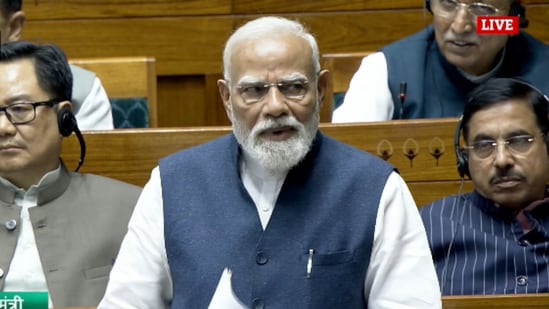
'Kabhi maaf nahi karege': PM Modi's warning to Opposition over women's quota bill| India News
# Modi Warns Opposition Over Women’s Quota
By Rajesh Kumar, *National Political Desk*, April 16, 2026
On Thursday, Prime Minister Narendra Modi delivered a scathing address in the Lok Sabha, sternly warning opposition leaders against stalling the implementation of the historic Women’s Reservation Bill. Speaking during the ongoing parliamentary session on April 16, 2026, Modi cautioned that any political faction attempting to derail the legislative rollout will “not be spared by the women of India.” The Prime Minister’s forceful declaration—highlighted by the phrase *’kabhi maaf nahi karege’* (they will never forgive)—underscores the ruling party’s strategic focus on consolidating female voters as the nation navigates the complex delimitation and census exercises required to enforce the 33% gender quota. [Source: Hindustan Times | Additional: Lok Sabha Live Proceedings].
## A Fiery Address in the Lower House
The atmosphere in the Lok Sabha was highly charged as the Prime Minister took the floor to address the ongoing debates surrounding parliamentary representation and the impending electoral reforms. Opposition members had been raising procedural objections regarding the sequence of the upcoming census and the subsequent delimitation of constituencies—two constitutional prerequisites for the activation of the Nari Shakti Vandan Adhiniyam (Women’s Reservation Act).
Sensing an opportunity to frame the opposition’s procedural grievances as anti-women, Prime Minister Modi pivoted his speech toward a passionate defense of women’s empowerment. He stated categorically that the era of treating women’s political representation as a secondary issue was over. Pointing directly at the opposition benches, he declared that the women of India are watching the proceedings closely and that those who put political roadblocks in the way of this monumental reform will face their wrath at the ballot box.
“The mothers, sisters, and daughters of this great nation have waited decades for their rightful share of representation. Those who oppose this bill, or try to delay it through backdoor parliamentary tactics, must remember one thing: *kabhi maaf nahi karege*,” Modi proclaimed amidst heavy desk-thumping from the treasury benches. [Source: Hindustan Times].
## The 2026 Delimitation Roadblock and Political Friction
To understand the intense friction in parliament today, one must look at the constitutional calendar. The implementation of the Women’s Reservation Bill, which was passed with near-unanimous support in late 2023, was explicitly tied to the next decadal census and the subsequent delimitation exercise.
Under the 84th Amendment to the Indian Constitution, the number of Lok Sabha seats and state assembly constituencies was frozen until the publication of the first census figures after the year 2026. Now that the year 2026 has arrived, the political landscape is bracing for a massive overhaul. Delimitation involves redrawing the boundaries of electoral constituencies to reflect changes in population.
Opposition parties, particularly those from southern states where population growth has been successfully stabilized, have expressed deep anxieties about the delimitation process. They argue that tying the women’s quota to a delimitation exercise based on a new census could politically penalize southern states by reducing their proportionate representation in the Lok Sabha compared to the more populous northern states.
By linking the opposition’s resistance to delimitation with an alleged resistance to the Women’s Reservation Bill, PM Modi is executing a highly calculated political maneuver. He is effectively daring the opposition to block the process, knowing that doing so risks alienating half the electorate. [Source: Hindustan Times | Additional: Constitutional Law Analysis, Article 82 of the Indian Constitution].
## Decoding the ‘Kabhi Maaf Nahi Karege’ Ultimatum
The Prime Minister’s use of the Hindi phrase *’kabhi maaf nahi karege’* is not merely rhetorical flair; it is a meticulously crafted message aimed at the grassroots level. Over the past decade, female voters have emerged as the most critical demographic constituency for the ruling coalition.
Through targeted welfare schemes—such as the Ujjwala Yojana (free cooking gas connections), Swachh Bharat Abhiyan (sanitation and toilets), and the PM Awas Yojana (housing registries primarily in women’s names)—the government has cultivated a loyal base of female beneficiaries, often termed the *’labharthi’* class.
Dr. Meena Agarwal, a prominent political sociologist at the New Delhi Centre for Democratic Studies, analyzes the strategy: “When the Prime Minister says ‘they will never forgive you,’ he is activating a voter base that transcends traditional caste and religious fault lines. Female voters in India are increasingly voting independently of the male members of their households. Any party perceived as deliberately delaying their entry into the highest legislative bodies will suffer severe electoral consequences.” [Additional: Expert Political Commentary].
The framing positions the government as the solitary champion of women’s rights, while casting the opposition as obstructionist gatekeepers clinging to patriarchal political norms.
## Opposition Demands: The OBC Sub-Quota Contention
The opposition’s stance, however, is more nuanced than a simple rejection of women’s empowerment. Leaders from the INDIA alliance and various regional parties have repeatedly argued that the current iteration of the bill is flawed because it lacks a sub-quota for women belonging to the Other Backward Classes (OBCs).
While the Nari Shakti Vandan Adhiniyam guarantees reservations for women from Scheduled Castes (SC) and Scheduled Tribes (ST) within their already existing quotas, it does not carve out specific seats for OBC women. Opposition leaders argue that without an OBC sub-quota, the 33% reservation will disproportionately benefit upper-caste, affluent women from urban centers, thereby failing to democratize representation for the deeply marginalized rural classes.
“We are not opposing the reservation; we are demanding equitable reservation,” a senior opposition leader stated outside parliament shortly after the Prime Minister’s speech. “The government is hiding behind the broader narrative of women’s empowerment to avoid addressing the legitimate demands of the backward classes. They are using the delimitation timeline as a smokescreen to delay the bill while shifting the blame.” [Additional: Parliamentary Opposition Briefings].
Despite these valid sociopolitical arguments, the opposition finds itself in a precarious public relations position. Communicating the intricacies of sub-quotas and delimitation mathematics to the average voter is incredibly difficult, especially when countered by the government’s straightforward, emotive messaging that “the opposition is blocking women’s seats.”
## Historical Context: The Nari Shakti Vandan Adhiniyam
The journey to secure political reservations for women in India has been a decades-long struggle marked by false starts, torn documents in parliament, and deeply entrenched patriarchal resistance.
First introduced in 1996 under the HD Deve Gowda government, the bill languished for 27 years. Various iterations were introduced in 1998, 1999, and 2008. While the Rajya Sabha successfully passed it in 2010, the Lok Sabha failed to take it up due to intense opposition from regional powerhouses who demanded quotas within quotas for minorities and backward classes.
It was finally passed in a historic special session of Parliament in September 2023, officially becoming the 106th Amendment to the Indian Constitution. The legislation mandates that one-third of the total number of seats to be filled by direct election to the House of the People (Lok Sabha) and state Legislative Assemblies shall be reserved for women. However, Section 5 of the Act explicitly stipulated that the reservation would come into effect only after an exercise of delimitation is undertaken post the first census conducted after the passage of the Act.
Now, three years later, as the procedural hurdles are actively being tackled, the historical baggage of the bill continues to haunt the parliamentary discourse. [Source: Hindustan Times | Additional: Legislative History Archives].
## The Demographic Shift: Women as Key Electoral Deciders
The urgency behind PM Modi’s speech is largely driven by empirical electoral data. Over the past two decades, India has witnessed a silent, structural revolution in voting patterns.
Historically, male voter turnout significantly outpaced female voter turnout. However, this gap began closing in the 2010s. By the 2019 general elections, female voter turnout (67.18%) marginally surpassed male turnout (67.01%) for the first time in the history of independent India. This trend solidified in subsequent state elections, where women not only voted in larger numbers but also demonstrated a distinct voting pattern separate from the men in their households.
**Key Statistical Drivers:**
* **Literacy Rates:** Increasing female literacy has led to higher political awareness and engagement.
* **Financial Inclusion:** Initiatives like the Jan Dhan Yojana have given women autonomous financial identities.
* **Security and Law:** Political messaging surrounding law and order disproportionately resonates with female voters.
Given this demographic reality, alienating the female voter base is tantamount to political suicide. The Prime Minister’s warning is an acknowledgment of this power dynamic. By championing the rapid execution of the quota and branding the opposition as obstructionist, the government is making a direct bid to secure this vital voting bloc for the foreseeable future.
## The Road Ahead: Census, Delimitation, and Execution
Despite the political rhetoric, the administrative mechanics of implementing the 33% quota remain incredibly complex.
First, the government must formally complete and publish the findings of the national census, a monumental administrative task that faced massive delays earlier in the decade. Once the population data is formalized, the President of India must constitute a Delimitation Commission.
This independent body will be tasked with redrawing the boundaries of every parliamentary and assembly constituency in the country based on the new population data. Only after the boundaries are finalized can the commission identify which specific constituencies will be reserved for women. To prevent political monopolies, these reserved seats are expected to be rotated after each subsequent delimitation exercise.
The sheer scale of this task means that actual implementation could still be months, if not years, away. By preemptively attacking the opposition, the ruling party is setting the narrative stage. Any administrative delay in the census or delimitation process will now likely be framed as a consequence of opposition interference rather than governmental inefficiency.
## Conclusion: A High-Stakes Political Chess Match
Prime Minister Narendra Modi’s thunderous warning in the Lok Sabha on April 16, 2026, represents a critical inflection point in India’s ongoing democratic evolution. By weaponizing the Women’s Reservation Bill against his political adversaries, Modi has turned a constitutional and administrative necessity into a potent electoral wedge issue.
The opposition now walks a tightrope. They must find a way to advocate for fair representation for southern states and backward classes during the delimitation process without appearing hostile to the broader cause of female empowerment. If they fail to thread this needle, the Prime Minister’s prophecy may prove accurate: the newly empowered, highly mobilized female electorate of India may indeed “never forgive them.”
As the nation inches closer to the redrawing of its political map, the battle lines are clearly drawn, and the voices of India’s women have never been more central to the corridors of power.





